A lung cancer mutation result can feel frightening. EGFR lung cancer mutation findings can guide treatment. Learn what to ask next.
EGFR lung cancer mutation results usually mean that the cancer has a specific DNA change that may make it sensitive to certain targeted medicines. In lung cancer reports, the two most common activating EGFR changes are EGFR exon 19 deletion and the L858R mutation. These findings are most often seen in lung adenocarcinoma, although they can occasionally appear in other lung cancer types.
Seeing words like “mutation,” “deletion,” or “positive” can make a pathology report feel more frightening than helpful. For many patients and caregivers, this is the moment when the report stops feeling like information and starts feeling like a warning. A clear explanation can turn that fear into a set of practical questions for the oncology team.
This result does not tell the whole story by itself. It must be interpreted with the diagnosis, stage, imaging results, symptoms, and overall health of the patient. A pathology report is one part of a larger treatment map, and molecular testing helps doctors choose the safest and most effective route whenever possible.
EGFR Lung Cancer Mutation — What It Actually Means
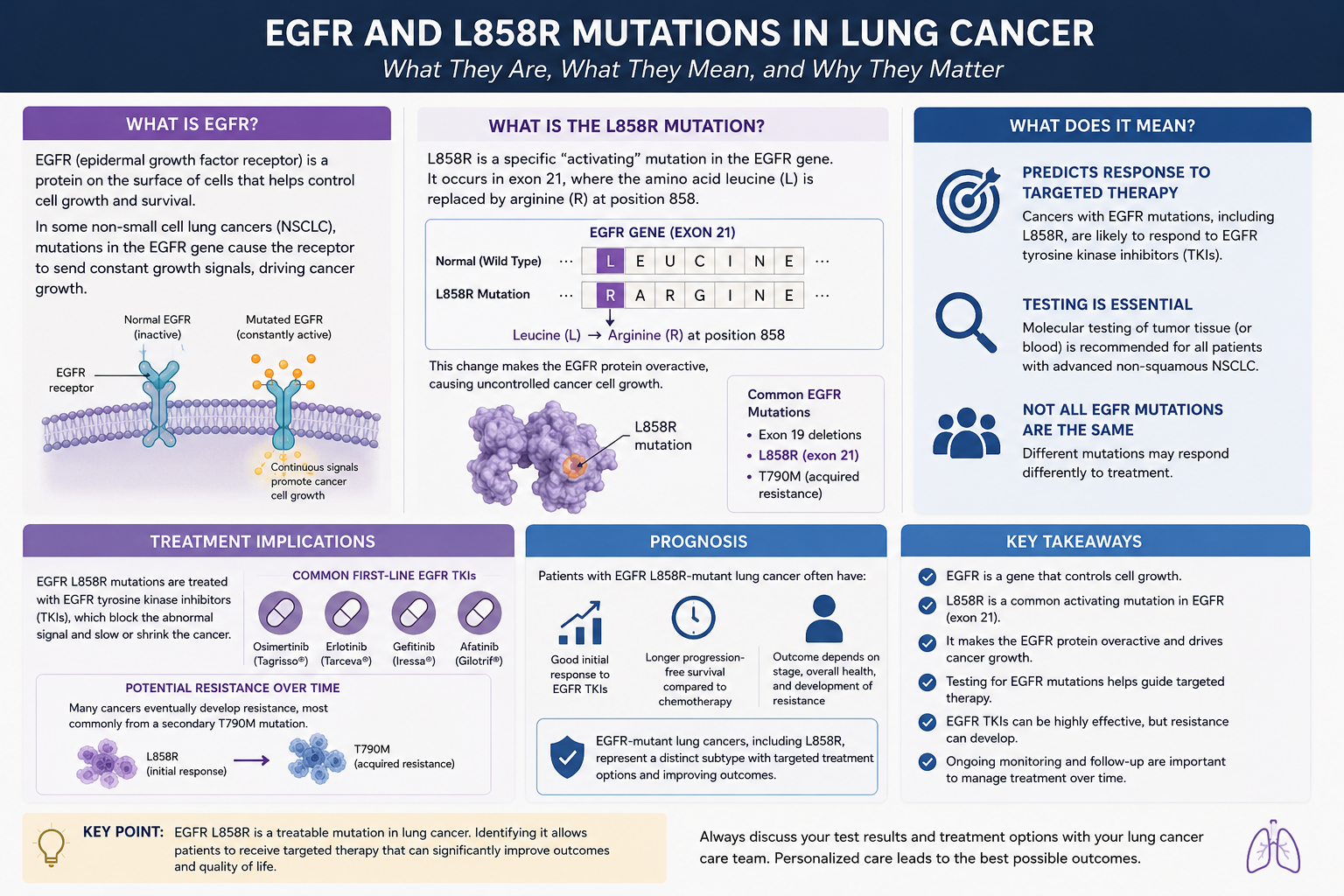
An EGFR lung cancer mutation is a change in the EGFR gene inside cancer cells. EGFR stands for epidermal growth factor receptor, a protein that sits on the surface of cells and helps control growth signals. When certain EGFR mutations occur, the growth signal can become stuck in the “on” position, like a light switch that cannot be turned off. This can help cancer cells grow and divide.
The two classic sensitizing EGFR changes are EGFR exon 19 deletion and the L858R mutation. EGFR exon 19 means that a small piece of the EGFR gene is missing in a specific region called exon 19. The L858R mutation means that one building block of the EGFR protein has been swapped for another at position 858. Both changes can activate the tyrosine kinase part of the EGFR protein, which is why tyrosine kinase inhibitor medicines may be considered.
From a pathology perspective, this result is usually not diagnosed by looking at the cancer under a microscope alone. The tumor type may look like lung adenocarcinoma under the microscope, but molecular testing is needed to identify the exact DNA change. The test may use tissue from a biopsy, surgery, or sometimes tumor DNA circulating in the blood. For patients trying to understand the broader structure of the report, Understanding Your Pathology Report: How to Read It with Confidence can help explain where molecular results fit with the rest of the diagnosis.
Why Your Report Shows This Finding

A report shows an EGFR lung cancer mutation because the laboratory tested the cancer for genetic changes that may affect treatment. This is commonly done for non-small cell lung cancer, especially lung adenocarcinoma. The purpose is not to look for inherited risk in most cases. Instead, the goal is to identify changes acquired by the cancer cells themselves.
Molecular testing can be performed in several ways, including polymerase chain reaction, next-generation sequencing, or other validated laboratory methods. These tests analyze tumor DNA to look for specific alterations, such as EGFR exon 19 deletion, L858R mutation, ALK rearrangement, ROS1 rearrangement, BRAF mutation, MET exon 14 skipping, RET fusion, NTRK fusion, and other actionable changes. The exact panel varies by institution and specimen size. When tissue is limited, the pathology team may need to balance diagnostic stains, molecular testing, and preservation of material for future studies.
EGFR mutations are more common in lung adenocarcinoma than in squamous cell carcinoma. They are also more common in people who have never smoked, in women, and in patients of East Asian ancestry, although any patient can have this result. A history of smoking does not rule out an EGFR lung cancer mutation. Pathologists and oncologists interpret the result based on the cancer itself, not on stereotypes about who “should” or “should not” have a certain mutation.
How Serious Is An EGFR Lung Cancer Mutation?
An EGFR lung cancer mutation is serious because it is found in cancer, but the meaning is not simply “good” or “bad.” In many cases, it is clinically useful because it may identify a treatment option that is more specific than traditional chemotherapy. A helpful analogy is a lock and key: The mutation may create a vulnerable lock, and targeted therapy may act like a key designed for that lock. This does not make lung cancer simple, but it can make treatment more precise.
The seriousness depends heavily on the stage of the cancer, the specific EGFR change, prior treatments, overall health, and whether the disease has spread. An early-stage lung adenocarcinoma with an EGFR exon 19 deletion may be treated very differently from metastatic cancer with the same molecular finding. The L858R mutation is also considered a classic activating EGFR mutation and can guide treatment, but the complete plan depends on the whole clinical picture. The same phrase on a report can mean different next steps in different patients.
For advanced or metastatic disease, an EGFR lung cancer mutation may lead the oncology team to consider EGFR tyrosine kinase inhibitor therapy. These medicines are designed to block the abnormal EGFR signaling pathway. Over time, some cancers develop resistance, meaning the tumor finds another way to grow despite treatment. If that happens, repeat molecular testing or blood-based tumor DNA testing may be used to look for resistance mutations or other changes.
What Happens Next: Treatment And Monitoring
After an EGFR lung cancer mutation is found, the oncology team usually reviews the result together with imaging, stage, biopsy diagnosis, and the patient’s overall condition. In metastatic non-small cell lung cancer, targeted therapy is often considered when a sensitizing EGFR exon 19 deletion or L858R mutation is present. The exact drug choice depends on current guidelines, prior treatment, other mutations, brain involvement, medication risks, and patient-specific factors. Treatment decisions should be individualized rather than based on one line in the report.
In some earlier-stage lung cancers, EGFR results may also influence treatment after surgery. For example, selected patients may be considered for adjuvant targeted therapy after the tumor has been removed, depending on stage and clinical guidelines. This is why a pathology report often includes tumor size, lymph node status, margins, histologic type, and molecular testing results. For patients who are unsure how these pieces fit together, What Is a Pathology Report? offers a plain-language explanation of the report’s role in care.
Monitoring usually includes clinical visits, imaging studies, symptom review, and sometimes additional laboratory or molecular testing. If the cancer responds, scans may show shrinkage or stability. If the cancer grows again, the team may evaluate for resistance using tissue biopsy or tumor DNA from blood. Targeted therapy is powerful, but it is not the same as a guarantee; careful follow-up helps detect both response and change over time.
Questions To Ask Your Doctor Or Pathologist
Patients often feel more prepared when the report is translated into specific, practical questions. The following questions can help clarify what the EGFR result means in the context of the whole diagnosis:
- Was the cancer diagnosed as lung adenocarcinoma, another type of non-small cell lung cancer, or something else?
- Does the report show an EGFR exon 19 deletion, an L858R mutation, or another EGFR change?
- Was molecular testing performed on tissue, blood-based tumor DNA, or both?
- Is this EGFR lung cancer mutation considered sensitizing to EGFR targeted therapy?
- Are there other mutations or biomarkers in the report that affect treatment choices?
- Does the stage of the cancer change how the EGFR result will be used?
- Would a second pathology opinion or molecular review be helpful before treatment begins?
A second opinion can be especially helpful when the biopsy is small, the diagnosis is unusual, the molecular result is unclear, or treatment decisions are high-stakes. This does not mean the original report is wrong. It means another qualified pathology review may confirm the diagnosis, clarify wording, or recommend additional testing.
Patients considering review can ask whether the original tissue block, unstained slides, molecular report, and imaging summaries are available. When the diagnosis or biomarkers need confirmation, When Should You Get a Second Pathology Opinion? explains common situations where expert review may be valuable. A careful review should strengthen confidence before major treatment decisions.
Frequently Asked Questions
Is EGFR exon 19 deletion lung cancer treatable?
Yes, many cancers with EGFR exon 19 deletion are treatable with EGFR targeted therapy, especially in advanced non-small cell lung cancer. Treatable does not always mean curable, and the meaning depends on stage, spread, symptoms, and response to treatment. In early-stage lung adenocarcinoma, surgery, radiation, chemotherapy, and targeted medicines may be considered in different combinations. The oncology team can explain whether the result changes the first treatment choice.
What does L858R mutation mean in lung cancer?
The L858R mutation is a specific EGFR change that can drive cancer cell growth. It is one of the most common EGFR mutations in lung adenocarcinoma. This mutation often suggests that EGFR tyrosine kinase inhibitor treatment may be useful, depending on stage and other clinical details. The report should be reviewed with an oncologist who understands both the molecular finding and the full cancer picture.
Is an EGFR lung cancer mutation inherited?
Most of the time, an EGFR lung cancer mutation found on a tumor report is not inherited. It is usually a somatic mutation, meaning it developed in the cancer cells rather than being present in every cell of the body. This type of result usually does not mean that children or relatives automatically need genetic testing. If the report or family history raises concern for inherited cancer risk, the oncology team may recommend genetic counseling.
Can EGFR lung cancer mutation results change treatment?
Yes, EGFR lung cancer mutation results can strongly influence treatment choices. If the mutation is a sensitizing EGFR exon 19 deletion or L858R mutation, the care team may consider targeted therapy rather than starting with standard chemotherapy in some settings. Treatment may also depend on PD-L1 status, other biomarkers, and the stage of disease. The result should be discussed before treatment begins whenever possible.
Should a lung cancer mutation report get a second opinion?
A second opinion may be reasonable if the report is confusing, the tissue sample was very small, the diagnosis is rare, or the molecular testing result does not match the clinical picture. A review can confirm the lung adenocarcinoma diagnosis, check whether additional testing is needed, and clarify the EGFR exon 19 or L858R mutation wording. Patients can learn the practical steps through How to Get a Second Opinion on Your Pathology Diagnosis. A second review often provides reassurance, even when the original diagnosis remains unchanged.
An EGFR result can feel overwhelming at first, but it is also one of the most actionable pieces of information in many lung cancer reports. The safest next step is to connect the mutation result with the diagnosis, stage, and treatment goals. Honest Pathology consultations can help patients and families understand what the report says, what it does not say, and which questions deserve attention before treatment decisions are made.
References:
National Cancer Institute — Pathology Reports Fact Sheet
National Cancer Institute — EGFR Gene Mutation
MedlinePlus — Genetic Testing