A breast cancer report can feel frightening. residual cancer burden explains treatment response and what to ask the oncology team next.
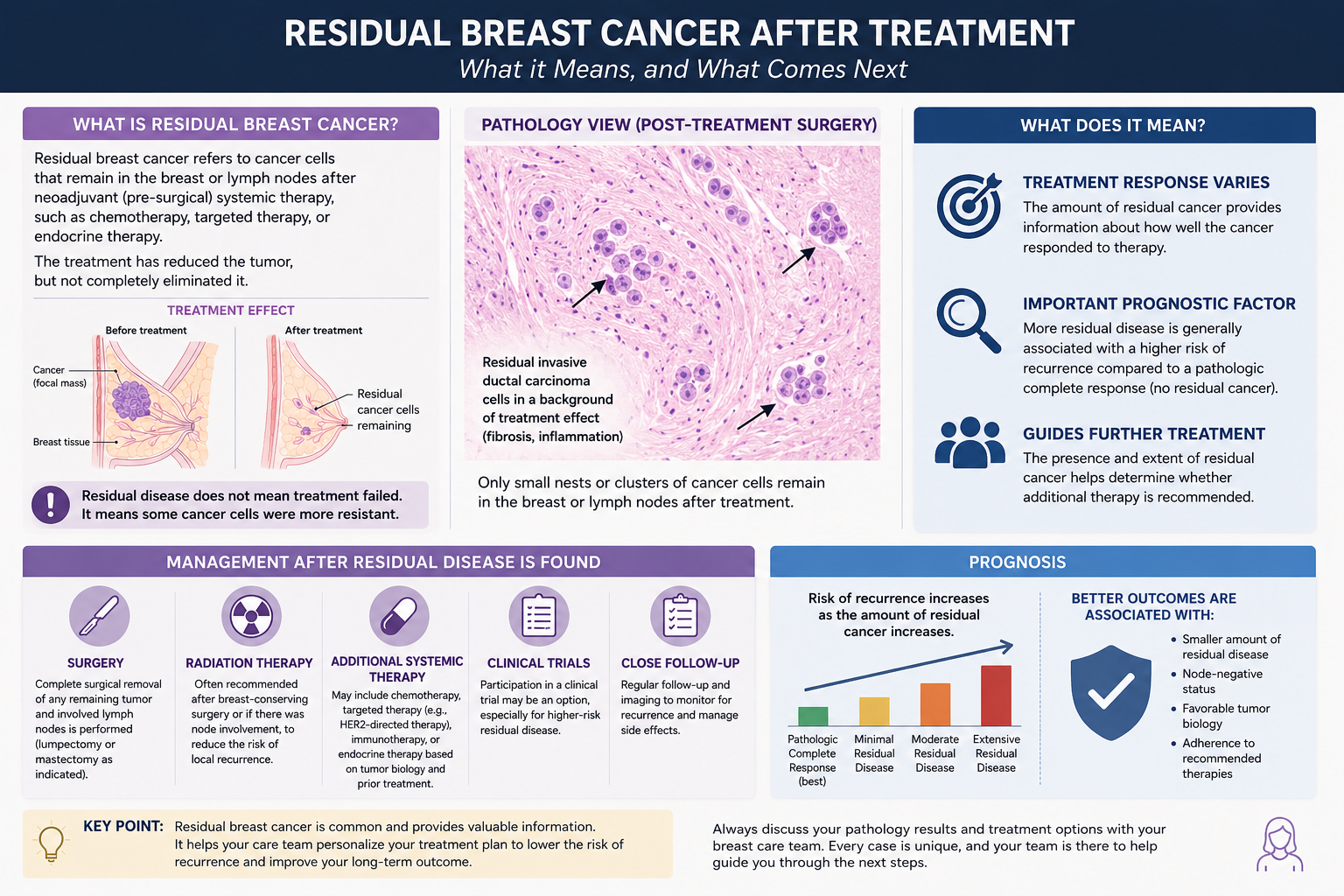
residual cancer burden is a pathology measurement that estimates how much breast cancer remains after treatment given before surgery. It is most often reported after neoadjuvant therapy, which means chemotherapy, immunotherapy, targeted therapy, or hormone therapy was used to shrink or control the cancer before the operation. The result helps the oncology team understand the pathologic response and decide whether more treatment may reduce the risk of recurrence.
Seeing this term in a pathology report can feel unsettling because it sounds final and technical. Many patients read the phrase and immediately wonder whether treatment failed, whether the cancer is still dangerous, or whether the next step will be more aggressive. The reality is more nuanced. Residual cancer burden is not a single yes-or-no answer; it is a structured way to describe treatment effect using several findings seen under the microscope and in the surgical specimen.
For patients and families, the goal is not to memorize a formula. The goal is to understand what the number means, what category it falls into, and how it fits with the full breast cancer treatment plan.
Residual Cancer Burden — What It Actually Means
Residual Cancer Burden is a calculation used after breast cancer treatment before surgery to estimate the amount of viable cancer left in the breast and nearby lymph nodes. A pathologist examines the removed tissue, measures the tumor bed size, estimates how much of that area still contains living invasive cancer, and evaluates lymph node status. These pieces are combined into an RCB score, which is then grouped into a class. The class helps describe whether there was no remaining invasive cancer, a small amount, a moderate amount, or a larger amount of residual disease.
A helpful analogy is a wildfire after firefighters have worked to control it. The pathology report does not only ask whether any smoke remains; it looks at the size of the burned area, how many active flames remain, and whether sparks reached nearby locations. In breast pathology, the tumor bed size is like the treated area, the percentage of cancer cellularity is like the amount of active fire, and lymph node status shows whether cancer was still present in regional drainage sites. This makes residual cancer burden more informative than a simple statement that cancer is present or absent.
The result appears in a pathology report because the surgical specimen gives direct evidence of how the cancer responded to neoadjuvant therapy. Imaging may show shrinkage, and a physical exam may suggest improvement, but microscope review confirms the pathologic response. Patients who want help understanding where this result fits in the full report may benefit from reviewing Understanding Your Pathology Report: How to Read It with Confidence. A clear reading of the pathology report often makes the discussion with the oncologist much less overwhelming.

Why Your Report Shows This Finding
A pathology report shows residual cancer burden when breast cancer treatment was given before surgery and the surgical specimen is evaluated for response. This situation is common in triple-negative breast cancer, HER2-positive breast cancer, larger tumors, node-positive disease, and some hormone receptor-positive cancers. Neoadjuvant therapy may greatly reduce the cancer, completely eliminate invasive cancer, or leave a measurable amount behind. The residual cancer burden calculation gives a standardized way to describe that range.
Pathologists assess several features to reach the RCB score. The tumor bed size is measured in two dimensions, because treated cancers may leave a scarred or fibrotic area where the tumor used to be. Within that area, the pathologist estimates the percentage of tissue that still contains invasive cancer and the percentage that is in situ disease. Lymph node status is also critical because residual cancer in lymph nodes carries different meaning than residual disease limited to the breast.
The report may also describe treatment effect, fibrosis, necrosis, calcifications, and scattered tumor cells. These findings reflect the tissue changes caused by neoadjuvant therapy and the cancer’s pathologic response. In some cases, the treated tumor becomes fragmented, leaving small islands of cancer spread across a larger tumor bed size. That pattern explains why residual cancer burden can require careful sampling and expert interpretation rather than a quick visual estimate.
How Serious Is Residual Cancer Burden After Treatment?
The seriousness of residual cancer burden depends on the RCB class, cancer subtype, lymph node status, tumor biology, margins, and the treatments already received. A low residual cancer burden can mean that the cancer responded very well, even if a tiny amount of invasive cancer remains. A higher residual cancer burden can mean that the cancer was less sensitive to the initial breast cancer treatment. This does not mean there is no effective next step; it means the oncology team has more information to tailor treatment after surgery.
The most reassuring category is pathologic complete response, often shortened as pCR, meaning no residual invasive cancer is found in the breast or lymph nodes. In many breast cancer subtypes, pathologic complete response is associated with a lower risk of recurrence. Residual cancer burden class I usually indicates minimal residual disease, while class II indicates moderate residual disease. Class III indicates a larger residual cancer burden and may lead the oncology team to discuss additional chemotherapy, targeted therapy, immunotherapy, endocrine therapy, radiation therapy, or clinical trial options.
Residual cancer burden should never be interpreted alone. For example, a small residual focus in the breast with negative lymph node status may carry a different outlook than a similar breast finding with multiple positive lymph nodes. The RCB score is one piece of the larger pathology report, along with tumor type, grade, receptor status, HER2 status, margins, and lymphovascular invasion. Patients trying to understand how these findings guide treatment may find helpful context in How Pathology Reports Guide Cancer Treatment. The key point is that residual cancer burden refines the plan rather than replacing the full clinical picture.
What Happens Next: Treatment and Monitoring
After residual cancer burden is reported, the oncology team usually reviews the result together with the pre-treatment biopsy, imaging, surgery type, lymph node status, and receptor studies. The RCB score may influence recommendations after surgery, especially when residual invasive cancer remains. For some patients, the next step is radiation therapy, endocrine therapy, HER2-directed therapy, immunotherapy continuation, or an additional medication designed for residual disease. The exact recommendation depends on the cancer subtype and the patient’s overall treatment course.
Pathology review may also confirm whether the surgical margins are clear and whether additional lymph node surgery is needed. Tumor bed size and residual cellularity may be discussed in a tumor board, where pathologists, surgeons, medical oncologists, radiation oncologists, radiologists, and other specialists review the case together. This type of discussion is especially useful when the residual cancer is scattered, when the RCB score is unexpected, or when the pathology report does not clearly explain the response. In complex cases, a second pathology opinion can confirm the diagnosis and response assessment.
Monitoring after surgery is usually individualized. Follow-up may include physical exams, breast imaging when appropriate, symptom review, medication monitoring, and coordination between oncology specialists. Residual cancer burden does not mean that cancer is definitely still spreading in the body. It means that invasive cancer was still present in the tissue removed at surgery, and that information can guide additional treatment designed to lower future risk.
Questions to Ask Your Doctor or Pathologist
- What is the exact RCB score and RCB class in the pathology report?
- Was there a pathologic complete response, or was invasive cancer still present?
- What was the tumor bed size, and how much of it contained viable invasive cancer?
- What does the lymph node status show after neoadjuvant therapy?
- Does this residual cancer burden change the recommended breast cancer treatment plan?
- Were the surgical margins clear, and do they affect the next step?
- Would a second pathology opinion help confirm the residual cancer burden calculation?
These questions can make the oncology visit more focused and less confusing. A patient does not need to understand every microscopic detail to ask for the RCB score, the class, and the main reason it matters. The pathology report should support clear decision-making, not create more fear.
When the result is unexpected, complex, or hard to reconcile with imaging, an expert review can be helpful. A second opinion is especially reasonable when residual cancer burden will influence additional therapy, clinical trial eligibility, or a major treatment choice. Patients considering this step can review When Should You Get a Second Pathology Opinion? for practical guidance.
Frequently Asked Questions
What does residual cancer burden mean in breast cancer?
Residual cancer burden means that the surgical specimen was evaluated to measure how much invasive breast cancer remains after treatment before surgery. The calculation includes tumor bed size, the amount of viable cancer in the breast, and lymph node status. It is reported as an RCB score and often as an RCB class. The result helps the oncology team understand treatment response and plan next steps.
Is residual cancer burden the same as cancer left behind?
Residual cancer burden means cancer was found in the tissue removed at surgery after neoadjuvant therapy, not necessarily that visible cancer was left in the body. If margins are clear, the known tumor may have been surgically removed even though residual disease was present in the specimen. The result describes what the pathologist found in the removed breast tissue and lymph nodes. The oncology team uses this information to decide whether additional treatment is recommended.
What is a good RCB score?
The most favorable result is RCB-0, which corresponds to pathologic complete response. RCB-I usually indicates minimal residual disease and is generally more reassuring than higher classes. RCB-II and RCB-III indicate increasing amounts of residual cancer burden, but interpretation depends on subtype, lymph node status, receptor results, and the treatment already given. The oncology team can explain what the score means for that specific case.
Can residual cancer burden change treatment?
Yes, residual cancer burden can change treatment after surgery. In some breast cancer subtypes, residual invasive disease may lead to additional chemotherapy, targeted therapy, immunotherapy, endocrine therapy, radiation planning, or clinical trial discussion. The decision is not based on the RCB score alone. It is combined with the full pathology report and the patient’s clinical history.
Should I get a second opinion on my pathology report?
A second opinion may be helpful if the pathology report is unclear, the RCB score seems unexpected, or the result will strongly affect treatment. Breast specimens after neoadjuvant therapy can be challenging because treated tumor may be scarred, fragmented, or difficult to measure. A second pathology review can confirm tumor bed size, lymph node status, receptor results, and the residual cancer burden class. Practical steps are outlined in How to Get a Second Opinion on Your Pathology Diagnosis.
Residual cancer burden can sound frightening, but it is meant to create clarity after breast cancer treatment, not to take hope away. The result helps turn a complicated treatment response into information that can guide the next decision. Honest Pathology consultations can help patients and families understand the wording, the RCB score, and the questions worth bringing to the treating oncology team.
References:
National Cancer Institute — Pathology Reports Fact Sheet
National Cancer Institute — Breast Cancer Treatment PDQ
National Cancer Institute — Neoadjuvant Therapy Definition