A new result can feel frightening. ALK positive lung cancer has specific treatment implications; learn what to ask next.
ALK positive lung cancer means the tumor has an ALK gene change that may make it respond to specific targeted medicines. This result is usually found through testing performed on a lung biopsy, surgical specimen, or sometimes a fluid sample containing cancer cells. For many patients, seeing a gene name on a pathology report feels confusing because it sounds technical, unfamiliar, and serious all at once.
That anxiety is understandable. A pathology report can feel like a locked file cabinet full of terms that matter deeply but are hard to translate. The goal is not to memorize molecular biology. The goal is to understand what the result means, why it was tested, how reliable it is, and what questions may help guide the next conversation with the oncology team.
Pathologists often describe ALK positive lung cancer as a finding that changes the treatment map. It does not describe a patient’s personality, choices, or anything that could have been prevented. It describes a feature inside the cancer cells that can help doctors choose more precise treatment.
ALK Positive Lung Cancer — What It Actually Means
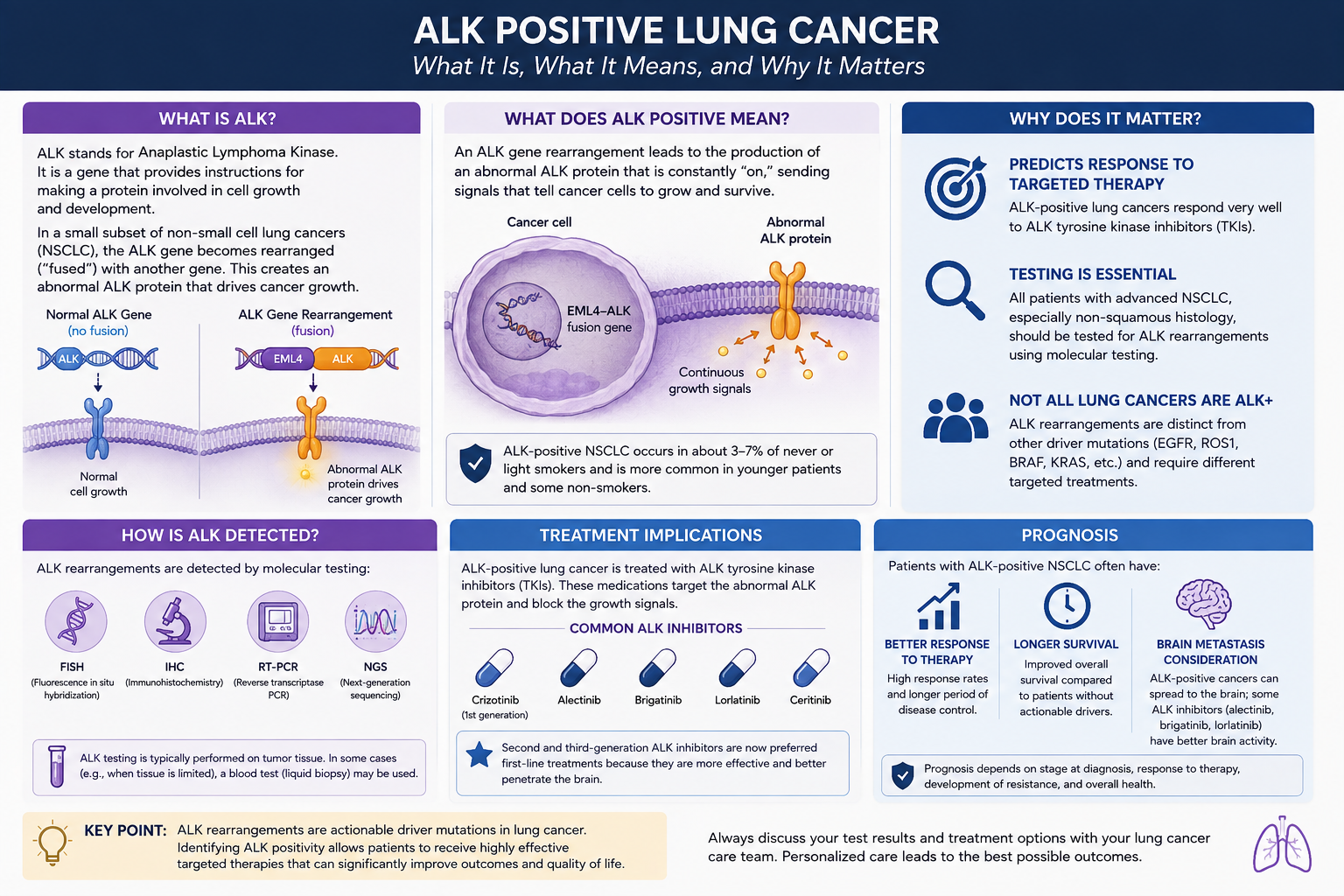
ALK positive lung cancer refers to lung cancer cells with an abnormal ALK gene pattern, most often an ALK gene rearrangement. ALK stands for anaplastic lymphoma kinase, a gene that can become fused with another gene and act like a stuck accelerator pedal inside cancer cells. Instead of turning growth signals on and off in a controlled way, the abnormal signal can keep telling the cell to grow. This is why ALK testing can be so meaningful in a lung biopsy report.
A useful analogy is a building with a faulty light switch. The problem is not that every wire in the building is broken; the problem is that one switch is jammed in the on position. In ALK positive lung cancer, the abnormal ALK signal may become one of the main drivers of tumor growth. When a driver is identified, targeted therapy may be available to block that signal more specifically than traditional chemotherapy.
Most cases are a type called lung adenocarcinoma, although ALK changes can occasionally be seen in other lung cancer patterns. Pathologists use the microscope findings, the diagnosis, and the available tissue to decide which additional tests are appropriate. For patients trying to understand the entire document, a plain-language overview such as What Is a Pathology Report? can help place ALK testing in context. The key point is that ALK positive lung cancer is not a separate organ diagnosis; it is a molecular result within a lung cancer diagnosis.
Why Your Report Shows This Finding

A report shows this finding because the tumor tissue was tested for biomarkers that may guide treatment. In non-small cell lung cancer, especially lung adenocarcinoma, molecular testing is commonly used to look for changes in genes such as ALK, EGFR, ROS1, BRAF, MET, RET, NTRK, and others. These tests search for features that are not visible by routine microscopy alone. A lung biopsy may show cancer under the microscope, but molecular testing helps identify what may be driving that cancer.
ALK testing can be performed in several ways. Some laboratories use an immunohistochemistry stain to look for abnormal ALK protein in the tumor cells. Others use fluorescence in situ hybridization, next-generation sequencing, or other molecular methods to detect a gene rearrangement directly. Each method has strengths, limitations, and quality checks, and pathologists interpret the result together with the tumor type and sample adequacy.
The report may mention whether the specimen had enough tumor cells for testing. This matters because a very small lung biopsy can contain only a limited amount of cancer tissue. If tissue is scarce, the laboratory may have to prioritize the most clinically useful tests, and additional molecular testing may require another sample or a blood-based test. Terms such as lung adenocarcinoma, immunohistochemistry stain, and gene rearrangement can appear in different sections, so reading the report step by step often makes it less overwhelming.
How Serious Is ALK Positive Lung Cancer?
ALK positive lung cancer is serious because it is a diagnosis of lung cancer, but the ALK result itself can also provide a treatment opportunity. The seriousness depends on the stage, tumor burden, symptoms, overall health, and whether the cancer has spread. An ALK result does not by itself say whether the cancer is early stage or advanced. It says that the cancer has a specific molecular feature that may respond to targeted therapy.
In advanced ALK positive lung cancer, targeted therapy is often a major part of treatment planning. These medicines are designed to inhibit the abnormal ALK signal, and they can be very effective for many patients. That does not mean the situation is simple or guaranteed, and resistance can develop over time. Still, compared with a report that has no actionable alteration, ALK positive lung cancer often gives the oncology team a clearer treatment direction.
In early-stage disease, ALK testing may still be relevant, but the treatment plan can be different. Surgery, radiation therapy, chemotherapy, immunotherapy, targeted therapy, or combinations may be considered depending on stage and medical factors. A lung biopsy only samples part of the disease, while staging studies show where the cancer is located in the body. This is why pathology results, imaging, and clinical information must be interpreted together rather than in isolation.
Patients often worry that a positive molecular result means the cancer is more aggressive. That is not the best way to understand this finding. ALK positive lung cancer is defined by a driver alteration, not by a single fixed behavior in every patient. Some tumors respond well to ALK-directed targeted therapy, while others require treatment changes over time. The most useful question is not only, “Is this bad?” but, “What does this result make possible now?”
What Happens Next: Treatment And Monitoring
After ALK positive lung cancer is identified, the oncology team usually confirms the full diagnosis, stage, and treatment options. The pathologist’s report may be reviewed along with imaging studies, procedure notes, and any prior pathology. If the sample came from a lung biopsy, the team may also check whether there is enough remaining tissue for additional molecular testing. This step helps avoid missing other clinically relevant information.
Treatment planning often focuses on targeted therapy when disease is advanced or when guidelines support an ALK-directed approach. The exact medicine depends on the clinical setting, prior treatments, side effect profile, brain involvement, and current standards of care. Monitoring usually includes follow-up imaging, symptom assessment, bloodwork, and sometimes repeat testing if the cancer changes or progresses. A later biopsy or blood test may be used to look for resistance mechanisms.
Pathology also remains relevant after the first diagnosis. If a new site is biopsied later, the report may confirm whether the same cancer is present, whether the tumor pattern has changed, and whether more molecular testing is needed. For patients who want help reading the structure of a report, Understanding Your Pathology Report: How to Read It with Confidence can make the language easier to follow. The safest interpretation usually comes from connecting the pathology findings with the oncologist’s full clinical picture.
Questions To Ask Your Doctor Or Pathologist
- Was the ALK result found by an immunohistochemistry stain, sequencing, FISH, or another method?
- Does the report describe a specific ALK gene rearrangement or fusion partner?
- Was there enough tumor in the lung biopsy for complete molecular testing?
- Does the diagnosis say lung adenocarcinoma, another non-small cell lung cancer type, or a mixed pattern?
- Are there other biomarker results still pending, such as EGFR, ROS1, BRAF, MET, RET, NTRK, or PD-L1?
- How does the ALK result affect targeted therapy options in this stage of disease?
- Would a second pathology review or repeat molecular testing change treatment planning?
These questions are not meant to challenge the care team. They help patients understand whether the result is complete, how it was obtained, and how it connects to treatment. A clear answer can reduce the feeling that decisions are being made from behind a curtain.
A second review may be helpful when the sample is small, the report is unclear, the diagnosis was made elsewhere, or treatment decisions depend heavily on the molecular result. Resources such as When Should You Get a Second Pathology Opinion? explain when expert review can add value. If a patient needs a practical path forward, How to Get a Second Opinion on Your Pathology Diagnosis describes the usual steps.
Frequently Asked Questions
What does ALK positive lung cancer mean?
ALK positive lung cancer means the cancer cells have an abnormal ALK gene change, usually a gene rearrangement, that may drive growth. This result is found through ALK testing on tumor tissue or, in some situations, blood-based testing. It is most often associated with lung adenocarcinoma. The result can help doctors choose targeted therapy.
Is ALK positive lung cancer curable?
Curability depends mostly on stage, not only on the ALK result. Early-stage cancer may sometimes be treated with curative intent using surgery, radiation, and selected additional treatments. Advanced ALK positive lung cancer is often treated as a long-term condition with targeted therapy, monitoring, and treatment adjustments. The oncology team can explain the goal of treatment for the specific stage.
How is ALK testing done on a lung biopsy?
ALK testing may be done using an immunohistochemistry stain, FISH, next-generation sequencing, or another validated laboratory method. The pathologist first confirms that enough tumor is present in the lung biopsy sample. Molecular testing then looks for evidence of an ALK gene rearrangement or related abnormality. If tissue is limited, additional testing may require another specimen or a blood-based test.
Does ALK positive lung cancer mean chemotherapy will not work?
ALK positive lung cancer does not mean chemotherapy cannot work. It means targeted therapy may be an especially relevant option, depending on stage and clinical setting. Some patients may receive chemotherapy at some point, while others receive ALK-directed treatment first. Treatment choices depend on guidelines, prior therapy, symptoms, imaging, and overall health.
Should I get a second opinion on an ALK result?
A second opinion can be reasonable if the report is unclear, the sample was small, results conflict, or major treatment decisions depend on the finding. Review may include the original slides, the lung biopsy diagnosis, and the molecular testing report. In many cases, the result is confirmed, which can still provide reassurance. In selected cases, review can clarify the diagnosis or recommend additional testing.
Receiving this result can feel frightening, but it can also provide actionable information. ALK positive lung cancer is a diagnosis that deserves careful explanation, not rushed assumptions. Honest Pathology consultations can help patients and caregivers understand the report, identify missing pieces, and prepare clearer questions for the treating team.
References:
National Cancer Institute — Pathology Reports
National Cancer Institute — ALK Gene
National Cancer Institute — Non-Small Cell Lung Cancer Treatment