A scary kidney biopsy result can feel overwhelming. Congo Red positive kidney explains possible amyloid and what to ask next.
Congo Red positive kidney means a kidney biopsy has shown material that stains in a pattern pathologists recognize as amyloid. This finding does not name the exact type of amyloid by itself, but it strongly points toward a condition called amyloidosis. In the kidney, amyloid deposits can interfere with the delicate filtering units that normally keep protein in the blood and remove waste through urine.
Receiving this phrase in a report can be frightening because it sounds rare, technical, and serious. Many patients first see it alongside words like proteinuria, nephrotic syndrome, renal insufficiency, or chronic kidney disease. The clearest path forward is to understand what the stain proves, what it does not prove, and what testing usually comes next. A pathology report is not just a label; it is a map that helps the care team decide the safest next step.
Congo Red Positive Kidney — What It Actually Means
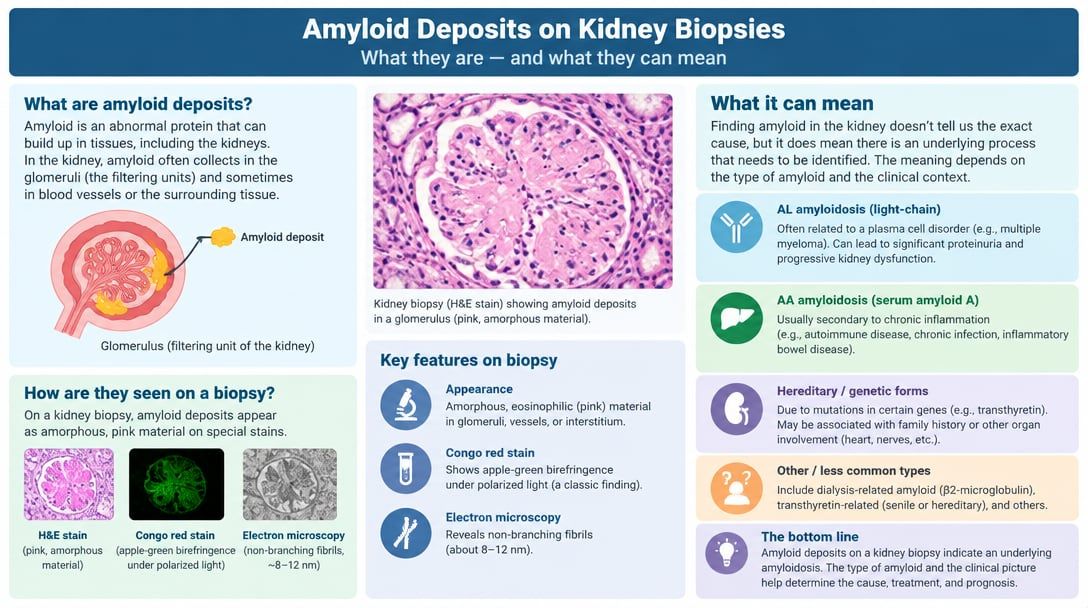
Congo Red positive kidney describes a staining result, not a complete diagnosis by itself. Congo red is a special dye used in pathology laboratories when amyloid deposits are suspected in tissue. Under routine microscope stains, amyloid can look like smooth pink material, which may overlap with other changes. Congo red helps confirm that the material has the structure expected for amyloid.
A useful analogy is a fingerprint powder at a crime scene. The powder does not identify the person by itself, but it reveals a pattern that was not obvious before. In the same way, Congo red makes amyloid deposits easier to recognize and confirm. In a kidney biopsy, the pathologist looks at where the deposits are located, how extensive they are, and whether they involve glomeruli, blood vessels, tubules, or surrounding tissue.
Many reports also mention apple green birefringence, which is a classic appearance seen when Congo red-stained tissue is viewed under polarized light. That phrase can sound dramatic, but it is a technical description of how amyloid bends light. A kidney biopsy may also include electron microscopy and immunofluorescence to better characterize the material. For patients trying to understand the larger report, Understanding Your Pathology Report: How to Read It with Confidence can help make the structure and wording feel less overwhelming.

Why Your Report Shows This Finding
A report shows Congo red positivity when the tissue contains amyloid, which is an abnormal protein material that folds into a very stable structure. The body has many proteins, and several different protein types can form amyloid deposits. In kidney tissue, these deposits may collect in the filtering units, along small blood vessels, or in the spaces between tubules. The exact location matters because it helps explain symptoms such as protein urine, swelling, fatigue, or declining kidney function.
The most common clinical question after amyloid deposits are found is the type of amyloid. One important type is light chain amyloid, also called AL amyloidosis, which can be related to abnormal plasma cells in the bone marrow. Other types include AA amyloid, hereditary transthyretin amyloid, and several less common forms. The amyloidosis diagnosis should not stop at the word amyloid; accurate typing is essential because treatments differ greatly.
Pathologists often use additional tests after Congo red confirms amyloid deposits. Immunofluorescence may look for kappa and lambda light chains, while immunohistochemistry may test for specific amyloid proteins. In many centers, mass spectrometry is considered a highly reliable method for amyloid typing, especially when routine stains are unclear. Apple green birefringence supports the diagnosis, but mass spectrometry may help determine the exact protein causing the deposits.
How Serious Is Congo Red Positive Kidney?
Congo Red positive kidney is a significant biopsy finding, but the seriousness depends on several details. The amount of amyloid deposits, the type of amyloid, kidney function, urine protein level, and involvement of other organs all matter. Some patients are diagnosed before severe kidney damage has occurred, while others already have advanced scarring or heavy protein urine. The same stain result can therefore lead to very different clinical conversations.
In general, Congo Red positive kidney deserves prompt follow-up because amyloidosis can be systemic, meaning it may affect organs beyond the kidney. The heart, nerves, liver, and gastrointestinal tract may be evaluated depending on symptoms and laboratory results. If light chain amyloid is suspected, blood tests, urine tests, and bone marrow evaluation may be used to look for an underlying plasma cell disorder. This does not automatically mean a patient has cancer, but it does mean the care team needs to identify the source of the amyloid protein.
The kidney biopsy can provide clues about prognosis. Extensive glomerular amyloid deposits often explain heavy protein urine and swelling, while vascular deposits may be associated with blood pressure or blood flow issues. Scarring, tubular atrophy, and interstitial fibrosis may suggest how much permanent kidney damage has already occurred. Congo Red positive kidney should be taken seriously, but seriousness is not the same as hopelessness; many treatment plans aim to slow or stop new amyloid formation and protect remaining kidney function.
What Happens Next: Treatment and Monitoring
After a kidney biopsy shows amyloid deposits, the next step is usually amyloid typing. Treatment cannot be chosen safely from Congo red staining alone because each amyloid type has different causes and different therapies. A patient may be referred to nephrology, hematology, cardiology, or a specialized amyloidosis center. The goal is to connect the tissue diagnosis with the full clinical picture.
Monitoring often includes blood creatinine, estimated glomerular filtration rate, urine protein measurements, albumin level, and blood pressure. Protein urine is often followed over time because it can reflect how actively the kidney filters are being injured. Doctors may also order serum free light chains, serum and urine protein electrophoresis, immunofixation, and cardiac biomarkers. If light chain amyloid is found, therapy may focus on the abnormal plasma cells that are producing the light chains.
Treatment may include disease-specific therapy plus kidney-protective care. Kidney-protective steps can include blood pressure control, salt management, diuretics for swelling, and medications that reduce protein urine when appropriate. The amyloidosis diagnosis may also lead to family history review if a hereditary type is suspected. A clear explanation of the pathology report can help patients understand why several specialists may become involved after one kidney biopsy.
Questions To Ask Your Doctor Or Pathologist
- What type of amyloid is suspected from this kidney biopsy?
- Was amyloid typing performed by immunofluorescence, immunohistochemistry, mass spectrometry, or another method?
- Did the report describe apple green birefringence under polarized light?
- Where are the amyloid deposits located in the kidney tissue?
- How much permanent scarring or chronic kidney damage was seen?
- Could light chain amyloid be responsible, and what blood or urine tests should check for it?
- Should the biopsy slides be reviewed by a kidney pathology or amyloidosis specialist?
These questions are not meant to challenge the care team. They help turn a frightening phrase into a practical checklist. A pathology report can contain answers that affect treatment, prognosis, and the need for additional testing. For a broader explanation of what pathology reports contain, What Is a Pathology Report? may be helpful.
A second review can be especially helpful when the amyloid type is uncertain, when the kidney biopsy was performed outside a major referral center, or when treatment decisions are urgent. A second opinion does not mean the first diagnosis was wrong; it often confirms the result and adds detail. Guidance on when to request a review is available at When Should You Get a Second Pathology Opinion?. For patients already planning a review, How to Get a Second Opinion on Your Pathology Diagnosis explains the practical steps.
Frequently Asked Questions
What does Congo red positive mean on a kidney biopsy?
Congo red positive means the biopsy tissue contains material that stains like amyloid. In the setting of Congo Red positive kidney, the finding strongly supports amyloid deposits in the kidney. The stain confirms the presence of amyloid-like material, but it does not always identify the exact amyloid type. Further testing is usually needed before treatment decisions are made.
Does Congo red positive kidney mean kidney failure?
Congo red positive kidney does not automatically mean kidney failure. Some patients have preserved kidney function at diagnosis, while others have reduced function or heavy protein urine. The severity depends on how much tissue is involved, how much scarring is present, and whether treatment can control the underlying amyloidosis diagnosis. Kidney function tests and urine protein trends help clarify the risk.
Can amyloid in the kidney be treated?
Amyloid in the kidney can often be treated by addressing the protein source that is forming amyloid deposits. Treatment depends on the amyloid type, which is why accurate typing is so important. Light chain amyloid may require hematology-directed therapy, while other types need different approaches. Kidney-protective care is also used to manage swelling, blood pressure, and protein urine.
Why is amyloid typing needed after Congo red staining?
Amyloid typing is needed because Congo red shows that amyloid is present, but it may not prove the exact protein causing it. Different amyloid types have different causes, specialists, treatments, and family implications. Mass spectrometry can be especially useful when routine staining does not give a clear answer. Correct typing helps avoid the wrong treatment plan.
Should I get a second opinion for amyloid on kidney biopsy?
A second opinion can be reasonable when amyloid deposits are found, especially if the amyloid type is unclear or treatment is about to start. Kidney amyloid diagnosis often depends on special stains, electron microscopy, and sometimes mass spectrometry. Another pathologist with kidney biopsy experience may confirm the diagnosis or recommend additional testing. This review can give patients and clinicians more confidence before major treatment decisions.
A Congo red result can feel like a sudden turn in the road, but it is also a clue that allows the care team to look for the cause more directly. The most helpful next step is usually careful amyloid typing, correlation with blood and urine tests, and a clear conversation with the treating clinicians. Honest Pathology consultations can help clarify biopsy wording, identify unanswered questions, and support a more informed discussion with the medical team.
References:
National Cancer Institute — Pathology Reports
NCBI Bookshelf — Medical Reference Library
MedlinePlus — Protein in Urine