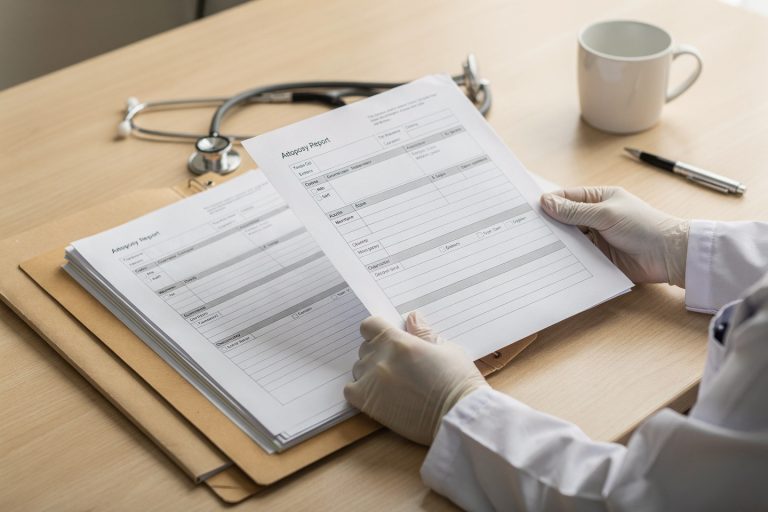
After an autopsy report, families may have questions. Learn what to ask, what the answers mean, and when expert review may help.
Autopsy report questions are often the first way families begin turning a painful document into clearer answers after a death. An autopsy report may explain the cause of death, describe major autopsy findings, and sometimes address whether disease, injury, medication, or another factor contributed. Even when the report is medically accurate, the language can feel cold, technical, or incomplete to a grieving family.
Receiving an autopsy report can reopen shock, sadness, anger, and uncertainty all at once. Many families read the same sentence repeatedly and still wonder what it means in ordinary language. That reaction is not a failure of understanding; it is a normal response to dense medical wording during an emotionally difficult time. Clear questions can help families prepare for a conversation with a physician, pathologist, coroner, or medical examiner.
First Questions Families Should Ask About Autopsy Reports
The most helpful autopsy report questions usually begin with the central conclusion: What does the report list as the cause of death, and what evidence supports that conclusion? The cause of death is the disease, injury, or event that directly led to death, such as a heart attack, pneumonia, pulmonary embolism, overdose, or complications of cancer. Families may also see a sequence of conditions, where one condition led to another and finally to death. A useful analogy is a row of dominoes: The final domino falls last, but the report may try to show which earlier domino started the chain.
Another early question is whether the report states a manner of death. The manner of death is a classification such as natural, accident, suicide, homicide, or undetermined, depending on the circumstances and jurisdiction. This wording can feel emotionally heavy, but it is not the same as blame. It is a medicolegal category that places the death into a broad framework. When the manner of death feels surprising, families can ask which facts, scene information, medical history, and autopsy findings led to that classification.
Families may also want to ask which parts of the autopsy were performed. Some autopsies include external examination only, while others include internal examination, organ dissection, microscopic examination, toxicology, microbiology, genetic testing, or other special studies. If only a limited autopsy was authorized or possible, the report may answer some questions but not others. Autopsy report questions should include whether any organs, tissue blocks, slides, photographs, or retained specimens remain available for review. This is especially helpful when a second review may be considered later.
Why Autopsy Reports May Seem Incomplete or Confusing

An autopsy report can feel incomplete because death investigation depends on more than what is seen at the examination table. The pathologist or medical examiner often combines medical records, family history, emergency response notes, scene information, toxicology results, and autopsy findings. If one piece of information is missing, the final explanation may include cautious wording. Words such as “consistent with,” “suggestive of,” or “cannot exclude” usually mean that the evidence points in a direction but does not prove every detail with absolute certainty. Medical reports often reflect degrees of confidence rather than simple yes-or-no answers.
Some findings are visible to the naked eye, while others require microscopic examination. For example, the heart may look enlarged during the autopsy, but microscopic examination may show scarring, inflammation, or a pattern of injury that adds meaning. Similarly, the lungs may show congestion or fluid, but the cause of those changes may require clinical context. Toxicology results can also take weeks, and an initial report may be amended when drug, alcohol, medication, or poison testing returns. Families can ask whether the report is final or whether pending toxicology results or other studies could change the conclusion.
Confusion can also occur because the death certificate may use shorter wording than the full autopsy report. A death certificate is designed for official recordkeeping and may not include every contributing disease or detail. The report may list additional conditions that were present but not directly responsible for death. For families, the difference between “cause,” “contributing condition,” and “incidental finding” can be hard to separate. A plain-language explanation of medical terminology can be helpful, and families who need a foundation in report structure may benefit from reading what a pathology report is before reviewing an autopsy document line by line.
How Questions Clarify the Cause of Death

Autopsy report questions can help families understand how serious each finding was and whether it truly explains the death. Not every abnormality in an autopsy report is fatal. A person may have mild coronary artery disease, small benign nodules, old scars, or age-related changes that did not directly cause death. The key question is whether a finding was severe enough, recent enough, and medically connected enough to explain what happened. When the cause of death is uncertain, the report may use “undetermined” or describe multiple possible contributors.
Autopsy report questions are especially valuable when the reported cause of death does not match what family members observed. For example, a sudden death may be attributed to heart disease even if the person had no known heart symptoms. That can happen because some dangerous heart conditions remain silent until a fatal rhythm disturbance occurs. In other cases, the autopsy findings may not fully explain the timing, and the medical examiner may rely on medical history, scene information, and exclusion of other causes. Families can ask what evidence makes one cause more likely than another.
The manner of death also deserves careful discussion when it affects legal, insurance, or emotional concerns. A natural manner of death usually means disease processes caused the death. An accident may involve an unintended injury, fall, medication exposure, or substance-related event. An undetermined manner of death means the available evidence is not strong enough to choose a single category. Families should ask how the death certificate wording relates to the full report, because the death certificate may be brief while the autopsy report explains the reasoning in greater detail.
What Comes Next: Records, Review, and Family Conversations
After receiving an autopsy report, families can request a meeting or call with the physician, pathologist, coroner, or medical examiner who can explain the findings. The most useful conversations happen when the family has the full report, the death certificate, and a written list of questions. If toxicology results were pending, families can ask whether an amended report has been issued. If microscopic examination was performed, the family can ask whether the microscopic results confirmed or changed the gross impression. These details can prevent misunderstandings caused by reading only the final diagnosis section.
Some families seek an independent review when the explanation does not feel complete, when major clinical questions remain, or when the autopsy findings have implications for relatives. A review may involve the autopsy report, medical records, photographs, histology slides, toxicology results, and other available materials. This is not about assuming the original report is wrong. It is about asking whether another expert can clarify the reasoning, identify overlooked context, or explain the findings in a way the family can use. Families considering this step can read more about when a second pathology opinion may be useful.
Genetic or inherited conditions may need special attention. Some sudden cardiac deaths, aneurysms, clotting disorders, metabolic conditions, and cancers can have implications for children, siblings, or parents. If the report mentions unusual heart muscle disease, unexplained sudden death, rare tumors, or young age at death, families can ask whether genetic counseling or family screening is recommended. Autopsy report questions in this setting may affect living relatives, not only the understanding of the death. A primary care physician or specialist can help translate those concerns into appropriate follow-up.
Questions to Ask the Doctor or Pathologist

- What exact cause of death is listed, and what findings support it?
- Was the manner of death natural, accident, suicide, homicide, or undetermined, and why was that category chosen?
- Which autopsy findings were directly related to death, and which were incidental?
- Were toxicology results, cultures, genetic tests, or microscopic examination still pending when the report was issued?
- Does the death certificate match the full autopsy report, or does the report contain additional explanation?
- Could any findings affect blood relatives, including inherited heart disease, cancer risk, or clotting risk?
- Are slides, tissue blocks, photographs, or other materials available if an independent review is requested?
Families do not need to understand every medical term before asking for clarification. A good review should translate terminology into plain language while preserving medical accuracy. Helpful preparation may include highlighting confusing phrases, writing down the timeline of events, and comparing the report with hospital or emergency records. A resource on reading pathology reports with confidence can also help families organize questions before a meeting.
When questions remain unanswered, a second opinion can be appropriate, especially if the cause of death seems unclear, contested, or medically important for relatives. Families can ask what materials are needed and whether the original office will release slides or records. The process is often simpler when requests are specific and respectful. Practical steps for arranging review are outlined in this guide to getting a second pathology opinion.
Frequently Asked Questions
What should families ask after an autopsy report?
Families should ask what the report lists as the cause of death, what evidence supports that conclusion, and whether any results were still pending. Questions should also address the manner of death, the meaning of major autopsy findings, and whether any findings affect relatives. Autopsy report questions are most useful when written down before a call or meeting. A focused list helps the conversation stay clear during a painful time.
Can an autopsy report be wrong?
An autopsy report can be limited by available information, the type of examination performed, and whether additional testing was completed. Most reports are careful and evidence-based, but some conclusions may later be clarified by toxicology results, microscopic examination, medical records, or expert review. An independent review does not automatically mean an error occurred. It can help explain whether the original conclusion is well supported.
What does undetermined mean on an autopsy report?
Undetermined usually means the available evidence does not allow a confident single conclusion about the cause or manner of death. It may be used when findings are nonspecific, circumstances are unclear, or several possibilities remain. This word can feel frustrating, but it is sometimes the most honest medical answer. Families can ask which possibilities were considered and what evidence was missing.
Do toxicology results change the autopsy report?
Toxicology results can change or clarify an autopsy report, especially when medication, alcohol, drugs, carbon monoxide, or poison exposure is possible. Some reports are issued as preliminary documents while toxicology results are pending. Once results return, the report may be finalized or amended. Autopsy report questions should include whether toxicology was performed and whether the family has the final version.
Can families request a second opinion on an autopsy?
Families can often request an independent review, although the process depends on the office, jurisdiction, and available materials. A reviewer may need the full autopsy report, death certificate, medical records, slides, tissue blocks, photographs, and toxicology results. The original pathologist or medical examiner may still remain the official certifier. A second review can provide clarity, especially when medical wording feels confusing or incomplete.
Autopsy reports can be painful to read, but they can also provide a path toward understanding. Clear questions, organized records, and careful explanation can help families separate what is known, what is uncertain, and what may matter for living relatives. Honest Pathology consultations can help families understand autopsy language and consider whether expert review may be appropriate.
References:
National Cancer Institute — Autopsy
National Cancer Institute — Pathologist
National Cancer Institute — Pathology Reports