A KRAS result can feel frightening. KRAS G12C lung cancer has specific treatment meaning. Learn what to ask the cancer team next.
KRAS G12C lung cancer means that a lung cancer sample has a specific change in the KRAS gene that may help guide treatment decisions. This result usually comes from molecular testing performed on biopsy tissue, surgical tissue, or sometimes blood. It does not replace the diagnosis under the microscope, but it adds an important layer of information about the cancer’s biology.
Receiving a report with gene names, numbers, and letters can feel cold and confusing, especially when the word cancer is already overwhelming. Many patients see “KRAS G12C” and worry that it means something automatically hopeless or untreatable. In reality, this result is a clue, not a full sentence. Pathologists and oncology teams use that clue together with the tumor type, stage, imaging findings, and overall health of the patient.
A pathology report is often the starting map for care. Helpful background on report structure is available in What Is a Pathology Report?, especially for patients trying to understand where molecular results fit.
KRAS G12C Lung Cancer — What It Actually Means
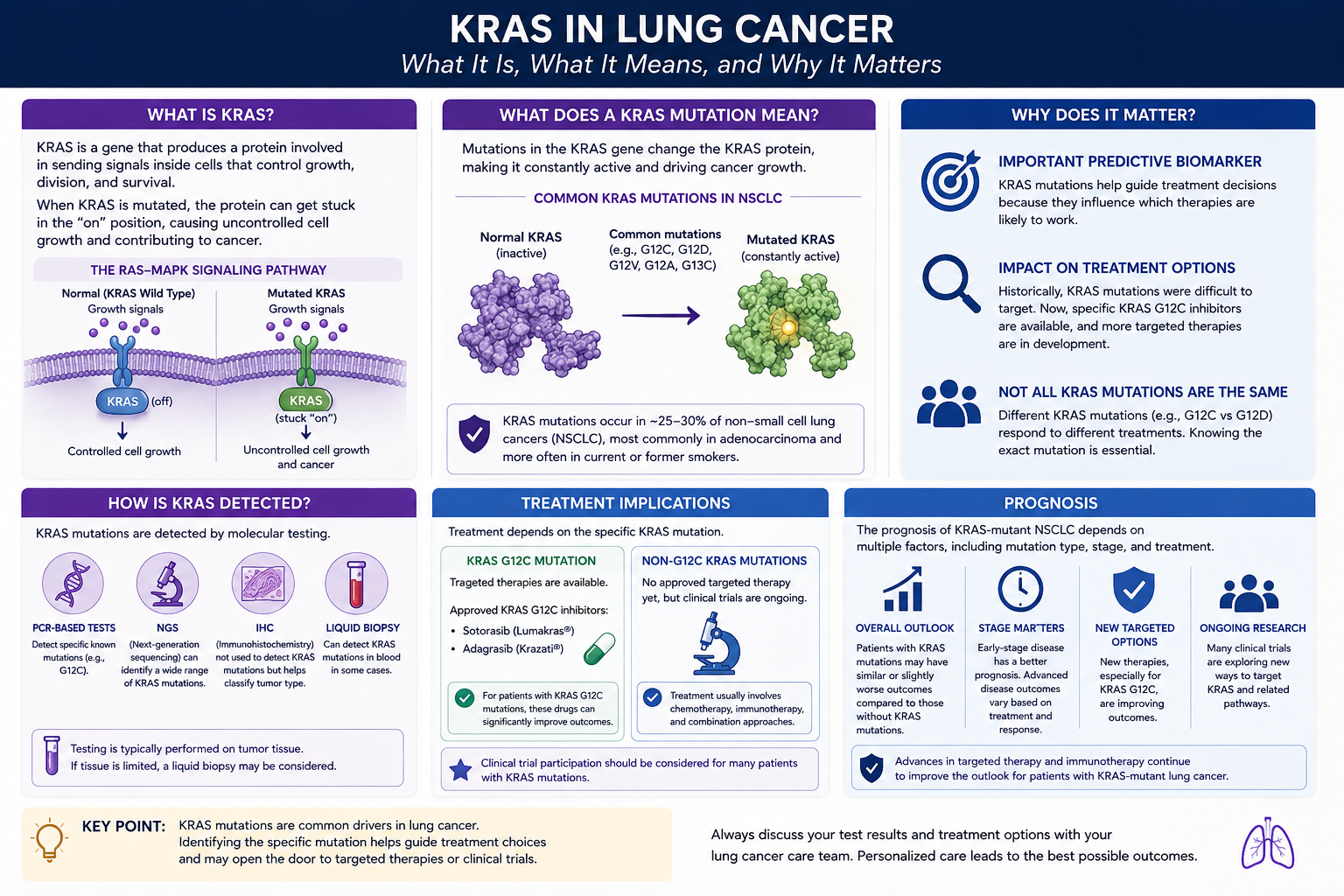
KRAS G12C lung cancer refers to a cancer with a particular mutation in the KRAS gene. KRAS is part of a signaling pathway that helps cells respond to growth signals. When the G12C mutation is present, the KRAS protein can become stuck in a more active state, pushing cancer cells to grow and survive. A useful analogy is a light switch that should turn on and off, but instead gets jammed partly on.
In the laboratory, a KRAS mutation test looks for changes in tumor DNA. This testing may be done by next-generation sequencing, polymerase chain reaction, or another validated molecular method. The report may list the result as “KRAS p.G12C,” “KRAS G12C,” or “c.34G>T,” depending on the format used by the laboratory. These notations describe the same clinically important type of alteration.
KRAS G12C lung cancer is most often seen in non-small cell lung cancer, particularly lung adenocarcinoma. It can occur in people with a smoking history, but smoking history alone does not predict the result reliably. The finding matters because certain drugs have been developed to target this altered KRAS protein. In that sense, molecular testing turns part of the report into a treatment roadmap rather than just a description.
Why Your Report Shows This Finding

A report shows KRAS G12C when the laboratory detects that specific genetic change in the cancer cells tested. The change is considered somatic in most lung cancers, meaning it developed in the tumor and is not usually inherited from a parent. The pathologist first confirms that the sample contains enough cancer cells for accurate testing. Then tumor DNA is extracted and analyzed for mutations that may affect treatment.
The KRAS mutation test may be ordered as part of a broader molecular testing panel. Many lung cancer panels also check EGFR, ALK, ROS1, BRAF, MET, RET, NTRK, and other markers. This broad approach is common because lung adenocarcinoma can be driven by different genetic changes that are not visible under the microscope. Two tumors can look similar on a slide but behave differently because their tumor DNA carries different alterations.
Some patients also have blood-based testing, sometimes called a liquid biopsy, when tissue is limited or additional information is needed. Blood testing looks for small fragments of tumor DNA shed into the bloodstream, but a negative blood result does not always rule out a mutation. Tissue molecular testing remains very important when enough biopsy material is available. Patients who want more context about report sections may find Understanding Your Pathology Report: How to Read It with Confidence useful alongside the oncology visit.
How Serious Is KRAS G12C Lung Cancer?
KRAS G12C lung cancer is serious because it is a form of lung cancer, but the mutation itself does not tell the whole story. Stage, tumor size, lymph node involvement, spread to other organs, performance status, and treatment options all strongly affect prognosis. A small, localized lung adenocarcinoma with KRAS G12C is very different from widespread metastatic disease with the same mutation. The mutation is one piece of a larger clinical puzzle.
For many patients, the most meaningful part of KRAS G12C lung cancer is that it may open the door to targeted therapy. Targeted therapy is treatment designed to interfere with a specific cancer-related molecule or pathway. In advanced disease, drugs such as sotorasib treatment and adagrasib treatment may be considered after prior therapy, depending on current guidelines, prior treatments, and the patient’s clinical situation. These medications are not the same as traditional chemotherapy, although they also have possible side effects that require monitoring.
KRAS G12C lung cancer should not be interpreted as “good” or “bad” in isolation. Some tumors with this mutation respond to immunotherapy, chemotherapy, targeted therapy, or combinations used in standard oncology care. Others may be more resistant, especially when additional mutations or complex clinical factors are present. The best interpretation comes from combining the KRAS mutation test with the full pathology diagnosis, imaging stage, PD-L1 result, and treatment history.
What Happens Next: Treatment and Monitoring
After KRAS G12C is reported, the oncology team usually confirms the exact lung cancer type, stage, and prior treatment history. For newly diagnosed advanced lung adenocarcinoma, molecular testing results are often reviewed along with PD-L1 immunohistochemistry and imaging. In earlier-stage disease, surgery, radiation, chemotherapy, immunotherapy, or combinations may be considered based on stage and resectability. The KRAS result remains part of the record because it may become relevant if the cancer recurs or progresses.
Targeted therapy decisions depend on whether the patient meets specific criteria for a KRAS G12C inhibitor. Sotorasib treatment and adagrasib treatment are examples of targeted drugs developed for this mutation in certain settings. An oncologist may discuss expected benefits, side effects, drug interactions, liver test monitoring, lung inflammation risk, and how response will be measured. Targeted therapy is not automatically the first treatment for every patient with KRAS G12C lung cancer.
Monitoring usually includes imaging studies, symptom review, laboratory tests, and sometimes repeat molecular testing if the cancer changes behavior. A repeat biopsy or blood test may be used to look for resistance mechanisms in tumor DNA. This does not mean the original report was wrong; cancers can evolve under treatment pressure. A clear record of the original KRAS mutation test helps later teams compare old and new findings.
Questions to Ask Your Doctor or Pathologist
- Does the report confirm non-small cell lung cancer, and is the specific type lung adenocarcinoma?
- Was the KRAS mutation test performed on tissue, blood, or both?
- Does the report show KRAS G12C specifically, or a different KRAS mutation?
- Were EGFR, ALK, ROS1, BRAF, MET, RET, NTRK, and other lung cancer markers also tested?
- Is there enough tumor tissue left for additional molecular testing if needed?
- How does this KRAS G12C result affect treatment sequencing, including targeted therapy?
- Would a second pathology opinion or molecular pathology review be helpful before treatment starts?
These questions help turn a technical report into a practical conversation. Patients are not expected to know every gene name, but the cancer team should be able to explain why each result matters. When the diagnosis, tumor type, or molecular testing seems unclear, a second review can be especially valuable. Guidance on this decision is available in When Should You Get a Second Pathology Opinion?.
A second opinion may involve reviewing slides, blocks, immunohistochemistry, molecular reports, and outside laboratory data. This type of review does not always change the diagnosis, but it can confirm that treatment decisions are being built on solid pathology information. For patients preparing to request a review, How to Get a Second Opinion on Your Pathology Diagnosis explains the practical steps.
Frequently Asked Questions
What does KRAS G12C mean in lung cancer?
KRAS G12C means the cancer cells have a specific mutation in the KRAS gene. In KRAS G12C lung cancer, this mutation can keep growth signaling more active than normal. The result helps oncologists consider whether targeted therapy may be appropriate in certain clinical settings. It should always be interpreted with the diagnosis, stage, and full molecular profile.
Is KRAS G12C lung cancer curable?
KRAS G12C lung cancer can sometimes be treated with curative intent when found at an early stage and removed or treated locally. In advanced or metastatic disease, treatment often focuses on controlling the cancer, extending life, and preserving quality of life. The mutation alone does not determine whether a cancer is curable. Stage and overall clinical context are the major factors.
Is KRAS G12C inherited?
In lung cancer, KRAS G12C is usually a somatic mutation found in the tumor rather than an inherited family mutation. That means it typically developed in the cancer cells during life. A standard KRAS mutation test on tumor tissue does not automatically mean relatives are at risk. Genetic counseling is usually reserved for situations where the personal or family history suggests an inherited cancer syndrome.
What treatment targets KRAS G12C?
Some targeted drugs are designed specifically for cancers with KRAS G12C. Sotorasib treatment and adagrasib treatment are examples used in selected patients with advanced non-small cell lung cancer. Eligibility depends on prior therapy, current approvals, side effect risks, and the oncologist’s assessment. Clinical trials may also be discussed when appropriate.
Can a KRAS result be wrong?
No laboratory test is perfect, but validated molecular testing is designed to be highly reliable when enough tumor is present. Problems can occur if the sample has very little cancer, poor DNA quality, or conflicting results between tissue and blood. A pathology or molecular second opinion may help when the KRAS mutation test does not fit the clinical picture. Repeat testing may also be considered if the cancer progresses or if the first sample was limited.
KRAS G12C lung cancer is a meaningful result, but it is not the entire story of a person’s cancer. Clear answers usually come from connecting the microscopic diagnosis, molecular testing, imaging stage, and treatment plan. Honest Pathology consultations can help patients and families understand whether the pathology and molecular findings support the next treatment decision.
References:
National Cancer Institute — Pathology Reports
National Cancer Institute — KRAS Gene Mutation
MedlinePlus — Genetic Testing