
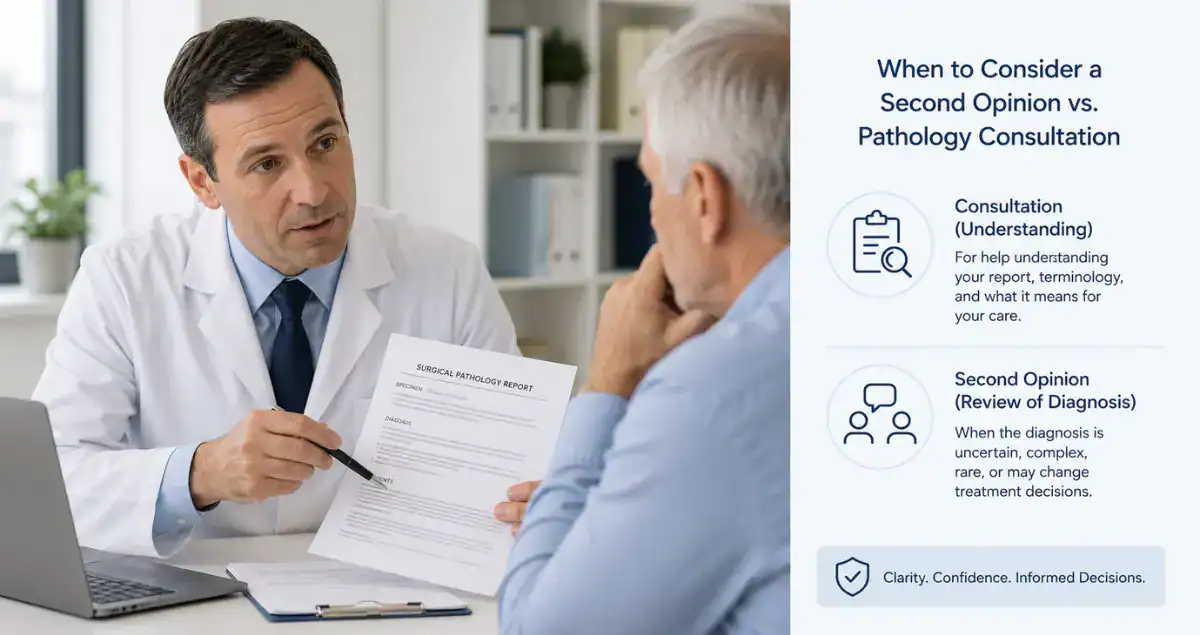
After receiving a cancer diagnosis, many patients immediately wonder whether they should get a second opinion on their pathology report. This reaction is completely understandable. A cancer diagnosis changes a patient’s life instantly. Patients want certainty before beginning surgery, chemotherapy, radiation, or other treatments. They want reassurance that the diagnosis is correct and confidence that the treatment plan makes sense. But an important question often gets overlooked during this stressful process: Do you truly need a formal second opinion on the diagnosis itself, or do you mainly need help understanding your pathology report more clearly?
At HONEST Pathology, we frequently speak with patients who believe they urgently need another pathologist to review their biopsy slides. Yet after carefully discussing the pathology report and explaining the findings in understandable language, many realize the diagnosis is actually straightforward and well-supported.
The issue was not necessarily diagnostic uncertainty. The issue was confusion. This distinction matters because formal pathology second opinions can be expensive, time-consuming, emotionally stressful, and occasionally even more confusing if slight wording differences emerge between reports. For many patients, a pathology consultation service focused on understanding the diagnosis may be a far more valuable first step.
Still, there are absolutely situations where formal second opinions are appropriate and medically important. Understanding when a second opinion is likely to help — and when a consultation may provide the clarity you really need — can make an enormous difference during the cancer journey.
When Breast Cancer Diagnoses May Benefit From a Second Opinion
In breast cancer, for example, formal second opinions are often most useful when the pathology findings involve borderline or difficult-to-classify lesions. Distinguishing between atypical ductal hyperplasia and ductal carcinoma in situ can sometimes be challenging, even for experienced pathologists. Rare breast tumors or unusual tumor patterns may also benefit from specialized review.
However, many breast cancer patients diagnosed with straightforward invasive ductal carcinoma or invasive lobular carcinoma do not necessarily need another formal interpretation of the slides. What they often need is help understanding terms like tumor grade, hormone receptor status, HER2 testing, surgical margins, or lymph node findings.
A patient reading “invasive ductal carcinoma, grade 2, estrogen receptor positive, HER2 negative” may feel terrified simply because the terminology sounds unfamiliar and severe. At HONEST Pathology consultations, we help patients understand what those findings actually mean, why they matter, and what questions they may want to discuss with their oncologist or surgeon. That understanding alone often provides enormous reassurance.
Understanding Technical Language in Lung Cancer Pathology
Lung cancer pathology creates similar anxiety for many patients. Reports commonly contain highly technical language involving immunohistochemical stains, molecular markers, and tumor classification systems. Patients may see terms like “TTF-1 positive adenocarcinoma,” “poorly differentiated non-small cell carcinoma,” or “PD-L1 expression” and assume the diagnosis must be uncertain or controversial. In reality, much of this language reflects standard modern lung cancer evaluation.
Formal second opinions in lung cancer may become more important when the tumor subtype is unclear, the cancer appears unusually rare, molecular findings are conflicting, or imaging and pathology do not align well. Certain rare thoracic tumors or poorly differentiated cancers can absolutely justify additional review. But many lung cancer patients primarily need help understanding what the pathology terminology actually means before assuming another pathologist must review the case urgently.
Why Colon Cancer Reports Often Cause Confusion
Colon cancer pathology is another area where confusion frequently leads patients to seek immediate second opinions. Patients often become frightened reading phrases such as “adenocarcinoma invading through the muscularis propria into pericolonic adipose tissue with lymphovascular invasion and positive lymph nodes.” Without explanation, this wording sounds catastrophic.
However, much of the report is simply describing how colon cancers are staged and classified routinely. Terms involving depth of invasion, lymph node involvement, margins, and tumor differentiation are standard components of colon cancer pathology reporting.
Formal second opinions in colon cancer may make sense when biopsies are ambiguous, hereditary syndromes are suspected, unusual molecular patterns are identified, or rare tumor subtypes are involved. But for many patients, understanding the pathology report more clearly may provide the reassurance they are seeking without immediately entering an expensive second-opinion process.
How Prostate Cancer Grading Can Affect Treatment Decisions
Prostate cancer is another excellent example because grading interpretation can sometimes vary between pathologists. The Gleason grading system and Grade Group classifications play major roles in determining treatment decisions, including surgery, radiation, or active surveillance.
In prostate cancer, formal second opinions can sometimes meaningfully affect management, particularly when borderline Gleason patterns or low-volume disease are involved. A change from Gleason 3+3 to Gleason 3+4, for example, may alter treatment recommendations substantially.
At the same time, many prostate cancer patients become anxious simply because they do not understand what Gleason scores, Grade Groups, perineural invasion, or core involvement percentages actually mean. A pathology consultation can help patients understand these concepts clearly and prepare more informed questions for their urologist or radiation oncologist.
Why Patients Often Mistake Confusion for Diagnostic Uncertainty
At HONEST Pathology, we believe this distinction is incredibly important because patients often assume uncertainty when what they are really experiencing is lack of explanation. Pathology reports are written for physicians, not patients. They contain dense medical language that can sound frightening without context.
Patients frequently receive these reports through online portals late at night before they have spoken with their healthcare team. They immediately begin searching online and quickly encounter worst-case scenarios, conflicting information, and alarming interpretations, including many of the common mistakes people make when reading a cancer report. In that moment, a formal second opinion can feel emotionally necessary even when the diagnosis itself is straightforward.
When a Pathology Consultation May Be the Better First Step
At HONEST Pathology, our consultations are designed to help patients slow down, understand the report carefully, and distinguish between normal pathology terminology and genuinely unusual findings. Importantly, pathology consultations can also help clarify when a formal second opinion truly would be beneficial.
Rare tumors, conflicting pathology interpretations, ambiguous biopsies, unusual molecular findings, borderline lesions, or discrepancies between imaging and pathology may absolutely justify additional review. But many patients discover after a consultation that they already have a clear and reliable diagnosis and that what they truly needed was education, reassurance, and clarity rather than another expensive diagnostic review. That realization can reduce anxiety dramatically.
At HONEST Pathology, we believe patients deserve honest guidance about when second opinions are likely to provide meaningful value and when understanding the pathology report more clearly may be the better first step. If you have received a breast cancer, lung cancer, colon cancer, prostate cancer, or other cancer diagnosis and are unsure whether you truly need a formal pathology second opinion, HONEST Pathology offers pathology consultations designed to help patients better understand their diagnosis, gain confidence, and determine whether additional formal review is actually necessary. Because sometimes peace of mind comes not from another diagnosis — but from finally understanding the one you already have.