For decades, pathology operated almost entirely behind the scenes of medicine. Patients rarely interacted directly with pathologists, and obtaining expert review of biopsy material often required complicated coordination between hospitals, laboratories, and major academic medical centers. Today, telepathology is beginning to change that model.
Telepathology allows pathology slides to be reviewed remotely using digital imaging technology, creating new opportunities for patient education, subspecialty consultation, and expanded access to pathology expertise. Large hospital systems and academic pathology departments increasingly rely on telepathology to share cases across geographic distances, accelerate consultations, and improve collaboration between specialists.
At Honest Pathology, telepathology has become the foundation of a new kind of patient-centered pathology consultation experience. Unlike traditional institutions where pathology communication is often filtered entirely through treating physicians, Honest Pathology offers patients direct educational insight into their pathology slides through remote review and consultation. This approach represents a major shift in how patients can engage with pathology and better understand their diagnoses.
What Is Telepathology?
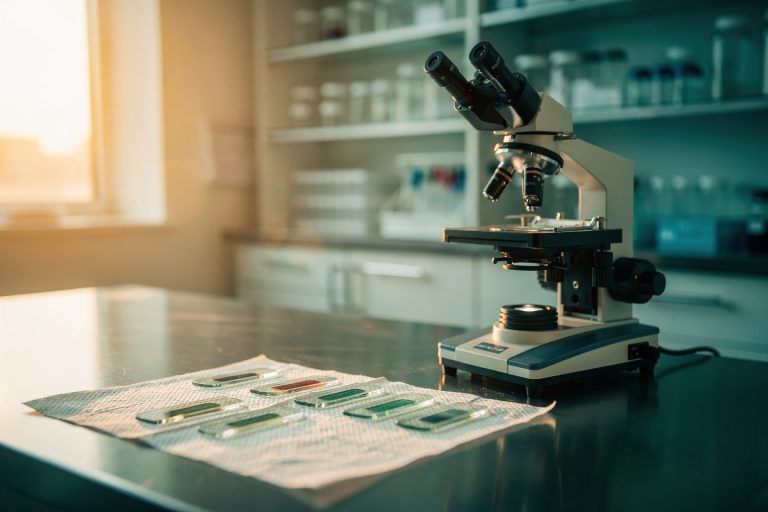
Telepathology refers to the practice of reviewing pathology material remotely using digital technology. Instead of requiring a pathologist to physically examine glass slides under a microscope in the same laboratory where the tissue was processed, telepathology allows slides to be scanned, transmitted, and reviewed electronically from another location. The technology may involve static images, live robotic microscopy, or high-resolution whole-slide imaging systems that reproduce an entire microscope slide digitally.
Modern telepathology systems allow pathologists to zoom through tissue at multiple magnifications, examine cellular detail, evaluate tissue architecture, and navigate across the slide much like they would using a traditional microscope. Telepathology is now widely used for consultation services, intraoperative frozen section support, quality assurance, tumor boards, research collaboration, and subspecialty referral review. As digital pathology technology has improved, telepathology has become increasingly integrated into mainstream pathology practice.
How Large Academic Centers Use Telepathology
Many leading academic institutions use telepathology routinely as part of modern pathology workflows. Large pathology departments at institutions such as Mayo Clinic, MD Anderson Cancer Center, and Beth Israel Deaconess Medical Center have incorporated digital pathology and telepathology systems into consultation services, multidisciplinary conferences, education programs, and diagnostic workflows.
Telepathology allows subspecialists to review cases originating from hospitals across the country or internationally without requiring immediate physical slide shipment in every situation. This can improve efficiency and help connect smaller healthcare systems with highly specialized expertise. For example, a difficult lymphoma case from a community hospital may be reviewed remotely by a hematopathology expert hundreds of miles away. A rare skin tumor may be evaluated by a dermatopathologist at a tertiary referral center without requiring the patient to travel. Academic centers also use telepathology extensively for resident training, peer review, and collaborative conferences where multiple physicians analyze pathology findings together.
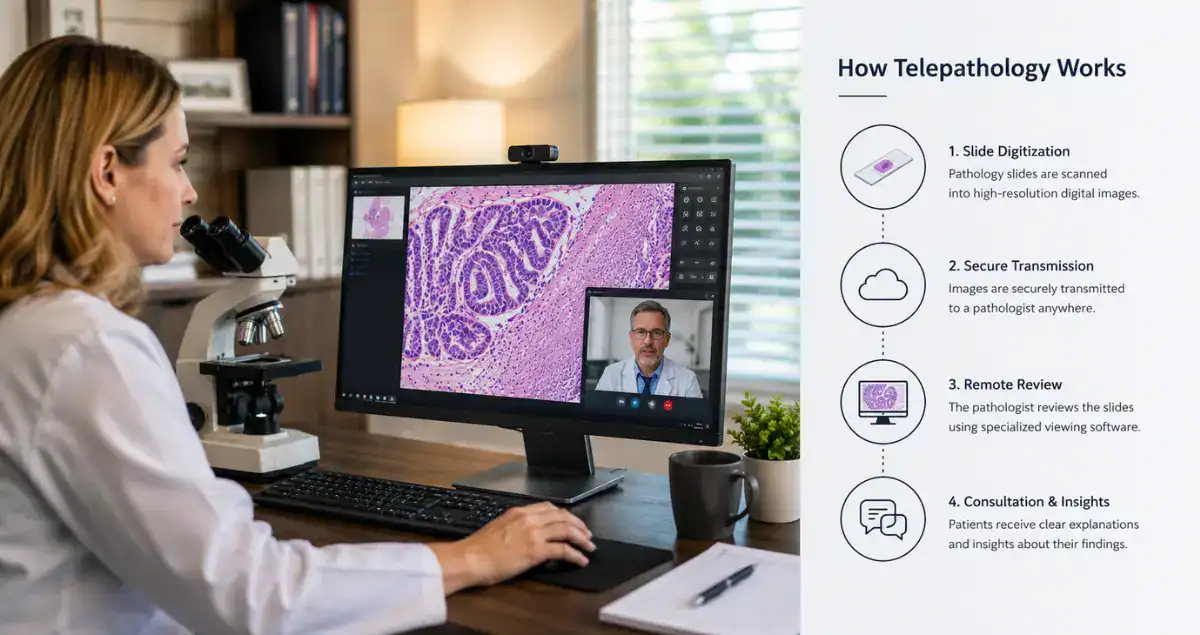
How Telepathology Works in an Honest Pathology Consultation
At Honest Pathology, telepathology is used differently from many traditional medical institutions. Conventional pathology systems are usually designed primarily for physician-to-physician communication. Patients often receive only a final pathology report filled with technical terminology and little direct explanation from the pathologist who reviewed the slides. Honest Pathology was created to help bridge that communication gap.
Using telepathology technology, pathology slides can be reviewed remotely while helping patients understand what is actually being observed under the microscope. Instead of functioning solely as an institutional referral system between hospitals, the consultation process focuses on direct patient education and observational review.
Patients often want answers to questions that standard pathology reports do not address clearly. They may want to understand why a diagnosis was made, what specific microscopic features are being evaluated, whether findings appear straightforward or borderline, and whether additional subspecialty review could be valuable. Telepathology makes this type of educational consultation possible in ways that traditional pathology workflows historically did not support, especially through accessible pathology consultation services designed to help patients better understand their diagnoses.
A First-of-Its-Kind Patient-Centered Pathology Consultation Model
Historically, very few pathology departments provided direct patient-facing consultation services. In most healthcare systems, pathology remained almost entirely invisible to patients despite being one of the most important components of diagnosis. Even major academic institutions primarily structure pathology consultations around physician referral networks rather than direct patient access.
At Honest Pathology, telepathology is being used to create a different kind of experience. Rather than limiting pathology interpretation to behind-the-scenes institutional workflows, the consultation model focuses on helping patients engage directly with their pathology information in a transparent and understandable way. This approach is unusual within pathology.
Many patients have never spoken with a pathologist before seeking consultation. Some are surprised to learn that pathologists are physicians who make many of the diagnoses that determine cancer treatment, surgery recommendations, and prognosis. By combining telepathology with direct educational consultation, Honest Pathology offers a model that differs from the traditional structure used by most hospitals and pathology departments.
Why Patients Are Interested in Telepathology
Patients increasingly want to participate more actively in medical decision-making. As access to medical records and pathology reports has expanded through online patient portals, many patients now read their biopsy reports directly and search for additional information independently. Unfortunately, pathology terminology can be highly technical and difficult to interpret without specialized training.
Telepathology consultations can help patients better understand what their pathology findings actually mean. Patients may feel more reassured when they know their slides have been reviewed carefully and explained clearly. Telepathology also expands access. Patients who live far from major academic medical centers may still be able to obtain educational pathology consultation without extensive travel or complicated referral coordination.
This is particularly important for patients with rare diagnoses, unusual pathology findings, or uncertainty about whether they should pursue a formal second opinion. Patients researching advanced diagnostic approaches may also explore topics such as how liquid biopsies show cancer progression while learning more about modern pathology technologies. At Honest Pathology, telepathology helps patients access pathology expertise in a more approachable and understandable format than has traditionally been available.
Is Telepathology Accurate?
One of the most commonly searched questions about telepathology involves accuracy. Modern telepathology systems use extremely high-resolution whole-slide imaging technology capable of reproducing remarkable microscopic detail. Numerous studies have demonstrated strong concordance between digital pathology interpretation and conventional glass slide microscopy across many pathology applications.
Large medical centers increasingly rely on telepathology because the technology has matured significantly over the past decade. Importantly, the pathologist still performs the diagnostic interpretation. Telepathology is simply the method used to review the slides remotely. At Honest Pathology, the emphasis remains on careful pathological observation and thoughtful explanation regardless of whether slides are viewed digitally or through traditional microscopy.
The Difference Between Telepathology Consultation and Formal Diagnosis
Patients should understand that telepathology itself is simply a technology platform. The legal and medical nature of a consultation depends on how the service is structured. Formal pathology second opinions involve licensed physicians issuing official diagnostic interpretations that may directly affect medical management. These services operate within specific regulatory and state licensing frameworks.
Honest Pathology consultations are structured differently. Rather than formally replacing the original pathology diagnosis, the consultation focuses on reviewing the slides, discussing observations, and helping patients understand whether further formal subspecialty review may be appropriate. For some patients, the consultation provides reassurance that the pathology findings appear straightforward. For others, observational concerns may suggest that pursuing a formal second opinion through a specialized pathology department could be beneficial. This educational and observational approach distinguishes Honest Pathology from many traditional institutional pathology consultation models.
The Future of Telepathology
Telepathology is likely to continue expanding rapidly in the coming years. Advances in digital slide scanning, artificial intelligence, cloud-based image sharing, and remote collaboration are reshaping how pathology services are delivered worldwide. Geographic barriers to subspecialty expertise are gradually becoming less significant. At the same time, patients increasingly expect greater transparency and accessibility within healthcare.
Pathology has historically remained one of the least visible medical specialties despite playing a central role in diagnosis. Telepathology creates opportunities for patients to better understand the pathology behind their medical care and participate more actively in important decisions. At Honest Pathology, telepathology is being used not simply as a technological tool, but as a way to make pathology more understandable, accessible, and patient-centered. By combining remote slide review with direct educational consultation, patients can gain clearer insight into their diagnoses and decide more confidently whether additional formal pathology review is needed.