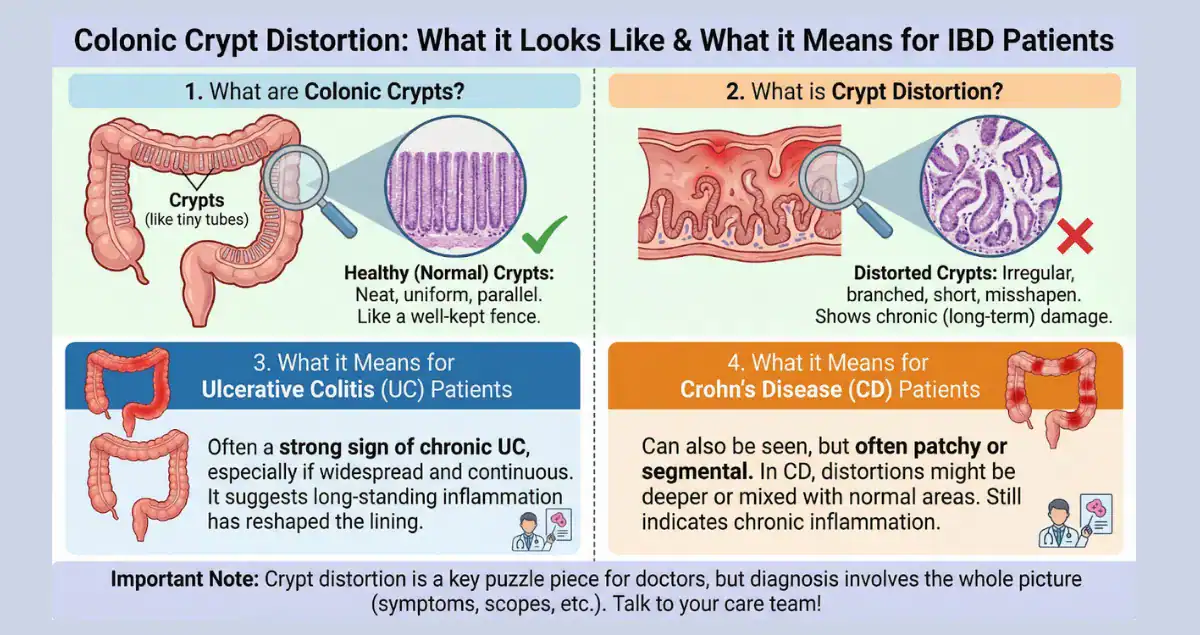
Crypt distortion on a colon biopsy is one of the most common yet often confusing findings patients encounter after colonoscopy. When the pathology report mentions irregular, branched, shortened, or budding crypts, many individuals immediately wonder whether this signals inflammatory bowel disease, a reversible change, or something more serious. Crypt distortion is a microscopic hallmark of chronic injury to the colonic mucosa, reflecting repeated cycles of inflammation and repair that alter the normal architecture of the intestinal glands. Unlike acute colitis, which shows neutrophils and surface damage without long-term structural changes, crypt distortion indicates that the injury has been ongoing for weeks to months or longer.
Honest Pathology provides expert pathology consultations that translate these technical biopsy descriptions into clear, patient-centered explanations, empowering individuals to understand their exact findings and participate confidently in decisions about diagnosis, treatment, and follow-up.
What Does Crypt Distortion Actually Look Like Under the Microscope?
In a healthy colon, crypts are straight, parallel, evenly spaced tubular glands that extend from the surface down to the muscularis mucosae. Pathologists describe them as “test-tube shaped” with uniform spacing and no branching. When crypt distortion is present, the glands appear irregular: some are shortened or atrophic, others show branching or budding, and the overall arrangement becomes haphazard.
This change is often accompanied by other chronic features such as basal plasmacytosis, increased lamina propria cellularity, or Paneth cell metaplasia in the left colon. The finding is not a diagnosis by itself but a key piece of evidence that helps pathologists classify the type of colitis. Honest Pathology consultations walk patients through their specific biopsy images or descriptions, pointing out exactly where the distortion is mild, moderate, or severe and how it fits with the rest of the microscopic picture.
Common Causes of Crypt Distortion on Colon Biopsy
Crypt distortion most frequently appears in the setting of chronic inflammatory bowel disease, but it is not limited to IBD. In ulcerative colitis, the distortion is usually diffuse and continuous from the rectum proximally, while in Crohn’s disease it tends to be patchy and can occur anywhere in the gastrointestinal tract. Other important causes include chronic infections such as unresolved bacterial colitis or parasitic disease, ischemic colitis in older adults, diversion colitis after surgical diversion of the fecal stream, radiation colitis, and medication-induced injury. Even resolving acute colitis can leave behind mild residual distortion that gradually normalizes. Patients often wonder whether the finding automatically means lifelong IBD. In many cases the answer is no; context from the entire clinical picture, including symptoms, endoscopy appearance, and additional biopsy features, is essential. Honest Pathology integrates these details during consultations to help patients see whether their crypt distortion is part of a chronic IBD pattern or a more limited, potentially reversible process.
Crypt Distortion in Inflammatory Bowel Disease
When crypt distortion occurs alongside basal plasmacytosis and architectural disarray throughout the mucosa, it strongly supports a diagnosis of chronic colitis, most commonly ulcerative colitis or Crohn’s colitis. In ulcerative colitis the changes are typically uniform and lack granulomas, whereas Crohn’s disease may show focal distortion, skip areas, and occasional granulomas. The presence of crypt distortion helps confirm that the inflammation is chronic rather than purely acute, which influences treatment decisions such as the need for maintenance therapy.
Many patients ask whether mild crypt distortion means their disease is severe. The degree of distortion correlates loosely with disease duration and severity but is only one piece of the puzzle; clinical symptoms and endoscopic findings matter just as much. Honest Pathology explains these nuances clearly, allowing patients to understand how the biopsy contributes to the overall IBD diagnosis and why certain therapies are recommended.
Non-IBD Causes of Crypt Distortion and How They Differ
Not every colon biopsy with crypt distortion represents IBD. Ischemic colitis in the elderly often shows distorted crypts with hyalinized lamina propria and withered surface epithelium, usually in the left colon. Diversion colitis produces similar architectural changes that can resolve after reanastomosis. Radiation colitis features prominent telangiectasias and atypical stromal cells alongside distortion. Chronic infections or medication effects may cause focal rather than diffuse distortion.
Pathologists look for these distinguishing clues, and the absence of diffuse basal plasmacytosis or Paneth cell metaplasia in the left colon helps steer away from IBD. Patients frequently want reassurance that their biopsy does not mean they have Crohn’s or ulcerative colitis for life. Honest Pathology highlights these differential features, giving patients a precise explanation of why their particular pattern is more consistent with a treatable or self-limited process.
Symptoms, Endoscopic Findings, and the Bigger Clinical Picture
Crypt distortion itself does not cause specific symptoms; the underlying inflammation does. Patients may experience diarrhea, rectal bleeding, abdominal pain, or urgency, but many with mild distortion are asymptomatic and discovered incidentally. Colonoscopy may show loss of vascular pattern, friability, or ulcers in active disease, yet biopsies with crypt distortion can come from endoscopically normal-appearing areas in quiescent IBD.
The combination of clinical history, endoscopic appearance, and histology gives the most accurate diagnosis. Honest Pathology consultations place the biopsy findings in this broader context, helping patients connect what they feel, what the doctor saw, and what the slides reveal.
Prognosis and Long-Term Implications of Crypt Distortion
The long-term outlook depends entirely on the underlying cause. In non-IBD settings such as ischemia or diversion, crypt distortion can improve or resolve once the trigger is corrected. In well-controlled IBD, the architectural changes usually persist but do not necessarily worsen if inflammation is suppressed. Long-standing, uncontrolled chronic colitis does carry a modestly increased risk of colorectal cancer over decades, primarily related to the duration and extent of inflammation rather than crypt distortion alone.
Regular surveillance colonoscopy is therefore recommended for patients with extensive IBD of more than eight to ten years’ duration. Patients often worry whether crypt distortion means their risk is immediately elevated. In most cases the answer is reassuring: with proper treatment and monitoring, the vast majority of individuals maintain excellent long-term health. Honest Pathology helps by clarifying whether the biopsy shows active inflammation alongside distortion or quiescent changes, guiding expectations about cancer surveillance needs.
How Honest Pathology Empowers Patients Facing Crypt Distortion Findings
A pathology report that includes “crypt distortion,” “architectural irregularity,” or “chronic colitis” can feel vague or alarming without expert interpretation. Honest Pathology specializes in patient-focused consultations that break down every detail of the report: the severity and distribution of the distortion, the presence or absence of other chronic features, and how these findings align with possible diagnoses. Patients leave the consultation with a clear understanding of whether their biopsy points toward IBD, a self-limited process, or something in between, along with practical questions to ask their gastroenterologist about treatment, monitoring, and lifestyle adjustments. This level of insight turns a confusing report into actionable knowledge, reducing anxiety and fostering a sense of control over the next steps in care.
Crypt distortion on colon biopsy is a common histologic clue to chronic mucosal injury rather than a standalone disease. Whether it reflects inflammatory bowel disease, a resolving infection, ischemia, or another process, the finding provides valuable information that guides management when placed in full clinical context. Through expert pathology consultations, Honest Pathology ensures patients receive straightforward explanations of their biopsy results, realistic prognostic information, and the confidence to engage actively with their healthcare team. By understanding exactly what crypt distortion means in their specific case, individuals can move forward with clarity, appropriate treatment, and peace of mind about their colon health.