
One of the first reactions many patients have after reading a pathology report is panic. A patient sees unfamiliar medical language describing a biopsy, cancer diagnosis, or surgical specimen and immediately begins searching online for answers. Within minutes, they are asking themselves whether they need an urgent pathology second opinion.
This response is understandable. Pathology reports often contain highly technical terminology that can sound frightening without context. Words like “poorly differentiated,” “invasive,” “metastatic,” “positive lymph nodes,” or “lymphovascular invasion” can create enormous anxiety when patients encounter them for the first time.
At HONEST Pathology, we frequently speak with patients who are convinced they urgently need another pathologist to review their diagnosis. But after discussing the report carefully, many discover that the primary issue is not that the diagnosis is unclear or likely incorrect. The issue is that no one has fully explained what the pathology report means.
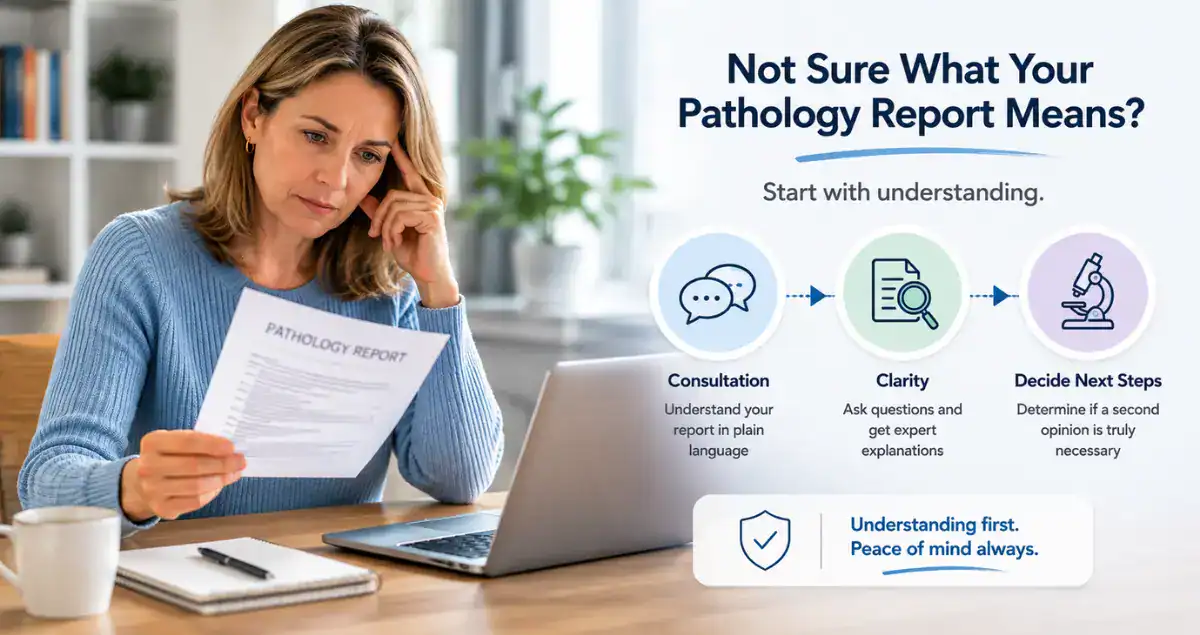
In many situations, what patients truly need first is a pathology consultation service focused on understanding the report rather than immediately pursuing a formal pathology second opinion. That distinction is important because pathology consultations and pathology second opinions serve very different purposes.
Understanding the Difference Between a Consultation and a Second Opinion
A pathology second opinion involves another pathologist formally reviewing biopsy slides, tissue samples, and supporting studies to determine whether they agree with the original diagnosis. This process can be extremely valuable in complex or uncertain cases, especially involving rare tumors, borderline findings, or unusual pathology interpretations.
A pathology consultation at HONEST Pathology is different. The consultation is educational and patient-centered. Its purpose is to help patients understand their pathology report in clear language, reduce confusion, identify meaningful questions for their healthcare team, and clarify whether a formal second opinion may actually be necessary. In many cases, patients initially believe they need an urgent second opinion simply because they do not yet understand the terminology used in the report.
For example, a patient with breast cancer may read “invasive ductal carcinoma, grade 2, estrogen receptor positive, HER2 negative” and assume the wording itself suggests uncertainty or severe disease progression. In reality, this may represent a very common and straightforward breast cancer diagnosis with clearly established treatment pathways.
A patient with colon cancer may panic after reading about lymph node involvement or tumor invasion into surrounding tissue because the staging terminology sounds alarming without explanation. A patient with lung cancer may see molecular testing results or immunohistochemical stains and mistakenly believe the diagnosis is questionable or disputed. These situations often benefit enormously from a pathology consultation before pursuing an urgent second opinion.
When a Pathology Consultation Can Be More Helpful
At HONEST Pathology, we help patients understand which findings are routine parts of pathology reporting and which findings may truly warrant additional review. Once patients better understand the report, many feel more confident moving forward with their existing healthcare team.
Importantly, a pathology consultation does not discourage second opinions when they are genuinely appropriate. In fact, one of the valuable aspects of speaking directly with a pathologist is that the consultation itself may help clarify whether a formal second opinion should be pursued. There are absolutely situations where additional pathology review can be important.
If the pathology diagnosis is described as uncertain, indeterminate, or difficult to classify, a second opinion may be very reasonable. Rare cancers, unusual tumor subtypes, borderline lesions, conflicting pathology findings, or disagreement between imaging and pathology may all justify additional review by another pathology specialist.
For example, distinctions between atypical ductal hyperplasia and ductal carcinoma in situ in breast pathology can sometimes be subtle. Certain rare lung tumors may require subspecialty review. Complex gastrointestinal biopsies involving dysplasia or unusual inflammatory conditions may occasionally benefit from expert gastrointestinal pathology consultation. But many patients seeking urgent second opinions are not actually facing those kinds of diagnostic uncertainties. Instead, they are confronting something else entirely: confusion, fear, and lack of explanation.
Why Modern Pathology Reports Create Anxiety
Modern healthcare systems increasingly give patients immediate access to pathology reports through online portals, often before they have spoken with their physician. Patients may receive emotionally overwhelming information late at night, over weekends, or between appointments. They begin searching online and quickly encounter worst-case scenarios or misleading interpretations of isolated pathology terms.
Without context, even standard pathology language can feel catastrophic. At HONEST Pathology, we believe patients deserve the opportunity to understand their diagnosis before assuming the diagnosis itself is incorrect. A pathology consultation creates space for that understanding.
Patients are able to ask questions directly to a board-certified pathologist who can explain terminology, staging, grading, biomarkers, margins, lymph node findings, and other pathology concepts in plain language. The consultation helps patients understand not only what the report says but also which parts are clinically important and which terms may sound more alarming than they truly are. This process often dramatically reduces anxiety.
Patients frequently realize that what initially sounded terrifying or uncertain is actually a routine descriptive component of pathology reporting. They also gain practical guidance on what questions to bring to their oncologist, surgeon, dermatologist, gastroenterologist, or primary physician. In that sense, the pathology consultation becomes an empowering step rather than a reaction driven purely by fear.
When a Second Opinion May Truly Be Necessary
Another important reality is that formal pathology second opinions can take time, involve additional coordination, and sometimes create unnecessary delays if pursued reflexively without first understanding the original diagnosis. Patients may feel pressured to urgently “double-check everything” before they have even had the opportunity to fully discuss the pathology findings with their treating physicians.
At HONEST Pathology, we encourage patients to first understand what the report is actually saying. That understanding often helps clarify whether additional pathology review is likely to provide meaningful benefit.
Sometimes the answer is yes. Sometimes a consultation reveals legitimate reasons why another pathology review could be valuable. But many times, patients leave the consultation realizing that their diagnosis is already clear and well-supported and that what they truly needed was education and context.
This distinction matters because pathology reports guide major treatment decisions. Patients deserve to understand the information shaping those decisions. They also deserve to know when additional review is likely to be helpful versus when fear and unfamiliar terminology are driving unnecessary panic.
Helping Patients Make More Informed Decisions
At HONEST Pathology, our goal is not to replace a patient’s healthcare team or automatically recommend second opinions. Our goal is to help patients understand their pathology findings clearly enough to make more informed decisions about next steps.
That may include helping patients recognize that a formal second opinion would provide reassurance or diagnostic clarification. It may also include helping patients realize that their pathology report is straightforward and that the most important next step is discussing treatment planning with their physicians.
Patients should not feel embarrassed for wanting to understand their pathology report more fully. Receiving a cancer diagnosis or abnormal biopsy result is one of the most stressful experiences many people will ever face. Seeking clarity is reasonable, responsible, and important. At HONEST Pathology, we believe understanding should come before panic.
If you have received a pathology report and are wondering whether you urgently need a pathology second opinion, a pathology consultation may be the best first step. Understanding your diagnosis more clearly can reduce anxiety, improve communication with your healthcare team, and help determine whether additional pathology review is truly necessary. Patients who are still waiting for results may also benefit from understanding why a pathology report is delayed so they can better navigate the waiting process. Because sometimes what patients need most is not another diagnosis. It is a clearer understanding of the diagnosis they already have.