
When patients receive a pathology report, they are often told that the diagnosis is definitive and final. In reality, pathology is a highly specialized field of medicine, and not every pathologist has the same level of expertise in every disease type. Choosing the right specialist for a pathology consultation can make a meaningful difference in diagnosis accuracy, treatment planning, and peace of mind.
At Honest Pathology, patients frequently ask an important question: how do you know whether the pathologist reviewing your case is truly the right expert for your specific diagnosis? The answer involves understanding subspecialty expertise, state licensing requirements, communication style, and the difference between a general review and a formal second opinion. This article explains how patients can evaluate pathology consultation services and choose the right specialist for their case.
Why Pathology Expertise Matters
Pathology is the foundation of modern medical diagnosis. Treatment decisions for cancer, inflammatory diseases, infections, and many autoimmune conditions often depend entirely on what a pathologist sees under the microscope. However, pathology is not a one-size-fits-all specialty. A pathologist who spends most of their career reviewing skin biopsies may not have the same depth of experience interpreting prostate cancer or lymphoma specimens. Likewise, a physician who specializes in gastrointestinal pathology may recognize subtle features in colon biopsies that a general pathologist encounters only occasionally.
Medicine has become increasingly subspecialized because diseases themselves are increasingly complex. Modern pathology involves molecular testing, immunohistochemistry, genetic markers, staging systems, and rapidly evolving diagnostic criteria. Choosing the right pathology consultant means finding someone whose daily practice aligns closely with the disease process being reviewed. At Honest Pathology, consultations are approached from the perspective that patients deserve access to subspecialty expertise rather than generic reassurance. Patients are often surprised to learn that even highly experienced physicians routinely seek second opinions from subspecialists when confronted with difficult or unusual cases.
Understanding Pathology Subspecialties
Many patients assume all pathologists review all types of tissue equally. In practice, pathology is divided into highly focused areas of expertise. Breast pathology specialists concentrate on conditions such as ductal carcinoma in situ, invasive breast carcinoma, atypical hyperplasia, and hormone receptor interpretation. Gastrointestinal pathologists focus on diseases of the colon, stomach, pancreas, and liver.
Hematopathologists specialize in leukemia, lymphoma, and bone marrow disorders. Dermatopathologists evaluate skin biopsies and melanocytic lesions. Even within cancer pathology, expertise varies considerably. A lung pathology specialist may spend years refining their understanding of tiny distinctions between adenocarcinoma subtypes that directly influence targeted therapy eligibility. A neuropathologist may focus almost exclusively on tumors of the brain and spinal cord.
This level of specialization matters because diagnostic disagreement in pathology is not rare. Studies have repeatedly shown that second opinions can occasionally change diagnoses, tumor grading, staging, or treatment recommendations. Some discrepancies are minor, while others may significantly alter management decisions. Choosing a consultant with disease-specific expertise increases the likelihood that the review will incorporate the latest diagnostic standards and nuanced interpretation.
The Importance of State Licensing in Pathology Consultations
One of the least understood aspects of pathology consultations is physician licensing. In the United States, physicians are licensed on a state-by-state basis. This means a pathologist practicing medicine for patients in one state may need medical licensure in that state depending on the type of consultation being provided. This issue becomes particularly important in virtual pathology consultations and online second opinion services.
Patients should understand that there is a difference between educational pathology review and formal medical diagnosis. A formal second pathology opinion that directly contributes to patient care may require the consulting physician to hold appropriate licensure depending on the patient’s location, the nature of the consultation, and applicable state medical board regulations.
At Honest Pathology, licensing and regulatory compliance are taken seriously because pathology consultations exist within a legal and ethical medical framework. Patients should be cautious of online services that appear vague about physician credentials, licensing status, or the legal nature of their consultations. Transparency matters. Patients have the right to know who is reviewing their pathology, what their qualifications are, and whether the consultation constitutes formal medical practice under state law.
Questions Patients Should Ask Before Choosing a Pathology Consultant
Patients often feel uncomfortable asking physicians detailed credentialing questions. In pathology consultation, these questions are entirely appropriate. One of the most important questions is whether the pathologist regularly interprets the specific disease being reviewed. Experience matters far more than broad claims of expertise. Patients should also ask whether the physician is board certified in pathology and whether they have fellowship training in a relevant subspecialty. Fellowship training represents advanced focused education beyond residency and often reflects concentrated expertise in a disease category.
Another important consideration is whether the consultant personally reviews the original pathology slides. Some services only review reports rather than microscopic material. While report reviews may provide educational value, direct slide review generally offers a much deeper level of diagnostic assessment. Patients should also understand whether ancillary studies such as immunohistochemistry or molecular testing are being considered. Modern pathology increasingly relies on these tools, especially in cancer diagnosis. At Honest Pathology, the emphasis is placed on thoughtful interpretation rather than rushed volume-based review. Patients deserve clarity about what is actually being analyzed during the consultation process.
Why Communication Skills Matter in Pathology Consultation
Pathologists traditionally work behind the scenes, often with little direct patient interaction. As pathology consultation services become more patient-facing, communication has become increasingly important. A highly knowledgeable specialist who cannot explain findings clearly may leave patients feeling more anxious and confused than before. The best pathology consultants can translate highly technical diagnostic language into understandable information without oversimplifying medical reality.
Patients should look for specialists who are willing to explain uncertainty honestly. Not every pathology case has absolute black-and-white answers. In some situations, diagnoses involve borderline findings, overlapping features, or evolving classification systems. Trustworthy consultants acknowledge limitations openly rather than projecting false certainty.
At Honest Pathology, consultations are designed to help patients understand what their pathology actually means. Patients often say they have never previously had a physician explain their pathology report in plain language. That educational component can be incredibly valuable during stressful medical situations.
Red Flags When Evaluating Online Pathology Services
As virtual medical services expand, pathology consultation websites have become increasingly common. Not all services operate with the same level of rigor or transparency. Patients should be cautious of services that promise guaranteed diagnostic changes or imply that most pathology diagnoses are incorrect. Ethical pathology consultation focuses on careful review, not sensationalism.
Another warning sign is lack of transparency regarding physician identity or qualifications. Patients should be able to identify who is reviewing their case and verify their credentials. Websites that fail to discuss licensing considerations may also warrant caution. Legitimate medical consultation services recognize the importance of regulatory compliance.
Patients should additionally be wary of services that provide overly simplistic interpretations without reviewing actual pathology slides. Reports alone do not always capture the complexity of microscopic findings. At Honest Pathology, the philosophy centers on realistic, evidence-based consultation rather than dramatic promises. Patients researching when an expert pathology review may be needed should focus on services that prioritize transparency, diagnostic accuracy, and patient education.
The Difference Between a General Pathologist and a Subspecialty Expert
General pathologists play an essential role in healthcare and diagnose the vast majority of routine cases accurately. However, complex or rare diagnoses may benefit from subspecialty review. For example, distinguishing atypical ductal hyperplasia from low-grade ductal carcinoma in situ in the breast can occasionally involve subtle criteria that dedicated breast pathologists interpret frequently. Certain soft tissue tumors may require advanced expertise and ancillary testing unavailable in smaller practice settings.
Subspecialists often participate in national conferences, publish research, contribute to diagnostic guidelines, and review high volumes of narrowly focused cases. That concentrated experience can improve recognition of rare patterns or newly defined disease entities. Patients should not view subspecialty consultation as criticism of their original pathologist. Medicine routinely incorporates second opinions in challenging situations. In pathology, collaborative review is often considered good medical practice.
How Pathology Consultation Can Affect Treatment Decisions
Pathology drives many major treatment decisions in medicine. In cancer care, pathology determines whether a tumor is benign or malignant, how aggressive it appears, whether lymph nodes are involved, and which biomarkers are present. A change in tumor grade, stage, or subtype can potentially influence surgery recommendations, chemotherapy decisions, radiation planning, or eligibility for targeted therapies.
Even non-cancer diagnoses may affect major medical decisions. Inflammatory bowel disease classifications, autoimmune disorders, kidney biopsies, and dermatologic conditions can all involve nuanced pathological interpretation. For this reason, patients should approach pathology consultation thoughtfully rather than viewing it as merely administrative paperwork. Choosing the right specialist means choosing someone capable of recognizing clinically meaningful details. At Honest Pathology, the goal is not simply to repeat a diagnosis but to provide patients with a deeper understanding of the pathology underlying their medical care.
Choosing a Pathologist Patients Can Trust
Trust is central to pathology consultation. Patients facing serious diagnoses are often overwhelmed by uncertainty. The right pathology consultant combines scientific expertise with honesty, transparency, and careful communication. Patients should look for consultants who explain their credentials clearly, discuss limitations openly, and prioritize patient understanding over marketing language. A trustworthy pathology specialist recognizes that every slide represents a real person making important medical decisions.
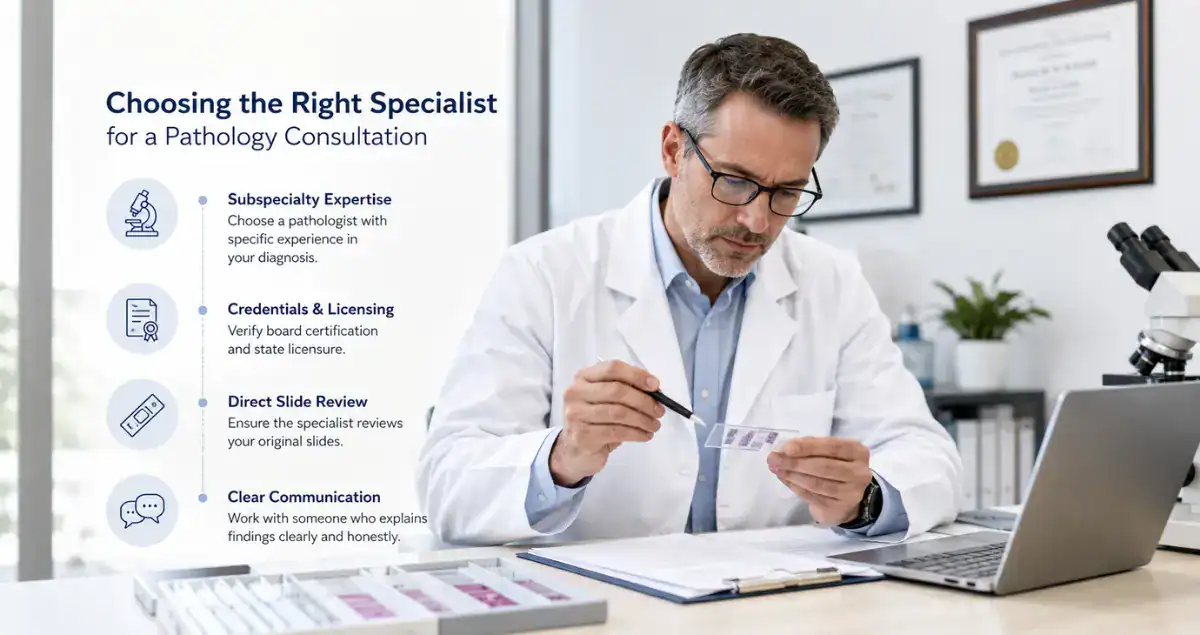
Licensing compliance, subspecialty expertise, direct slide review, and patient communication all matter when selecting a pathology consultant. These factors help distinguish meaningful pathology consultation from superficial review services. As pathology becomes increasingly accessible through virtual consultation platforms, patients now have more opportunities than ever to seek specialized expertise. Choosing wisely can provide reassurance, clarification, and sometimes critically important diagnostic insight. At Honest Pathology, the belief is simple: patients deserve accurate information, honest interpretation, and access to qualified pathology expertise when it matters most.