When patients receive a pathology diagnosis, two common options often come up if there is uncertainty or a desire for clarity: obtaining a formal second opinion or scheduling a pathology report review consultation. While these may sound similar, they serve very different purposes and involve very different processes.
At Honest Pathology, we help patients understand this distinction clearly so they can choose the option that best fits their needs. In many cases, what patients actually need is not a full re-evaluation of tissue, but a clear explanation of their existing pathology report.
Understanding the difference between these two approaches can save time, reduce confusion, and help you move forward with confidence.
What a Formal Second Opinion Involves
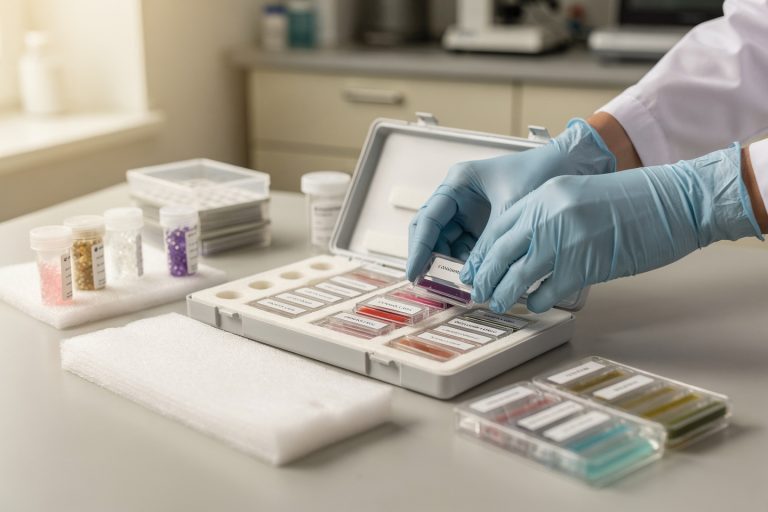
A formal pathology second opinion is a diagnostic process. It is used when another pathologist re-examines your original tissue samples, known as pathology slides, to independently evaluate the diagnosis.
This process typically involves your original healthcare provider or hospital sending physical slides (or digital equivalents) to another pathology laboratory. The reviewing pathologist then examines the tissue under a microscope and issues a new or confirmed diagnostic report.
Because this involves direct re-analysis of biological material, a formal second opinion is part of the diagnostic pathway in clinical medicine. It is often used in more complex, unusual, or high-stakes cases where confirmation or revision of the diagnosis may be necessary.
This process is medical in nature and may take time, coordination between institutions, and formal clinical documentation.
What an Honest Pathology Consultation Is
An Honest Pathology consultation is different in purpose and scope. It is not a diagnostic re-evaluation. Instead, it is a pathology report review consultation designed to help you understand your existing diagnosis.
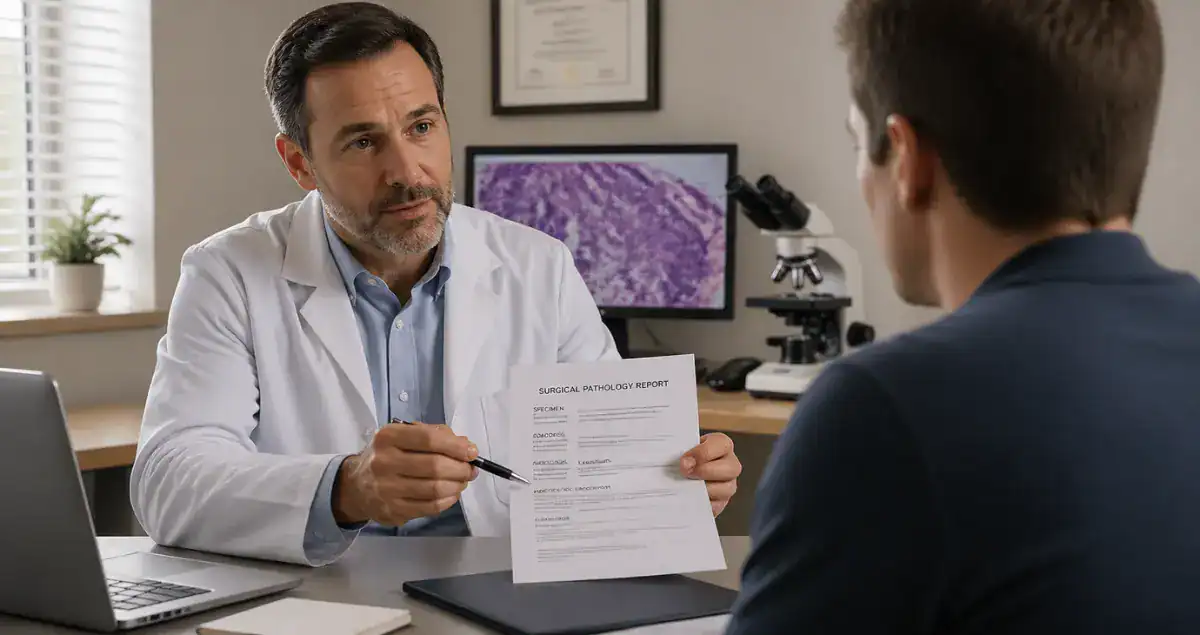
In this setting, you provide your finalized pathology report, and a board-certified pathologist explains it to you in clear, accessible language. The focus is on education, clarity, and patient understanding.
There is no re-examination of slides, no new laboratory testing, and no change to the original diagnosis. The goal is to help you fully understand what your report already says.
This makes the process faster, more accessible, and centered on communication rather than diagnostic repetition.
The Key Difference: Re-Analysis vs. Explanation
The most important distinction between these two options is what is being done with your pathology information.
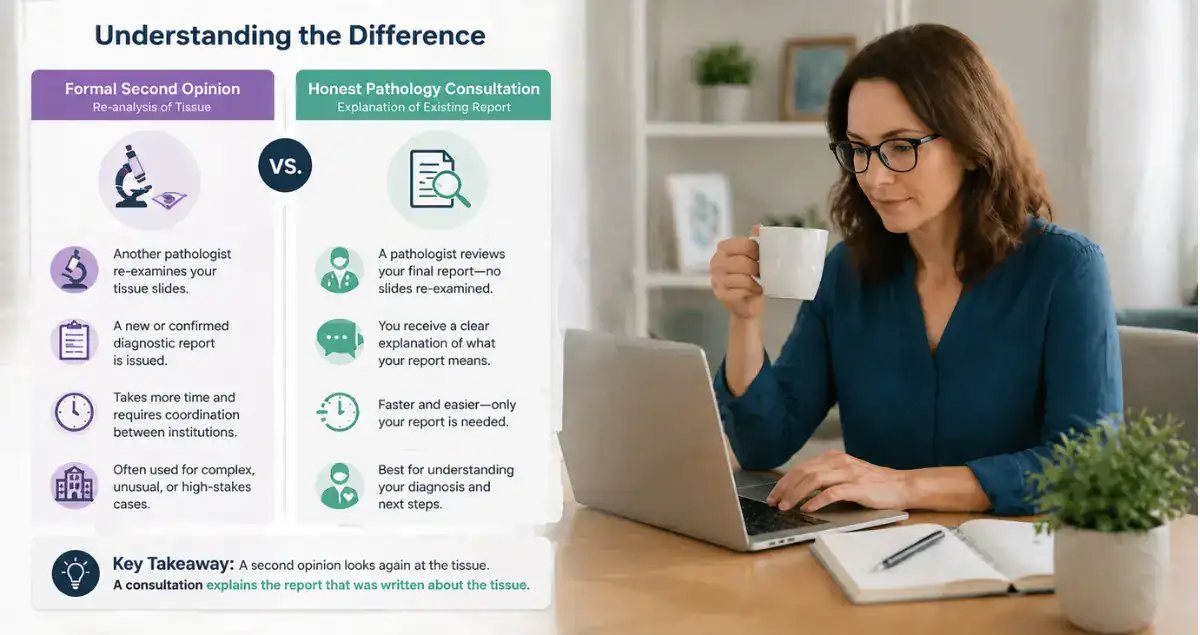
A formal second opinion involves re-analyzing the original tissue under a microscope. It is a second diagnostic interpretation of the physical specimen.
An Honest Pathology consultation involves explaining the existing written report that was already generated from that analysis.
In simple terms, a second opinion looks again at the tissue. A pathology consultation explains the report that was written about the tissue.
Both are valid medical services, but they serve different purposes depending on what the patient needs.
When a Formal Second Opinion Is Typically Used
A formal second opinion is usually considered when there is uncertainty about the diagnosis itself or when the pathology findings may significantly impact treatment decisions.
This may include cases where the diagnosis is rare, complex, or controversial, or where additional microscopic evaluation could potentially change the interpretation.
It may also be used when treating physicians specifically request a re-review of tissue samples as part of clinical decision-making.
Because it involves full diagnostic reassessment, it is a more resource-intensive process that requires coordination between medical institutions.
When an Honest Pathology Consultation Is Most Helpful
An Honest Pathology consultation is most helpful when the diagnosis itself is already established, but the patient needs clarity in understanding what the report means.
Many patients fall into this category. They already have a pathology report but are unsure how to interpret the language, what the findings mean, or how serious certain terms are.
In these cases, what is missing is not a new diagnosis, but a clear explanation of the existing one.
The consultation provides that explanation directly from a board-certified pathologist, helping patients understand their results without needing to initiate a full diagnostic review process.
Access and Practical Differences
There are also important practical differences between the two approaches.
A formal second opinion typically requires obtaining original pathology slides from a hospital or laboratory, arranging transfer to another pathology service, and waiting for a new diagnostic report to be completed.
An Honest Pathology consultation requires only your pathology report. There is no need to obtain slides, coordinate with institutions, or manage physical specimen transfers.
This makes the consultation process significantly faster and more accessible for patients who primarily want clarity rather than diagnostic re-evaluation.
The Role of the Pathologist in Each Process
In a formal second opinion, the pathologist acts as an independent diagnostician. Their role is to examine tissue and determine whether the original diagnosis should be confirmed or modified.
In an Honest Pathology consultation, the pathologist acts as an interpreter and educator. Their role is to explain the existing diagnosis in detail and ensure the patient understands what it means.
Both roles require the same level of medical expertise, but they are applied in very different ways.
One focuses on making a diagnosis. The other focuses on making that diagnosis understandable.
Why Patients Often Confuse the Two
It is common for patients to assume that any pathology-related service must involve re-examining slides or changing a diagnosis.
In reality, many patients simply need help understanding their report rather than repeating the diagnostic process.
Because pathology reports are written in technical medical language, they can be difficult to interpret without guidance. This often leads patients to seek second opinions when what they actually need is clarification.
Honest Pathology helps bridge that gap by offering a service focused entirely on understanding rather than re-analysis.
How Honest Pathology Helps You Decide if a Second Opinion Is Needed
In many cases, a pathology report review consultation can help determine whether a formal second opinion is even necessary. This is closely related to the idea of a pathology consultation vs second opinion, where understanding the report comes before deciding on further steps.
During your consultation, the pathologist explains your report in detail and helps identify whether the findings are straightforward or complex.
If the diagnosis is clear and well-established, you may feel reassured that a second opinion is not needed. If there are elements that suggest complexity or uncertainty, you may be advised that further review could be appropriate.
This helps you make an informed decision rather than pursuing additional testing without clarity.
Two Different Goals, Two Different Services
Ultimately, the difference between a formal second opinion and an Honest Pathology consultation comes down to purpose.
A formal second opinion is about diagnostic confirmation or re-evaluation. It is part of the clinical diagnostic process and involves direct analysis of tissue samples.
An Honest Pathology consultation is about understanding. It is an educational service that helps you interpret an already completed pathology report, as also discussed in our guide on when a second opinion is needed.
Both are valuable, but they are not interchangeable.
Final Thoughts: Choosing the Right Path for Clarity
Facing a pathology diagnosis can be overwhelming, and it is natural to question whether you need further testing or a second opinion.
Understanding the difference between these two options can help you make a more informed decision.
At Honest Pathology, we focus on helping patients understand their existing pathology reports clearly and confidently. For many patients, that clarity is exactly what they need to move forward without unnecessary complexity.
And when a formal second opinion is truly needed, understanding your report first can help you pursue it with greater purpose and direction.
Because in the end, the most important step is not just getting another answer—it is understanding the one you already have.