Hearing the words “skin biopsy” and “cancer” in the same sentence can be stressful. For many people, the biggest question after a biopsy is simple: do skin biopsies rule out cancer and does this result mean I’m in the clear?
At Honest Pathology, we regularly review pathology reports with patients who are trying to understand exactly that. Skin biopsies are one of the most important tools in diagnosing skin cancer, but like any medical test, they have limits. Knowing what they can and cannot tell you is key to feeling confident about your next steps.
How a Skin Biopsy Checks for Cancer
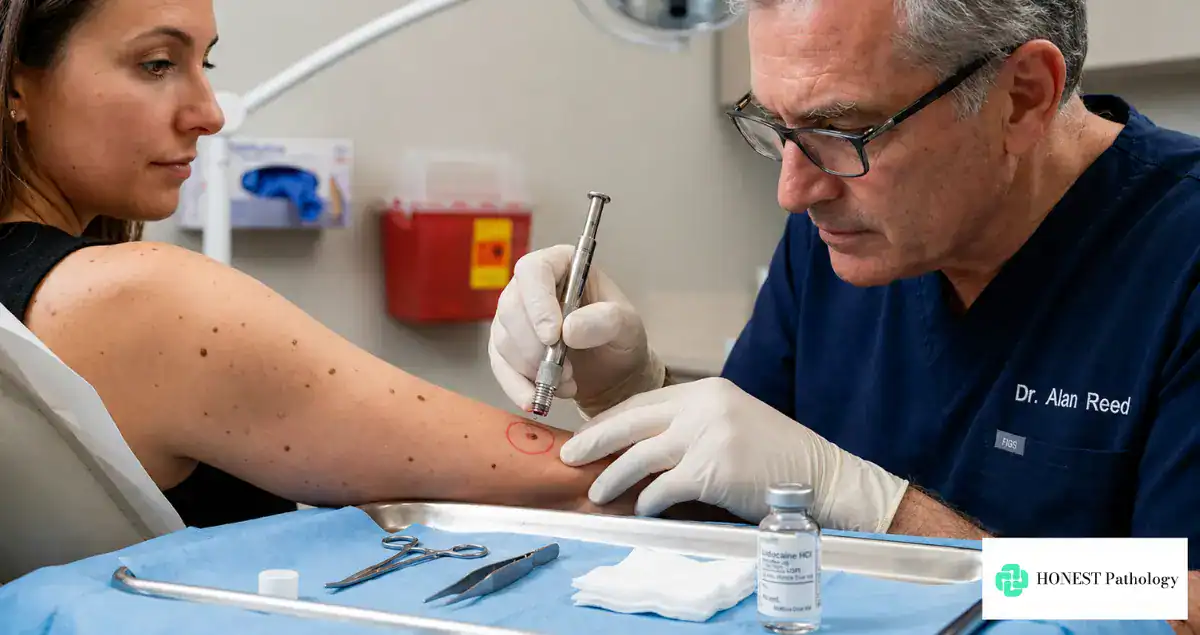
A skin biopsy is a procedure where a small piece of skin is removed and examined under a microscope. This allows a pathologist to look directly at the cells and determine whether they are normal, precancerous, or cancerous.
Different types of biopsies may be used depending on the situation. Sometimes only the top layers of skin are sampled, while in other cases a deeper portion is removed. The goal is to capture the area that looks most suspicious so it can be evaluated as accurately as possible.
Under the microscope, pathologists assess how the cells are arranged, how they look, and whether they show signs of abnormal growth. This is how skin cancers are identified and classified.
The Three Most Common Skin Cancers
When people are worried about skin cancer, they are usually referring to one of three types: basal cell carcinoma, squamous cell carcinoma, and melanoma. Each behaves differently, and each has its own features both on the skin and under the microscope.
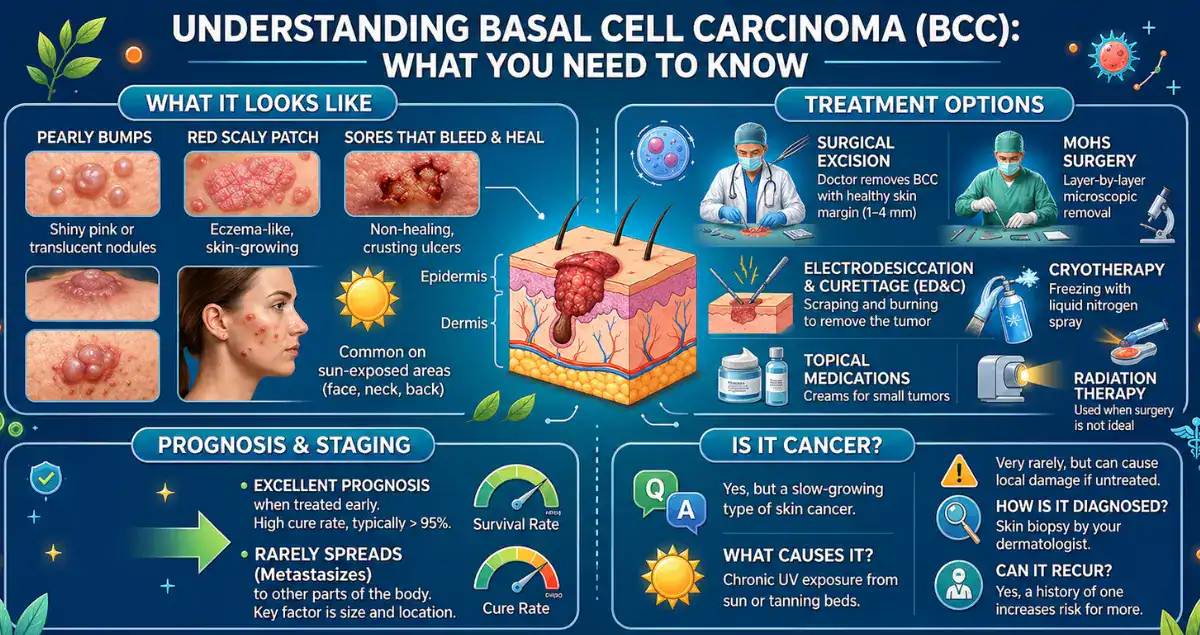
Basal cell carcinoma is the most common and tends to grow slowly. It often appears as a pearly bump or a sore that doesn’t heal. Squamous cell carcinoma may look like a scaly patch or a firm red bump and can grow more quickly. Melanoma is less common but more serious, often appearing as a dark or irregular mole that changes over time.
A biopsy is the gold standard for diagnosing all three. But the question many people are really asking is whether a biopsy can completely rule them out.
Does a Biopsy Always Rule Out Basal Cell Carcinoma?
In most cases, a properly performed biopsy is very good at detecting basal cell carcinoma. If the suspicious area is adequately sampled, the characteristic features are usually easy to recognize under the microscope.
However, no test is perfect. If the biopsy does not capture the part of the lesion that contains cancer cells, the result could come back as benign even if cancer is present nearby. This is sometimes referred to as a sampling issue.
This is why clinical judgment still matters. If a spot continues to look concerning or does not heal as expected, further evaluation may be needed, even after a negative biopsy.
What About Squamous Cell Carcinoma?
The same general principle applies to squamous cell carcinoma. Biopsies are highly effective at identifying it when the right area is sampled.
That said, squamous cell carcinoma can sometimes develop in areas of sun-damaged skin or precancerous changes, which may not be uniform throughout the lesion. A superficial biopsy or limited or suboptimal tissue sample might pick up early or less concerning changes while missing a deeper or more aggressive component.
This doesn’t mean biopsies are unreliable. It simply highlights that they provide information about the tissue that was actually sampled. If the clinical picture and the pathology report don’t fully match, follow-up is often recommended.
Can a Biopsy Miss Melanoma?
Melanoma is the skin cancer people tend to worry about most, and for good reason. It can behave more aggressively than other types.
Biopsies are very effective at diagnosing melanoma when the lesion is fully or adequately sampled. In many cases, dermatologists aim to remove the entire suspicious mole so it can be evaluated completely.
However, if only part of a lesion is biopsied and the most abnormal area is not included, there is a small chance that melanoma could be missed. This is why choosing the right biopsy technique and site is especially important when melanoma is a concern.
Changes over time also matter. If a mole continues to evolve after a benign biopsy result, it should be re-evaluated.
Why Results Don’t Always Feel Definitive
One of the most common frustrations we see at Honest Pathology is that patients expect a biopsy to give a simple yes-or-no answer. While it often does, there are situations where the results are more nuanced.
A report might describe a lesion as benign but include notes about inflammation, atypical features, or limited sampling. These details can be confusing without context, and they may raise questions about how confident the result really is.
The key is understanding that a biopsy reflects the specific piece of tissue that was examined. It is a powerful tool, but it is still one part of a larger clinical picture.
The Questions Most People Are Really Asking
Most people don’t just want to know what the report says. They want to know what it means for their health.
They want reassurance that cancer has truly been ruled out. They want to know whether they can stop worrying or if they need to keep watching the area. They want to understand why a biopsy might be repeated or why a lesion might still be removed even after a benign result.
These are valid questions, and they don’t always have one-size-fits-all answers. The level of certainty depends on factors like the type of biopsy, the size and location of the lesion, and whether the clinical appearance matches the pathology findings.
When to Consider Follow-Up
Even with a benign biopsy result, follow-up may be recommended in certain situations. If a lesion doesn’t heal, continues to grow, or changes in appearance, it’s worth taking another look.
Doctors may also recommend complete removal of a lesion if there is any uncertainty or if the biopsy only sampled part of it. This is especially common when melanoma is being considered.
The goal is not to create unnecessary worry, but to make sure nothing important is missed.
Understanding Your Report Brings Peace of Mind
A skin biopsy is one of the best tools we have for evaluating skin cancer, and in most cases, it provides clear and reliable answers. But understanding its limits is just as important as understanding its strengths.
At Honest Pathology, we focus on helping you make sense of your pathology report in plain language. We don’t change or reinterpret your diagnosis, but we do help you understand what the findings mean, how certain they are, and what questions you may want to ask your doctor next.
Because when you understand how your biopsy works and what your results truly say, you’re no longer left guessing. You’re equipped to move forward with clarity and confidence.