Pathology reports frequently determine the course of serious medical conditions, including cancer diagnoses and other complex diseases. When uncertainty arises, patients and physicians often seek formal second opinions. A key question emerges: should these formal second opinions be handled by a general pathologist or a subspecialist? Expert consensus and clinical evidence strongly support specialist involvement for the most accurate and clinically meaningful reviews. This article examines the role of specialists in formal pathology second opinions, common pathology subspecialties, and important considerations including state licensing requirements.
The Critical Need for Specialist Expertise in Formal Second Opinions
Formal second opinions involve sending original pathology slides, blocks, and reports to an independent pathologist or institution for a complete, documented reinterpretation. This process goes beyond informal discussions and produces an official report that can directly influence treatment decisions, surgical planning, and prognosis discussions.
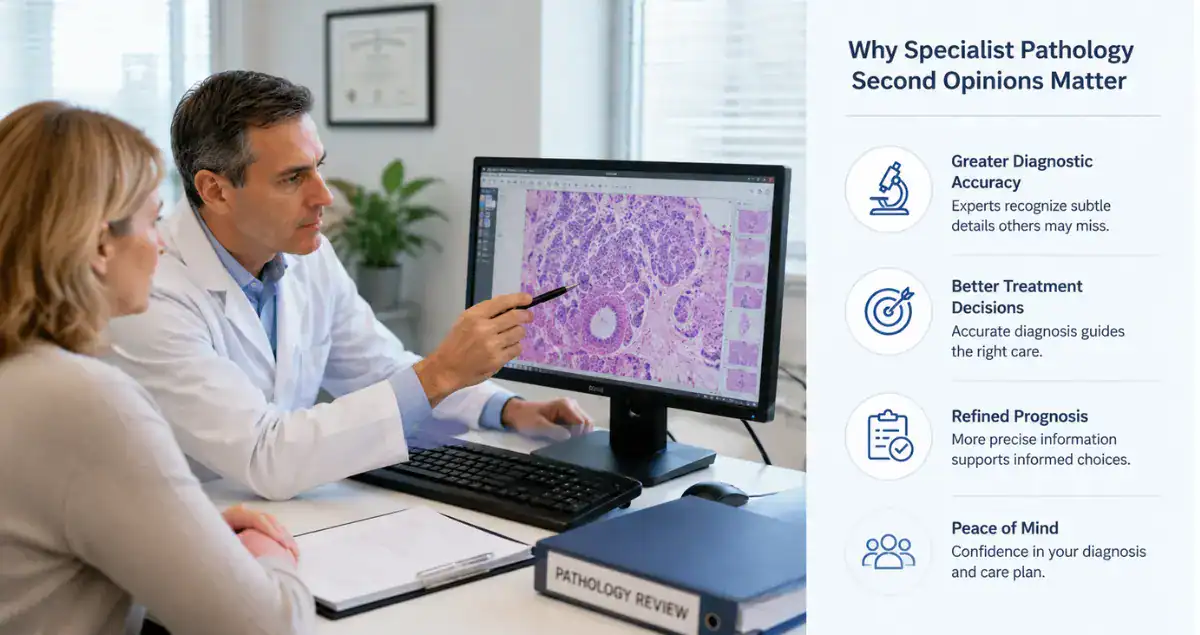
While general pathologists provide competent reviews in many routine cases, formal second opinions benefit significantly from subspecialty expertise. The microscopic interpretation of disease is highly pattern-dependent, and subtle morphologic details, grading nuances, and contextual factors can vary between observers. Subspecialists, who review hundreds or thousands of similar cases annually, develop superior pattern recognition and familiarity with the latest diagnostic criteria, classification systems, and ancillary testing modalities.
This depth often leads to refined diagnoses, changed tumor grades or stages, or identification of previously overlooked features. Major cancer centers routinely direct complex cases to subspecialists for formal second opinions precisely because these reviews have been shown to alter clinical management in a meaningful percentage of patients. For patients facing high-stakes decisions, engaging a specialist helps ensure the highest level of diagnostic confidence.
When a Specialist-Led Formal Second Opinion Is Most Important
Certain scenarios particularly warrant specialist involvement in formal second opinions. These include rare tumors, borderline or ambiguous lesions, cases with discordant clinical or radiographic findings, malignancies requiring precise grading or staging, and specimens where molecular or immunohistochemical studies play a pivotal role. In these situations, a general pathologist’s review may confirm the original diagnosis but might miss subtleties that a focused expert would detect.
Patients interested in understanding why rare cancers need specialist pathology often discover how subspecialty expertise can significantly influence diagnostic accuracy and treatment planning. Institutional formal second opinions sometimes route cases to available pathologists rather than the most appropriate subspecialist. Patients seeking the strongest possible review should inquire specifically about subspecialty matching when requesting a formal second opinion.
Common Pathology Subspecialties Relevant to Formal Second Opinions
Pathology has developed numerous subspecialties, each concentrating on specific organ systems or disease categories. Breast pathology specialists excel in evaluating the spectrum of breast lesions, including challenging in-situ and invasive carcinomas, margin assessments, and biomarker interpretations that directly guide surgical and systemic therapies.
Gastrointestinal pathology experts focus on diseases of the esophagus, stomach, intestines, pancreas, and liver. They provide refined interpretations of inflammatory bowel disease, Barrett’s esophagus, colorectal polyps, and gastrointestinal malignancies according to current WHO and other classification standards. Genitourinary pathology subspecialists concentrate on prostate, bladder, kidney, and testicular specimens. Prostate cancer grading remains particularly subjective, and expert review can meaningfully impact risk group assignment and treatment recommendations.
Dermatopathology specialists master the complex world of skin biopsies, distinguishing between benign and malignant melanocytic lesions, various carcinomas, and inflammatory dermatoses that can mimic one another microscopically. Additional key subspecialties include gynecologic pathology (cervix, uterus, ovaries), neuropathology (brain and spinal cord tumors), hematopathology (lymphomas, leukemias, and bone marrow disorders), thoracic pathology (lung and pleural diseases), and soft tissue/bone pathology. Cytopathology experts review cellular preparations from fluids and aspirations, while pediatric pathology addresses the unique spectrum of childhood diseases. Access to these subspecialists through formal second opinion channels can vary by institution and availability, sometimes requiring referrals to large academic medical centers.
State Licensing Issues in Formal Second Opinions
Formal second opinions trigger important state licensing considerations because they constitute the practice of medicine. Medical licensure is regulated at the state level, and the location of the patient, the reviewing pathologist, and the issuing laboratory all factor into compliance.
Many states require the reviewing pathologist to hold a valid license in the patient’s state of residence when issuing a formal diagnostic report that may guide treatment. Some jurisdictions offer limited exemptions for consultative opinions or when the review is performed at the request of the patient’s treating physician. Telepathology and digital slide review have added further layers of regulatory complexity in recent years. These licensing requirements protect patients but can restrict access to national experts and create delays. Patients pursuing formal second opinions should discuss these practical and regulatory aspects with their referring physicians and the receiving institution to avoid unexpected barriers.
Although valuable, formal second opinions have inherent limitations. The process is often physician-initiated and institution-to-institution, which can reduce direct patient involvement. Reports typically arrive in highly technical language without accompanying explanation, leaving patients to interpret dense medical terminology during already stressful times. Turnaround times can be lengthy, and communication of results may flow exclusively through the referring doctor. Additionally, not every formal second opinion guarantees subspecialty review or access to the most current diagnostic tools. These factors can leave patients with confirmation but without the deep clarity and contextual understanding they truly seek.
A Better Alternative: Patient-Focused Pathology Consultation
While formal second opinions by qualified specialists provide important diagnostic reassurance, many patients benefit from an even more accessible and communicative approach. Honest Pathology offers a superior patient-centered consultation service designed to overcome many of the limitations of traditional formal second opinions. At Honest Pathology, board-certified subspecialty pathologists review your materials and provide clear, understandable explanations tailored to your specific questions through personalized pathology consultation services.
Rather than receiving only a technical report, you gain direct insight into your diagnosis, its implications, and what it means for your care journey — all while maintaining full compliance with applicable licensing and regulatory standards. If you are considering a formal second opinion, we encourage you to explore the consultation option at Honest Pathology first or in addition. Our model combines specialist-level expertise with an unwavering commitment to clarity and patient empowerment. Contact Honest Pathology today to discover how our consultative approach can provide the confident understanding you deserve.
Your pathology diagnosis forms the foundation of your treatment plan. Whether through a specialist formal second opinion or a dedicated consultation, seeking expert review demonstrates prudent care. Honest Pathology stands ready as a clear, patient-focused alternative that prioritizes both diagnostic excellence and exceptional communication.