One of the most common questions patients ask before scheduling a pathology consultation is simple: “How long will the consultation take?” It is an understandable question. Modern healthcare often feels rushed. Patients are used to short appointments, limited time for questions, and complicated medical information being explained in only a few minutes. After receiving a cancer diagnosis or abnormal biopsy result, many patients worry that a pathology consultation will feel the same way.
At HONEST Pathology, we approach pathology consultations differently. Our priority is not meeting a strict time goal. Our priority is helping patients truly understand their pathology report. That means the length of a pathology consultation can vary depending on the complexity of the diagnosis, the number of questions a patient has, and how much explanation is needed for the patient to feel informed and comfortable moving forward.
Some consultations may be relatively straightforward. Others may require more time and discussion. What matters most is that patients leave with a clearer understanding of their pathology findings and a stronger sense of confidence when speaking with their healthcare team.
Why Some Pathology Consultations Take Longer Than Others
Pathology reports contain highly technical medical language. Patients commonly receive reports describing lung cancer, breast cancer, colon cancer, melanoma, lymphoma, or other serious diagnoses using terminology that was primarily written for physicians. Terms like “poorly differentiated adenocarcinoma,” “lymphovascular invasion,” “positive margins,” “microsatellite instability,” or “metastatic carcinoma” can feel overwhelming when read without explanation.
Many patients first encounter these reports through online patient portals late at night or before they have had the chance to speak with their doctor. They begin searching online for answers, often becoming more confused or anxious in the process, especially when trying to understand why a pathology report is delayed or what certain terminology means.
At HONEST Pathology, we believe understanding should never feel rushed. A pathology consultation is not simply about reviewing medical terminology. It is about helping patients process and understand information that may significantly affect their lives. Some patients want a detailed explanation of every section of the pathology report. Others want help understanding staging, grading, biomarkers, or whether certain findings are clinically important. Some patients mainly want guidance on what questions they should ask their oncologist, surgeon, or gastroenterologist next. Every patient is different, and every consultation reflects that.
Examples of Questions Patients Commonly Ask
For example, a patient with a breast cancer pathology report may need time to understand the difference between tumor grade and stage. They may want clarification about estrogen receptor positivity, HER2 status, surgical margins, or lymph node findings. These concepts are not always intuitive, especially for someone hearing them for the first time during an emotionally stressful period.
A patient with colon cancer may need help understanding what it means for a tumor to invade through the muscularis propria or why lymph node involvement affects staging and treatment recommendations. A lung cancer patient may have questions about molecular testing, biomarker analysis, or the significance of specific immunohistochemical stains.
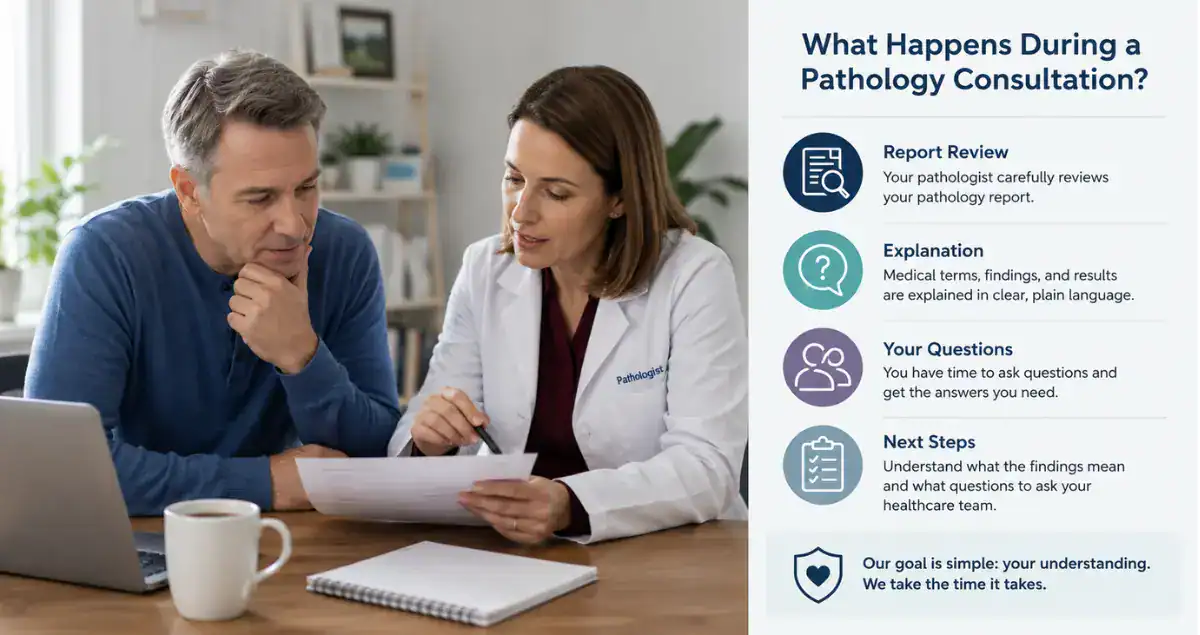
These conversations cannot always be condensed into a rigid timeframe. At HONEST Pathology, our goal is not to move patients through a consultation as quickly as possible. Our goal is to help patients leave feeling more informed than when they arrived. That often means slowing down and explaining concepts carefully in plain language.
Many patients tell us that during traditional medical appointments, they hesitate to ask follow-up questions because they feel rushed or worry about taking up too much time. They may leave appointments still confused about important aspects of their diagnosis but unsure where to turn for clarification.
The Importance of Patient Understanding During a Consultation
Pathology consultations create space for those questions. Patients frequently ask things like, “What exactly does invasive mean?” “How serious is grade 2?” “What are margins?” “What does positive lymph node involvement actually mean?” “Why does my report mention biomarkers?” “What should I ask my oncologist next?” These are important questions, and patients deserve thoughtful answers.
At HONEST Pathology, we recognize that understanding pathology is not just an academic exercise. It directly affects how patients experience their diagnosis and navigate treatment decisions. Patients who better understand their pathology reports often feel more confident during appointments with their healthcare teams. They are better prepared to ask targeted questions and participate actively in discussions about surgery, chemotherapy, radiation therapy, or additional testing.
A pathology consultation does not replace a patient’s treating physicians, and it does not change the diagnosis itself. Instead, it helps patients understand the diagnosis already made and equips them with knowledge that can improve communication with their medical team. That process takes as long as it takes.
Some patients may feel comfortable after reviewing only a few key concepts. Others may want a much deeper explanation of pathology terminology, cancer staging systems, biomarker interpretation, or the role pathology plays in treatment planning. We believe patients should never feel pressured to rush through information that is central to understanding their health. At HONEST Pathology, patient understanding is the priority from the beginning of the consultation to the end.
Why HONEST Pathology Prioritizes Clarity Over Speed
This approach reflects an important reality in modern healthcare: receiving a diagnosis is not only a medical event but also an emotional one. Patients are often processing fear, uncertainty, and large amounts of unfamiliar information simultaneously. Under stress, even relatively simple medical explanations can become difficult to absorb.
That is why pathology consultations often involve repetition, clarification, and revisiting concepts multiple times in different ways. Patients may need to hear explanations more than once before the terminology begins to feel understandable. They may think of additional questions midway through the conversation as they process the information more fully. We encourage those questions because genuine understanding matters more than efficiency.
Patients often tell us that one of the most valuable aspects of a pathology consultation is simply having the opportunity to speak directly with a pathologist. Most patients never meet the physician who actually examined their biopsy or interpreted their pathology findings under the microscope. Pathologists are central to diagnosis, yet they traditionally remain behind the scenes in patient care.
At HONEST Pathology, we believe patients benefit from direct access to pathologists who can explain pathology reports clearly, compassionately, and without unnecessary jargon through our pathology consultation services. That conversation should not feel hurried.
When a Pathology Consultation Has Achieved Its Purpose
Healthcare appointments are increasingly measured by schedules and productivity metrics. But pathology consultations are different because their primary purpose is education and clarity. Patients deserve time to understand the language shaping major medical decisions in their lives. A pathology report may influence cancer staging, treatment recommendations, surgical planning, or long-term follow-up. Patients should feel empowered to understand those findings rather than intimidated by them.
At HONEST Pathology, we believe the value of a consultation is not determined by how quickly it ends. The value comes from helping patients feel informed, prepared, and capable of having more meaningful conversations with their healthcare team afterward.
If a patient leaves the consultation understanding their pathology report more clearly, knowing which questions to ask their oncologist, and feeling less overwhelmed by medical terminology, then the consultation has achieved its purpose. That outcome matters far more than a specific number of minutes.
If you have received a pathology report and feel confused about the terminology, uncertain about the meaning of your diagnosis, or overwhelmed by the complexity of cancer pathology language, HONEST Pathology offers consultations designed around patient understanding, education, and clarity. Because when it comes to understanding your diagnosis, patients should never feel rushed.