
Receiving a pathology report can feel overwhelming, especially after a cancer diagnosis. Many patients open their online medical portal and immediately see unfamiliar medical terms like “adenocarcinoma,” “invasive ductal carcinoma,” “lymphovascular invasion,” or “positive lymph nodes.” Within minutes, they are searching online for answers and wondering whether they need a pathology second opinion.
As a practicing pathologist, I can tell you that many patients do not actually need a second opinion on their pathology diagnosis. What they need is a pathology consultation with a board-certified pathologist who can explain the pathology report in plain English.
At HONEST Pathology, we regularly speak with patients who are frightened not because their diagnosis is unclear, but because no one has explained what their pathology report actually means. There is an important difference between a pathology consultation and a pathology second opinion, and understanding that difference can save patients unnecessary stress, expense, and confusion.
Understanding the Difference Between a Pathology Consultation and a Second Opinion
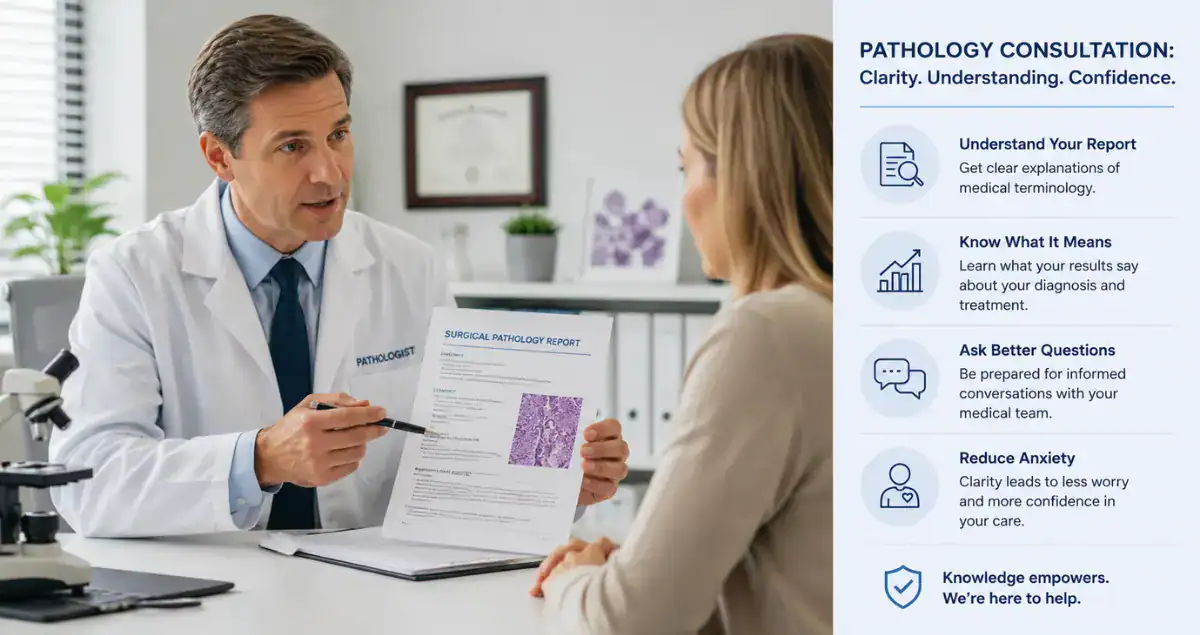
A pathology consultation is focused on education and understanding. A second opinion involves another pathologist formally reviewing slides and potentially issuing a new diagnosis. Most cancer patients already have an accurate diagnosis. What they often lack is clarity.
When patients search for terms like “how to read a pathology report,” “what does my cancer pathology report mean,” or “do I need a pathology second opinion,” they are usually looking for reassurance and explanation. This is especially true in common cancers such as lung cancer, breast cancer, and colon cancer, where pathology reports contain complex terminology that can sound alarming without context.
Why Lung Cancer Pathology Reports Can Feel Confusing
In lung cancer pathology, for example, a report may say “lung adenocarcinoma, moderately differentiated, TTF-1 positive.” To a patient reading this alone, the report may feel terrifying. They may assume that every unfamiliar word signals bad news or a worsening prognosis. In reality, much of the language in a lung cancer pathology report is descriptive and technical. “Adenocarcinoma” is simply the most common type of lung cancer. “Moderately differentiated” describes how the tumor cells look under the microscope. “TTF-1 positive” is a marker that helps confirm the tumor originated in the lung.
These details are important medically, but they are not necessarily signs that something unusual or catastrophic is happening. Patients often think they need another pathologist to review the diagnosis when what they really need is someone to explain the diagnosis already made.
At HONEST Pathology, we help patients understand the meaning behind the terminology through pathology consultation services. Once patients hear the explanations directly from a pathologist, the anxiety level often decreases dramatically. They begin to understand the distinction between descriptive pathology language and genuinely concerning findings.
That does not mean pathology second opinions are never necessary. In lung cancer, a second opinion may be appropriate when the diagnosis is uncertain, when the origin of the cancer is unclear, or when the pathology involves a rare subtype. If a report describes a poorly differentiated tumor with uncertain primary origin, or if molecular findings do not align with the microscopic appearance, another pathology review can be extremely valuable. Those situations are different from simply not understanding a report.
How Breast Cancer Pathology Reports Are Often Misunderstood
Breast cancer pathology reports create similar confusion for patients. A common breast cancer diagnosis might read “invasive ductal carcinoma, grade 2, estrogen receptor positive, progesterone receptor positive, HER2 negative.” Patients frequently panic after seeing words like “invasive” or “negative” without understanding the medical meaning behind them.
In breast pathology, “invasive ductal carcinoma” refers to the most common type of breast cancer. “Grade 2” describes the tumor’s appearance and growth characteristics. “ER positive” and “PR positive” mean the cancer is likely to respond to hormone-blocking treatments. “HER2 negative” is simply one of the molecular classifications used to guide therapy.
Patients often search online for “is HER2 negative bad,” “what does grade 2 breast cancer mean,” or “what does invasive ductal carcinoma mean.” These are educational questions, not necessarily signs that the diagnosis itself is questionable.
At HONEST Pathology, pathology consultations help breast cancer patients understand these distinctions. We explain the pathology findings in understandable language so patients can have more informed conversations with their surgeons, oncologists, and treatment teams.
There are situations in breast pathology where a second opinion is appropriate. Borderline lesions such as atypical ductal hyperplasia versus ductal carcinoma in situ may warrant review by a subspecialty breast pathologist. Rare tumors such as phyllodes tumors or metaplastic carcinoma may also benefit from another pathology opinion. But for the majority of patients, the problem is not an incorrect diagnosis. The problem is lack of explanation.
Understanding Colon Cancer Pathology and Staging Language
Colon cancer pathology reports also commonly trigger anxiety. Patients may read phrases like “moderately differentiated adenocarcinoma invading through the muscularis propria into pericolonic adipose tissue with two positive lymph nodes.” Without medical training, the report sounds catastrophic and impossible to interpret.
A pathology consultation helps translate the staging language. The report is describing how deeply the colon cancer has invaded and whether it has spread to nearby lymph nodes. These details are essential for cancer staging and treatment planning, but patients often need guidance to understand what the terminology means in practical terms.
Why Patients Need Clear Pathology Explanations
One of the most common statements we hear from patients at HONEST Pathology is, “I wish someone had explained this earlier.” Patients frequently receive pathology reports through electronic medical records late at night or over the weekend before they have spoken to their physician. They are left alone with frightening medical terminology and no context.
Modern healthcare systems have created a situation where patients receive instant access to highly technical pathology information that was originally written primarily for physicians. While transparency is important, immediate access without explanation can increase anxiety dramatically. A pathology consultation fills that gap.
When a Pathology Second Opinion May Be Appropriate
When patients ask whether they need a pathology second opinion, one of the most important questions is whether there is actual diagnostic uncertainty. If multiple doctors disagree about the diagnosis, if the pathology report itself says the findings are indeterminate, or if the cancer is extremely rare, then a second opinion may be very appropriate. Patients who are unsure can also learn more about when to ask for an expert pathology review before deciding what type of support they need. However, if the diagnosis is straightforward and the issue is understanding what the report means, a consultation may be far more useful.
At HONEST Pathology, our goal is to help patients understand their pathology reports directly from the specialists who interpret them. We explain terminology, clarify staging language, review biomarker results, and help patients prepare better questions for their treating physicians. We focus on patient education and pathology transparency.
Why Pathologists Are Often Invisible to Patients
Pathology is one of the most important parts of cancer care, yet pathologists are often invisible to patients. Most patients never meet the doctor who actually diagnosed their cancer under the microscope. They see surgeons, oncologists, and radiologists, but the pathologist who wrote the report remains behind the scenes.
That invisibility contributes to confusion. Patients often do not realize they can speak directly with a pathologist to better understand their diagnosis. At HONEST Pathology, we believe pathology consultations should be accessible, understandable, and patient-centered.
Patients Deserve to Understand Their Pathology Reports
Cancer pathology reports should not feel impossible to read. Patients deserve clear explanations of terms like tumor grade, stage, lymphovascular invasion, surgical margins, biomarker testing, and lymph node involvement. They deserve the opportunity to ask questions and understand the meaning of their diagnosis without relying entirely on internet searches or fragmented information online.
The difference between a pathology consultation and a pathology second opinion matters. A second opinion is intended to reassess the diagnosis itself. A consultation is intended to help the patient understand the diagnosis already made. Many patients initially believe they need another opinion when what they truly need is clarity and education.
If you have received a lung cancer pathology report, breast cancer pathology report, colon cancer pathology report, or another cancer diagnosis and feel confused about the terminology, a pathology consultation may be the best next step. Understanding your pathology report can reduce anxiety, improve communication with your doctors, and help you feel more informed about your care.
At HONEST Pathology, we believe patients deserve honest, understandable explanations from board-certified pathologists who can help make sense of complex pathology findings. Your pathology report should help guide you forward, not leave you overwhelmed and uncertain.