Receiving a pathology diagnosis can raise an immediate and important question: Do I need a second opinion? For many patients, the answer is not obvious. Pathology reports are highly technical, and it can be difficult to know whether what you are reading is straightforward, complex, or potentially worth further review.
At Honest Pathology, one of the most valuable roles we play is helping patients understand their pathology report clearly enough to make an informed decision about whether a formal second opinion is even necessary, often through an online second opinion consultation.
This is not about replacing your diagnosis or making treatment decisions. It is about giving you clarity so you can decide whether further review is truly needed.
Why Patients Consider a Second Opinion in the First Place
Patients usually think about a second opinion for one of a few reasons. Sometimes the diagnosis is serious or unexpected. Sometimes the language in the report feels uncertain or difficult to interpret. In other cases, different doctors may have used slightly different terminology, creating confusion about what the diagnosis actually is.
It is also common for patients to simply feel unsure whether they fully understand what their pathology report is saying.
In all of these situations, the underlying issue is often the same: lack of clarity rather than disagreement with the diagnosis itself.
The Role of Honest Pathology in Clarifying Your Report
Before deciding whether you need a formal second opinion, it is often helpful to first fully understand your existing pathology report.
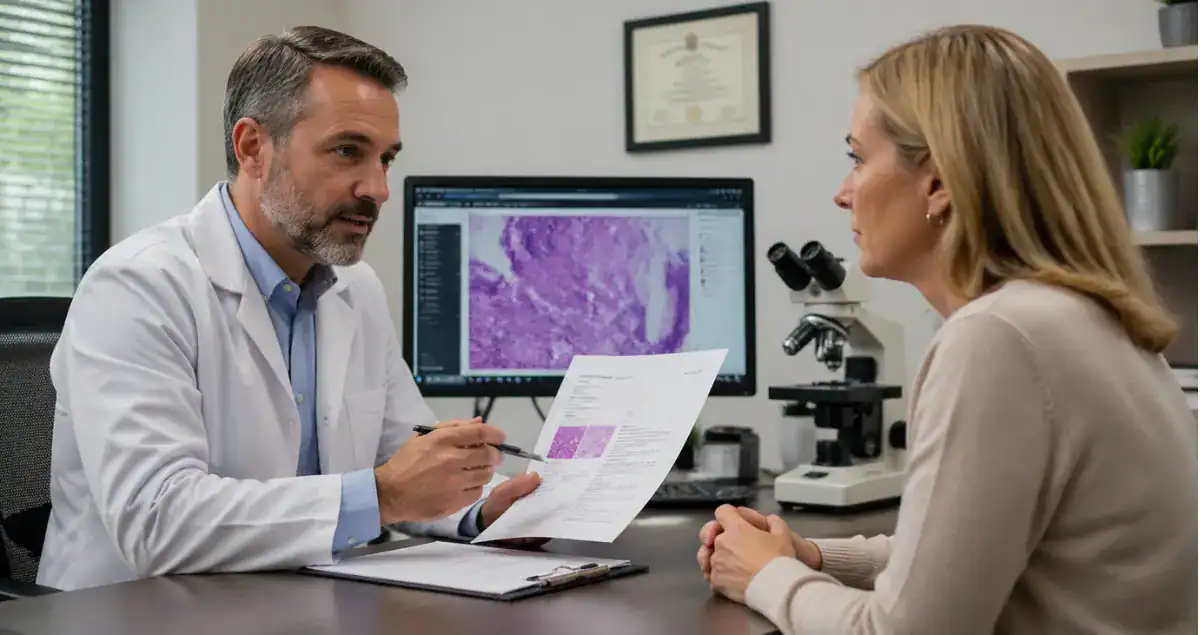
At Honest Pathology, we provide a pathology report review consultation with a board-certified pathologist who explains your report in clear, accessible language. We walk through the diagnosis, clarify medical terminology, and answer your questions directly.
This process often helps patients realize that what initially felt confusing or concerning is actually well-explained within the report once it is properly interpreted.
In other cases, it helps identify areas where further review may be appropriate.
Understanding Whether Your Report Is Straightforward or Complex
One of the key outcomes of a pathology consultation is determining how complex your diagnosis actually is.
Some pathology reports are relatively straightforward, with clear diagnostic conclusions and well-established classifications. Others may include nuanced findings, borderline features, or additional testing that adds complexity to interpretation.
During your consultation, the pathologist helps you understand where your report falls on this spectrum. This context is often essential in deciding whether a second opinion is necessary or simply optional.
Not every detailed report requires further review. In many cases, clarity alone is enough to move forward confidently.

Identifying True Uncertainty vs. Technical Language
One of the most common sources of concern for patients is wording that sounds uncertain. Terms like “atypical,” “indeterminate,” or “suspicious” can feel alarming when read without explanation.
However, these terms often reflect standard medical caution rather than diagnostic uncertainty.
At Honest Pathology, we help you distinguish between true uncertainty in a diagnosis and the routine use of careful language in pathology reporting. This distinction is often critical in deciding whether a second opinion is needed.
If a report is genuinely unclear or incomplete, that is different from a report that is fully diagnosed but uses technical phrasing.
When a Second Opinion May Be Worth Considering
While Honest Pathology does not replace formal diagnostic second opinions, we help you understand when one may be appropriate.
A second opinion is more commonly considered when a report contains unusual findings, rare diagnoses, or complex classifications that may benefit from additional review of tissue slides.
It may also be appropriate when there is a known discrepancy between clinical findings and pathology results, or when multiple interpretations have already been discussed by different providers.
In these situations, we help you recognize that further review of slides—not just the report—may be necessary.
When a Second Opinion May Not Be Necessary
In many cases, patients discover through a pathology report review consultation that a second opinion is not actually needed.
If your diagnosis is clearly stated, well-classified, and supported by standard microscopic findings, additional review may not change the interpretation. Instead, what is needed is simply a clear explanation of what the report already says.
At Honest Pathology, we often find that once patients fully understand their report, their initial concern about needing a second opinion decreases significantly.
Clarity alone can resolve a large portion of uncertainty.
Helping You Understand the Difference Between Review and Re-Evaluation
A key part of deciding whether you need a second opinion is understanding the difference between a report review and a diagnostic re-evaluation.
A pathology report review consultation focuses on explaining the findings already documented in your report. It does not involve re-examining tissue slides or altering the diagnosis.
A formal second opinion, by contrast, involves another pathologist independently reviewing the original slides to potentially confirm or revise the diagnosis.
At Honest Pathology, we help you understand which of these pathways matches your situation so you can make an informed decision.
Reducing Anxiety Through Understanding
Uncertainty about whether a second opinion is needed can itself be a source of stress.
Patients often feel caught between trusting their diagnosis and worrying that something may have been missed or misunderstood.
By providing a clear explanation of your pathology report, Honest Pathology helps reduce that uncertainty. In many cases, understanding the report in detail is enough to restore confidence in the diagnosis.
In other cases, that understanding clarifies why a second opinion may be appropriate, allowing you to pursue it with greater purpose and direction.
The Value of Direct Access to a Pathologist
One of the most important aspects of the Honest Pathology consultation is direct communication with a board-certified pathologist.
In most healthcare settings, patients do not have the opportunity to speak directly with the specialist who interpreted their tissue sample. This makes it difficult to ask nuanced questions about the diagnosis itself.
By speaking directly with a pathologist, you gain insight into how the diagnosis was made, how certain the findings are, and whether the report is likely to benefit from further review.
This direct access is often what allows patients to make a confident decision about next steps.
Making an Informed Decision With Confidence
Deciding whether to pursue a second opinion should not feel like guesswork. It should be based on clear understanding of your existing pathology report.
At Honest Pathology, our goal is to provide that clarity.
We help you understand what your report is saying, how certain the diagnosis is, and whether the findings suggest a need for further review. This allows you to make an informed decision rather than a reactive one.
For many patients, that clarity alone is enough to move forward without additional testing or consultation. For others, it provides the confidence to pursue a second opinion when it is truly warranted.
Final Thoughts: Clarity Before Action
A pathology report can be one of the most important and complex documents you will ever receive. It is natural to question whether you need additional opinions or further review.
Honest Pathology helps you step back from that uncertainty and understand your report clearly before making any decisions.
By providing direct access to a board-certified pathologist who explains your findings in plain language, we help you determine whether a second opinion is necessary—or whether you already have the answers you need, along with clearer insights into treatment guidance.
Because when it comes to your diagnosis, the best decisions are made not in confusion, but in clarity.