Receiving a cancer-related pathology report can be overwhelming, even when the diagnosis has already been communicated by your treating physician. The language is technical, the implications feel serious, and it is often difficult to know what you should be asking or what truly matters most.
At Honest Pathology, one of the most important parts of a consultation is the conversation itself. Because you are speaking directly with a board-certified pathologist, you also gain guidance on the most relevant questions to ask your doctor so you can better understand how your pathology findings fit into your overall care.
Many patients come into the consultation unsure of what to ask. That is completely normal. Below is a guide to the types of questions that are most helpful during a pathology report review consultation for a cancer diagnosis, along with why they matter.
Understanding the Exact Diagnosis in Plain Language
One of the most important aspects of clarity after a diagnosis is deciding whether a second opinion consultation is needed to better understand complex terminology and confirm key details. Cancer pathology reports often use precise but complex terminology that can be difficult to interpret without guidance.
It is appropriate to ask the pathologist to explain what the diagnosis means in simple, everyday language. This includes asking what type of cancer is identified in the report and how it is classified based on the microscopic findings.
Many patients find that even when they know the name of their diagnosis, they do not fully understand what it means biologically or clinically. This is where direct explanation from the interpreting pathologist becomes especially valuable.
Questions About Grade and Aggressiveness
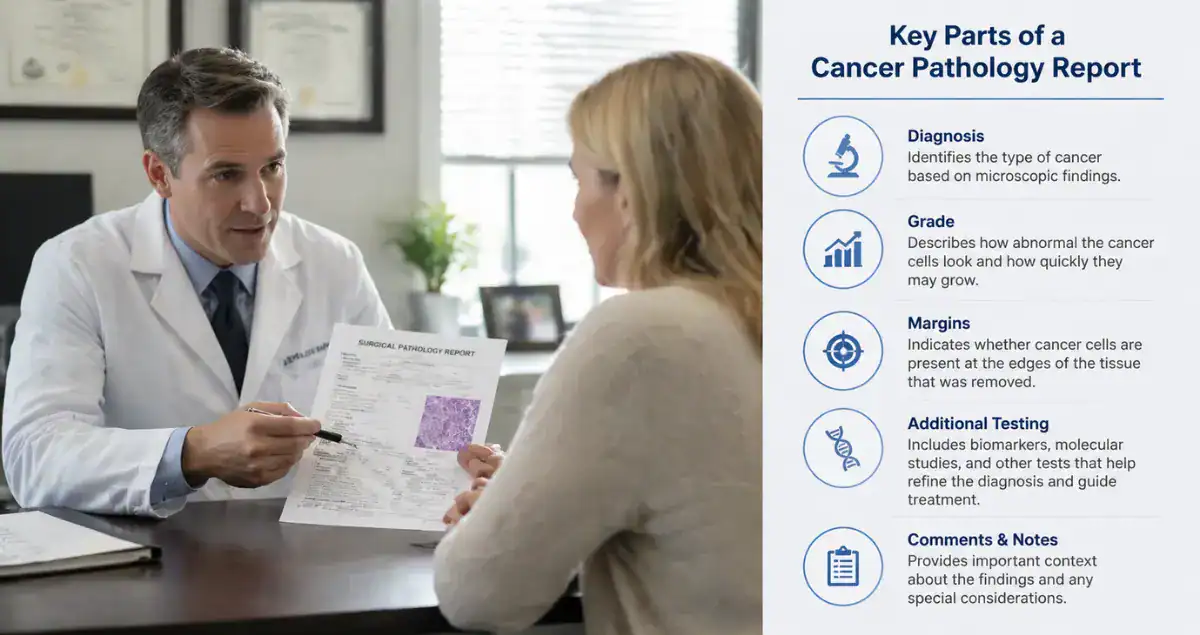
Cancer pathology reports often include a grade, which describes how abnormal the cancer cells appear under the microscope and how quickly they may be expected to grow or behave.
It is very reasonable to ask what the grade means in your specific case and how it relates to the overall behavior of the cancer. Patients often also ask whether the grade suggests a slow-growing or more aggressive process.
Understanding grading helps put the diagnosis into context and provides insight into why certain treatment approaches may be recommended.
Questions About Stage and What It Means Pathologically
While staging is often determined using a combination of imaging, surgery, and pathology, your pathology report may include important components that contribute to staging decisions.
It is appropriate to ask how the findings in your pathology report relate to staging and what specific features of the tissue were used to support that assessment.
Patients are often unsure how pathology contributes to staging, so clarifying this connection can be very helpful in understanding the bigger picture of the diagnosis.
Questions About Margins and Surgical Removal
If your cancer was removed surgically, your pathology report may include information about margins. Margins refer to whether cancer cells are present at the edges of the removed tissue.
A key question to ask is whether the margins are clear and what that means in terms of whether all visible cancer was removed.
If margins are close or involved, it is also appropriate to ask how that finding is typically interpreted and why it matters clinically.
This is one of the most important sections of many surgical pathology reports, and understanding it can significantly impact how patients interpret their results.
Questions About Tumor Type and Classification
Cancer is not a single disease, and even within one organ system, there can be multiple subtypes with different behaviors and treatment implications.
It is helpful to ask the pathologist to explain the specific type or subtype identified in your report and what distinguishes it from other forms of the same cancer.
Patients often benefit from understanding whether their diagnosis is considered common or rare, and how that classification influences interpretation of the pathology findings.
Questions About Additional Testing and Biomarkers
Many modern cancer diagnoses involve additional testing beyond standard microscopy. This may include immunohistochemistry, molecular studies, or genetic markers.
If these tests are included in your report, it is very useful to ask what they mean and how they contributed to the final diagnosis.
You can also ask whether any markers were particularly important in confirming or refining the diagnosis. These details often play a significant role in how pathology conclusions are reached.
Questions About Uncertainty or Complexity in the Report
In some cases, pathology reports include language that suggests uncertainty, borderline findings, or diagnostic complexity.
If you notice terms that seem ambiguous or cautious, it is appropriate to ask the pathologist to explain why that language was used and what level of certainty exists in the diagnosis.
At Honest Pathology, we often help patients understand that cautious language in pathology does not necessarily mean confusion, but rather reflects the careful standards used in diagnostic interpretation.
Questions About How the Diagnosis Was Reached
Many patients benefit from understanding the reasoning process behind their diagnosis.
You can ask how the pathologist identified the cancer under the microscope, what specific features were most important, and how those findings led to the final interpretation.
This type of question helps demystify the diagnostic process and provides insight into how pathology decisions are made.
Questions About What Matters Most in Your Report
Pathology reports can be long and detailed, and not every finding carries the same weight.
A very useful question is asking the pathologist what the most important findings are in your report. This helps you focus on the information that truly drives the diagnosis and clinical decision-making.
Patients often leave the consultation feeling clearer about which details are essential and which are more descriptive in nature.
Questions About Follow-Up Communication With Your Doctor
Because Honest Pathology consultations are educational, not treatment-based, it is also helpful to ask how you should discuss your report with your treating physician.
You can ask what key points you should bring up, what questions might be useful for your doctor, and how the pathology findings typically fit into broader treatment planning.
This helps bridge the gap between understanding your report and applying that understanding in your medical care.
Why Asking Questions Matters in a Pathology Consultation
A cancer diagnosis is not just a single line in a report—it is a complex set of findings that require interpretation and context. Without explanation, even accurate information can feel confusing or incomplete.
At Honest Pathology, we encourage patients to ask questions freely and without hesitation. There is no such thing as a “basic” question when it comes to understanding your diagnosis.
In fact, the most important questions are often the ones that bring clarity to uncertainty.
The Role of the Pathologist in Answering Your Questions
During your consultation, the pathologist’s role is to translate the technical language of your report into clear, understandable explanations. This includes not only describing what is in the report, but also addressing your specific concerns and questions.
Because you are speaking directly with the interpreting specialist, you are able to receive answers in real time, without waiting for information to pass through multiple layers of communication.
This direct interaction is one of the key differences between a traditional pathology report and a pathology report review consultation.
Moving From Uncertainty to Understanding
A cancer diagnosis can feel overwhelming, but understanding it does not have to be.
By asking thoughtful, focused questions during your Honest Pathology consultation, you can gain a much clearer picture of what your pathology report actually means. You do not need to be familiar with medical terminology in advance, and you do not need to know exactly what to ask before the conversation begins.
What matters most is having the opportunity to ask, listen, and understand.
At Honest Pathology, that is exactly what the consultation is designed to provide: clear answers, direct communication, and a deeper understanding of your diagnosis so you can move forward with greater confidence.