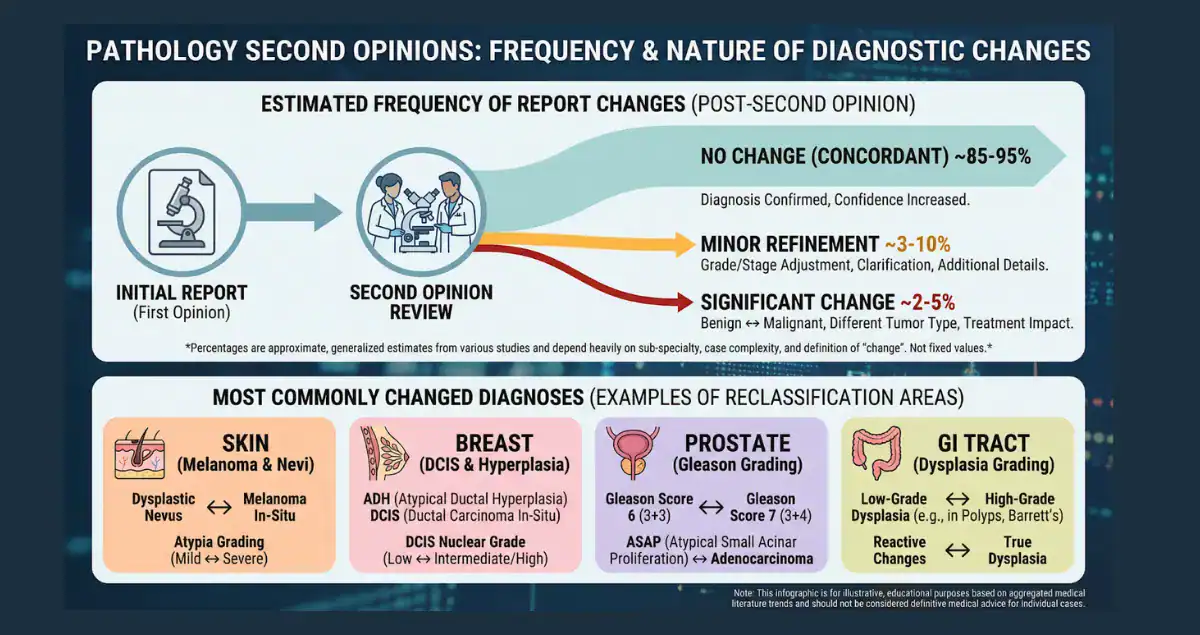
A pathology report represents the definitive interpretation of what a biopsy or surgical specimen truly reveals. It decides whether a suspicious lump is cancerous, identifies the exact type of malignancy if present, assesses how aggressive the process appears, and highlights molecular or genetic markers that can direct targeted therapies or influence prognosis. Even highly skilled general pathologists, who manage a wide variety of cases across multiple organ systems, cannot maintain deep expertise in every rare tumor subtype, subtle morphologic variant, or fast-evolving molecular assay. This is precisely where highly specialized expert pathologists become invaluable.
These subspecialists dedicate their careers to mastering one narrow domain, such as breast pathology, gastrointestinal and liver pathology, hematopathology and bone marrow disorders, neuropathology and central nervous system tumors, bone and soft-tissue sarcomas, gynecologic and ovarian pathology, pediatric and adolescent tumors, head and neck pathology, or advanced molecular and genomic diagnostics. Years or decades of focused practice allow them to recognize patterns that generalists might overlook, leading to diagnoses that are more precise, grades that are more accurate, actionable mutations that are more reliably detected, or even the reassuring exclusion of malignancy when it was initially suspected. For countless patients, requesting a second opinion from one of these experts transforms diagnostic uncertainty into clear understanding and paves the way for the most appropriate, effective treatment plan.
If you find yourself questioning whether your pathology report warrants expert review, perhaps because of a rare diagnosis, conflicting molecular results, or simply a desire for greater certainty, services like Honest Pathology make it straightforward. They connect patients directly with board-certified subspecialty pathologists who offer virtual second-opinion consultations, walk through every line of the report in straightforward language, and address your individual questions with patience and expertise.
Why Pathology Interpretation Differs from Other Medical Specialties
Pathology stands apart from fields like radiology or surgery because the diagnostic process centers on a single, irreplaceable tissue sample. Once the specimen is fixed in formalin, embedded in paraffin, sectioned, stained, and mounted on slides, the opportunity for repetition is limited, unlike an MRI that can be re-acquired or a surgical procedure that can be revised. Tiny variations in cellular morphology, staining intensity, architectural arrangement, or the results of ancillary molecular tests can fundamentally alter the interpretation from benign to malignant, from low-grade to high-grade, or from one tumor entity to an entirely different one with different clinical implications.
General surgical pathologists develop broad competence by handling diverse cases daily, but their exposure to any single rare entity remains comparatively limited. In contrast, subspecialists encounter dozens or even hundreds of similar challenging cases annually within their chosen field. This concentrated volume fosters exceptional pattern recognition, nuanced differential diagnosis skills, and familiarity with the latest diagnostic criteria and molecular associations. Peer-reviewed studies published in leading pathology journals consistently demonstrate that second-opinion reviews by subspecialists result in major diagnostic revisions in ten to thirty percent of cases overall. The rate climbs even higher, often approaching or exceeding forty percent, when the initial material involves rare tumors, sarcomas, lymphomas, central nervous system neoplasms, complex breast lesions, or difficult gynecologic specimens.
Common Situations Where Expert Second Opinions Make the Biggest Difference
Certain diagnostic scenarios are particularly prone to interpretive challenges and show the greatest benefit from subspecialty consultation. Rare sarcomas and soft-tissue tumors encompass more than seventy distinct subtypes, many of which display overlapping histologic features and depend on specific chromosomal translocations or gene fusions for accurate classification. A general pathologist, encountering such a lesion infrequently, might render a diagnosis of sarcoma not otherwise specified or favor a broad category, whereas a dedicated sarcoma pathologist can pinpoint the precise subtype, identifying, for example, the EWSR1-FLI1 fusion in Ewing sarcoma or the SYT-SSX fusion in synovial sarcoma, that directly informs chemotherapy responsiveness, eligibility for targeted agents, or expected biologic behavior. Brain and central nervous system tumors follow the 2021 WHO classification, which mandates an integrated approach combining traditional histology with essential molecular features including IDH mutation status, 1p/19q codeletion, MGMT promoter methylation, BRAF alterations, CDKN2A/B homozygous deletion, and others. Neuropathologists specializing in gliomas and other CNS tumors routinely detect subtle morphologic clues and correctly integrate molecular data to reclassify what might initially appear as glioblastoma into a lower-grade IDH-mutant astrocytoma or oligodendroglioma, profoundly changing anticipated survival and therapeutic intensity.
Lymphomas and hematologic malignancies present another area of high complexity, requiring sophisticated flow cytometry panels, extensive immunohistochemical marker sets, cytogenetic studies, and molecular profiling. Hematopathologists frequently resolve difficult distinctions between benign reactive lymphoid proliferations and low-grade B-cell lymphomas or accurately subtype aggressive processes, such as mantle cell lymphoma versus marginal zone lymphoma versus follicular lymphoma variants, that respond to markedly different targeted therapies including BTK inhibitors, BCL2 inhibitors, or CAR-T cell approaches. Gynecologic and breast pathology often involves borderline or morphologically ambiguous lesions such as serous borderline ovarian tumors, atypical ductal hyperplasia versus low-grade ductal carcinoma in situ, or triple-negative breast cancers with unusual features that affect staging or therapeutic options. Subspecialists in these areas refine risk assessment, hormone-receptor scoring, HER2 interpretation, and Ki-67 proliferation indexing with greater consistency. Gastrointestinal and pancreaticobiliary pathology frequently demands differentiation between well-differentiated neuroendocrine tumors and adenomas, or between pancreatic ductal adenocarcinoma and mass-forming autoimmune pancreatitis or chronic pancreatitis variants, tasks that benefit from subspecialty expertise in specialized stains, molecular markers, and correlation with endoscopic or radiologic findings.
What an Expert Second Opinion Actually Involves
The process begins when the subspecialist receives the original glass slides, digital whole-slide images, paraffin-embedded tissue blocks if additional studies are indicated, all previous pathology reports, relevant clinical notes, and imaging summaries. They may perform additional immunohistochemical stains, repeat or expand molecular or genetic testing, or compare the current case against extensive personal archives and teaching collections of analogous difficult examples. The final second-opinion report generally includes clear confirmation or revision of the original diagnosis, any necessary updates to grade, stage, or prognostic markers, a contextual explanation of molecular or genetic findings, a reasoned discussion of differential diagnoses considered and excluded, and practical recommendations for further testing, clinical correlation, or referral if appropriate.
Turnaround time typically ranges from one to three weeks, with expedited handling available for urgent clinical situations such as impending major surgery or initiation of systemic therapy. The financial cost of such a review is generally modest compared to the potential consequences of proceeding with an inaccurate or incomplete diagnosis, including unnecessary procedures, ineffective treatments, or delayed access to optimal therapies.
Real-World Impact: How Second Opinions Change Outcomes
Extensive literature and multidisciplinary tumor-board data illustrate the tangible benefits of subspecialty review. Major diagnostic revisions occur in up to twenty-five to thirty percent of sarcoma and brain tumor consultations. Reclassification from malignant to benign or the reverse happens in five to ten percent of challenging breast and gynecologic biopsies, occasionally preventing unwarranted mastectomy, chemotherapy, or radiation. Changes in tumor subtype can redirect systemic therapy choices, qualify patients for specific clinical trials, or shift management toward more effective targeted agents. Previously undetected targetable alterations, such as NTRK gene fusions, BRAF V600E mutations, RET rearrangements, or ALK translocations, are occasionally discovered only on expert review, transforming standard cytotoxic chemotherapy into precision medicine.
When the core diagnosis remains unchanged, the subspecialist opinion still delivers significant value through detailed reassurance, more nuanced prognostic counseling tailored to the individual case, or clearer justification for the proposed treatment pathway. For patients with rare or uncommon cancers, these reviews often facilitate referral to high-volume specialty centers, where multidisciplinary teams, greater surgical expertise, and access to novel therapies correlate with improved long-term survival and quality-of-life outcomes.
When Should You Consider Asking for a Second Opinion?
Pursue subspecialty review when the diagnosis appears rare, uncommon, or is described in the report as unusual, challenging, atypical, or difficult to classify. The wording includes hedging phrases such as favor, suspicious for, cannot exclude, most consistent with but not diagnostic of, or atypical features present. Proposed treatment feels unexpectedly aggressive or unusually conservative relative to published guidelines or information you have encountered.
The tumor arises in a diagnostically challenging anatomic location such as the brain, bone or soft tissue, pancreas, ovary, or head and neck region. Molecular, cytogenetic, or genetic results are intricate, contradictory, or hard to reconcile with the histologic description. You seek additional reassurance and confidence before committing to major interventions like chemotherapy, radiation, immunotherapy, or extensive surgery. Critically, patients do not require physician approval to request a pathology second opinion. You retain legal ownership of your tissue blocks, slides, and reports. Most academic medical centers and reference laboratories routinely process outside consultations, and independent services now offer direct patient access to subspecialists without institutional intermediaries.
The Bottom Line
Pathology interpretation, while highly reliable in experienced hands, is not infallible. The correct subspecialty perspective can elevate accuracy to an extraordinary level. A highly specialized pathologist contributes unparalleled depth of knowledge to cases that exceed the routine scope of general surgical pathology. This additional layer of expertise can confirm the initial diagnosis with strong conviction, identify and correct potential errors before they impact care, sharpen treatment recommendations, or deliver the peace of mind that allows you to proceed with assurance. In cancer care especially, where pivotal decisions hinge on the precise analysis of limited tissue material, the importance of subspecialty consultation cannot be overstated.
If your pathology report has generated lingering doubts, unanswered questions, or an intuitive sense that further clarity would help, an expert second opinion can supply the insight you need to advance with confidence. Honest Pathology connects patients with exactly these subspecialized pathologists, delivering clear, thorough, and compassionate reviews customized to your unique circumstances. Making that choice empowers you to advocate effectively for yourself and ensures you receive the most suitable and evidence-based care possible at a decisive moment in your health journey.