
If you have recently reviewed a pathology report after a cancer diagnosis, you may have noticed something called “Ki-67” followed by a percentage. For many patients, that number raises immediate questions. Is it good? Is it bad? Does it change treatment?
Ki-67 is a laboratory test pathologists use to measure how quickly cancer cells are growing. More specifically, it is a protein found inside the nucleus of cells that are actively dividing. When cells are resting and not preparing to divide, Ki-67 is not present. Because of this, Ki-67 acts like a growth meter for tumors.
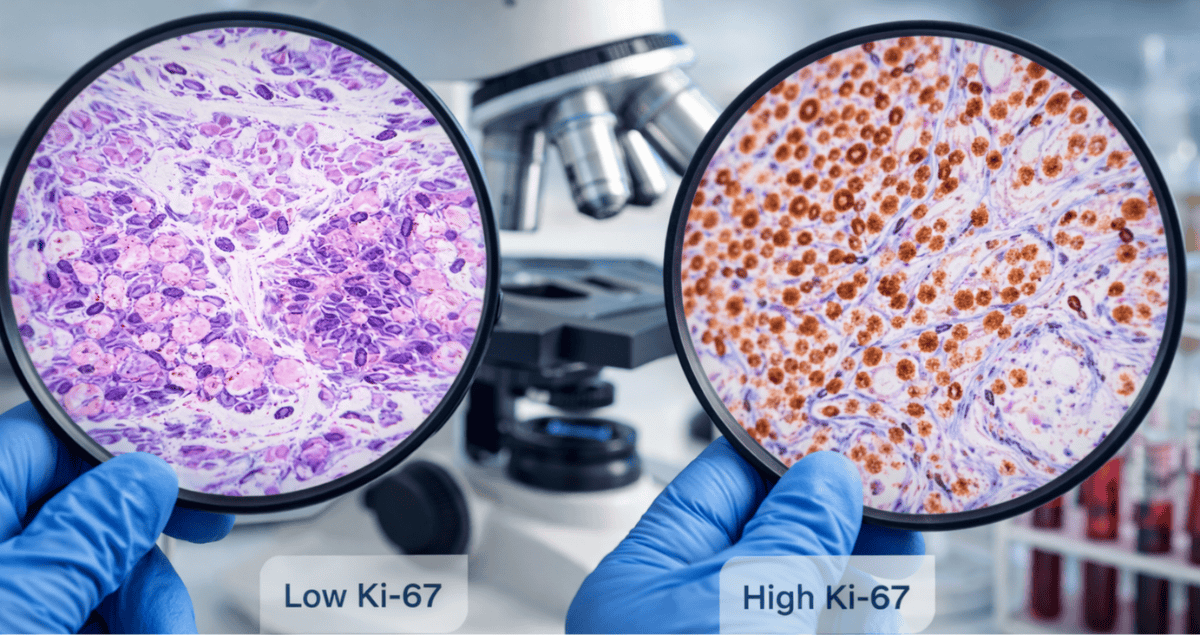
To perform the test, pathologists use a special staining technique called immunohistochemistry. This stain highlights the cancer cells that are in the process of dividing. Under the microscope, those cells light up, and the pathologist estimates what percentage of the tumor cells are actively growing. That percentage is called the Ki-67 index.
If your report says Ki-67 is 10 percent, it means about 10 percent of the tumor cells were dividing at the time the sample was taken. If it says 40 percent, then roughly 40 percent of the cells were actively growing.
Why Do Doctors Care About How Fast Cancer Cells Are Growing?
Cancer is, at its core, uncontrolled cell growth. Some cancers grow slowly over many years. Others grow more quickly and may spread faster. Knowing how rapidly a tumor is dividing gives doctors more information about how it might behave.
A lower Ki-67 percentage generally suggests slower growth. A higher percentage suggests faster growth. In many cancers, faster growth can be linked to more aggressive behavior. However, that does not automatically mean a worse outcome. Growth rate is just one piece of a much bigger picture that includes tumor type, stage, grade, genetic features, and overall health.
In some cancers, such as certain breast cancers and neuroendocrine tumors, Ki-67 plays a meaningful role in helping doctors estimate prognosis and guide treatment decisions. In others, it provides supportive information but is not the main deciding factor.
Understanding this can ease a common fear: seeing a “high” number does not automatically mean the situation is hopeless. It simply provides more detail about how the tumor is behaving.
 What Is Considered a “High” or “Low” Ki-67?
One of the most common concerns patients have is whether their Ki-67 number is considered high. The answer depends on the type of cancer.
There is no single universal cutoff that applies to every tumor. In some breast cancers, doctors may consider values under about 15 percent to be low and over 20 percent to be higher, but even these numbers can vary depending on the laboratory and medical guidelines being followed. In neuroendocrine tumors, very specific Ki-67 ranges are used to assign tumor grades.
This variability can be confusing. It is important to remember that the number must always be interpreted in context. A 25 percent Ki-67 in one type of tumor may carry different meaning than 25 percent in another.
If you are unsure what your number means, asking your doctor to explain it in relation to your specific cancer type is the most helpful approach.
Does a High Ki-67 Mean the Cancer Is Untreatable?
Many patients worry that a high Ki-67 means their cancer cannot be controlled. That is not true.
In fact, some rapidly dividing cancers respond very well to chemotherapy. Many chemotherapy drugs are designed to target cells that are actively dividing. When cancer cells are growing quickly, they can sometimes be more vulnerable to these treatments.
While faster growth can sometimes be associated with higher risk, it can also mean the cancer is more sensitive to certain therapies. This is why Ki-67 is only one factor among many that oncologists consider when designing a treatment plan.
Why Might Ki-67 Be Different Between a Biopsy and Surgery?
Another question that often comes up is why the Ki-67 percentage can change between a needle biopsy and a later surgical specimen.
Tumors are not uniform. One area may be growing more actively than another. A small biopsy samples only a portion of the tumor. When the entire tumor is removed during surgery, the pathologist has more tissue to examine, which may lead to a slightly different percentage.
Small differences do not necessarily mean something went wrong. They often reflect natural variation within the tumor.
Why Isn’t Ki-67 Always Included in Every Report?
Not all cancers require Ki-67 testing. Its usefulness depends on the tumor type and the clinical situation. In some cancers, other markers or genetic tests provide more detailed information, so Ki-67 may not be necessary.
There is also some variation between laboratories in how Ki-67 is measured and interpreted. While the test itself is widely available, the exact cutoffs used to define low versus high can differ slightly. Because of this, some institutions use it selectively rather than routinely.
Can Ki-67 Change After Treatment?
Yes, it can. If a patient receives chemotherapy, hormone therapy, or targeted therapy before surgery, the remaining tumor may show a lower Ki-67 percentage afterward. This can be a sign that the treatment reduced the tumor’s growth activity.
On the other hand, cancer biology can evolve over time. Changes in Ki-67 do not automatically mean improvement or worsening without looking at the entire clinical picture. Oncologists consider imaging results, pathology findings, and overall response when evaluating treatment success.
The Strengths and Limitations of Ki-67
Ki-67 is helpful because it gives a direct visual measure of how many tumor cells are dividing. It is relatively affordable and widely available. It fits naturally into standard pathology workflows.
At the same time, it has limitations. Different laboratories may use slightly different methods. Pathologists visually estimate percentages, which can introduce some variability. Tumor sampling differences can also affect results.
For these reasons, Ki-67 is best viewed as an informative tool rather than a standalone decision-maker. It adds depth to a diagnosis but does not replace other important clinical information.
Helping Patients Understand Their Pathology Reports
For many patients, the hardest part of cancer care is not just the diagnosis but understanding the terminology. Pathology reports are often written in technical language that can feel overwhelming.
A key part of the mission at Honest Pathology is to bridge that gap. Clear explanations of findings like Ki-67 empower patients to better understand their diagnosis and participate more confidently in treatment discussions. When complex medical information is translated into plain language, it reduces anxiety and builds trust.
Ki-67 is not just a number on a page. It represents insight into how a tumor is behaving. When explained thoughtfully and placed in context, it becomes a helpful piece of information rather than a source of fear.
The Bottom Line
Ki-67 immunostaining is a tool pathologists use to measure how quickly cancer cells are growing. The percentage reported reflects the proportion of tumor cells that were actively dividing at the time of testing. Lower numbers generally suggest slower growth, while higher numbers suggest faster growth, but interpretation depends heavily on cancer type and overall clinical context.
It does not determine your outcome on its own. It does not automatically predict success or failure of treatment. Instead, it contributes valuable information that helps doctors tailor care to the individual patient.
If you see Ki-67 on your pathology report and feel uncertain about what it means, you are not alone. Asking for clarification is both reasonable and encouraged. Understanding your pathology report is an important step in understanding your care, and clear communication can make all the difference.