Pathology reports for lung cancer often include technical terms that are unfamiliar to patients, even though those terms play a critical role in diagnosis and treatment planning. One of the most common and confusing is TTF-1. Seeing “TTF-1 positive” or “TTF-1 negative” on a pathology report can raise questions about what this marker means and why it matters. Understanding the role of TTF-1 in lung cancer can help patients better interpret their diagnosis and feel more informed as they move forward with care.
Understanding Immunohistochemistry in Lung Pathology
TTF-1, which stands for thyroid transcription factor-1, is a protein found in the nucleus of certain cells. In pathology, it is detected using a technique called immunohistochemistry. This method uses antibodies to highlight specific proteins within tumor cells, helping pathologists determine what type of cells the cancer most closely resembles.
In lung cancer, immunohistochemistry is especially important when tumors are poorly differentiated or when biopsy samples are small. Markers like TTF-1 provide additional clues that go beyond what can be seen with routine microscopic examination alone.
What Is TTF-1?
TTF-1 is a transcription factor involved in the normal development and function of the lungs and thyroid. In the adult lung, it is typically expressed in certain epithelial cells, including those that give rise to many lung adenocarcinomas.
Because of this normal expression pattern, TTF-1 has become a key diagnostic marker in lung pathology. Its presence or absence helps pathologists determine whether a tumor is likely a primary lung cancer and, if so, what subtype it may be.
TTF-1 and Lung Adenocarcinoma
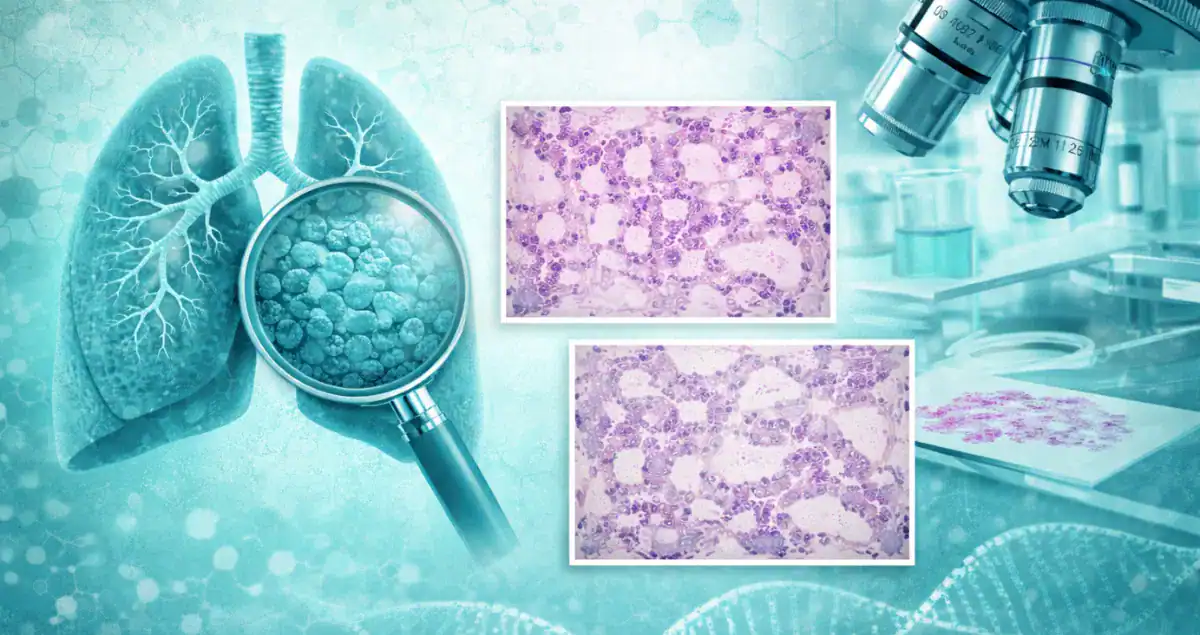
TTF-1 is most commonly associated with lung adenocarcinoma. A majority of lung adenocarcinomas are TTF-1 positive, meaning the tumor cells show nuclear staining for this marker. When a lung tumor is TTF-1 positive, it strongly supports a diagnosis of adenocarcinoma originating in the lung.
This is particularly helpful when evaluating metastatic tumors. If a tumor in another part of the body is TTF-1 positive, it raises the possibility that the cancer originated in the lung rather than elsewhere.
 TTF-1 in Squamous Cell Carcinoma and Other Lung Tumors
Squamous cell carcinomas of the lung are typically TTF-1 negative. This contrast helps pathologists distinguish between adenocarcinoma and squamous cell carcinoma, especially in small or poorly differentiated biopsies.
Other lung tumors, such as small cell carcinoma and some neuroendocrine tumors, may also express TTF-1. For this reason, TTF-1 is interpreted in combination with other markers and histologic features rather than in isolation.
Why TTF-1 Matters for Classification
Correctly classifying lung cancer subtype is increasingly important in modern oncology. Many treatment decisions, including molecular testing and targeted therapy eligibility, depend on whether a tumor is classified as adenocarcinoma, squamous cell carcinoma, or another type.
TTF-1 helps pathologists make this distinction more confidently, especially when tissue is limited. A TTF-1–positive non–small cell lung cancer is more likely to be managed as adenocarcinoma, prompting appropriate molecular testing and treatment planning.
TTF-1 and Molecular Testing
There is a strong relationship between TTF-1 positivity and the likelihood of actionable genetic alterations. Lung adenocarcinomas that are TTF-1 positive are more likely to harbor mutations that can be targeted with specific therapies.
As a result, TTF-1 status can influence how aggressively molecular testing is pursued, particularly when tissue is scarce. Preserving adequate material for genetic analysis is a key consideration in cases where TTF-1 helps guide diagnostic confidence.
What Does It Mean If TTF-1 Is Negative?
A TTF-1–negative result does not rule out lung cancer, nor does it automatically mean the tumor is not an adenocarcinoma. A significant minority of lung adenocarcinomas are TTF-1 negative. In these cases, pathologists rely on other immunohistochemical markers, morphologic features, and clinical context to make the diagnosis.
TTF-1 negativity may raise the possibility of squamous cell carcinoma or metastatic disease from another primary site, depending on the overall findings. This is why TTF-1 is always interpreted as part of a broader diagnostic panel.
TTF-1 in Metastatic Disease
One of the most valuable roles of TTF-1 is in evaluating tumors found outside the lung. When a cancer is discovered in the brain, bone, liver, or lymph nodes, TTF-1 positivity can suggest that the lung is the primary site.
This information can be crucial in guiding further testing, imaging, and treatment decisions, particularly when the primary tumor is not immediately obvious.
Limitations of TTF-1
While TTF-1 is a powerful diagnostic tool, it is not perfect. Some lung cancers do not express TTF-1, and some non-lung tumors may rarely show TTF-1 positivity. Technical factors, tissue quality, and tumor heterogeneity can also affect results.
Because of these limitations, pathologists never rely on TTF-1 alone. It is one piece of a larger diagnostic puzzle that includes morphology, additional markers, molecular findings, and clinical information.
Why Expert Interpretation Matters
Interpreting immunohistochemical stains like TTF-1 requires experience and context. Subtle staining patterns, intensity, and distribution all matter. Misinterpretation can lead to incorrect classification, which may affect treatment choices.
Expert pathology review can be especially helpful in challenging cases, such as small biopsies, poorly differentiated tumors, or conflicting immunohistochemical results.
Empowerment Through Understanding
Seeing TTF-1 listed on a pathology report can feel confusing, but it represents a sophisticated tool used to improve diagnostic accuracy. Understanding its role can help patients feel more informed and engaged in their care.
For patients seeking clarity or confirmation of their lung cancer diagnosis, Honest Pathology offers independent expert pathology review with clear, patient-centered explanations. Their goal is to help patients understand what markers like TTF-1 mean in the context of their overall diagnosis so they can move forward with greater confidence and peace of mind.