Waiting for pathology results can feel like being suspended between questions and answers. Time stretches, words feel heavier than they should, and even small updates can shift emotions dramatically. Few phrases cause more confusion than “preliminary pathology results” and “final pathology results.” Although they sound similar, they represent very different stages of diagnostic understanding. Knowing the difference matters not only medically, but emotionally.
Pathology is often discussed as if it delivers instant answers. In reality, it is a deliberate process. Understanding how preliminary and final results differ can reduce unnecessary anxiety and help patients and clinicians interpret reports more accurately.
What a Pathology Result Represents
A pathology diagnosis is not formed in a single moment. It develops through a structured workflow. Tissue removed from the body must be preserved, processed, embedded, sectioned, stained, and examined under the microscope. Findings are then interpreted in the context of clinical history, imaging, and sometimes laboratory or molecular data.
Because pathology is cumulative, understanding evolves over time. Early impressions may be helpful, but they are not the end of the story. Final diagnoses reflect integration, not speed.
Understanding Preliminary Pathology Results
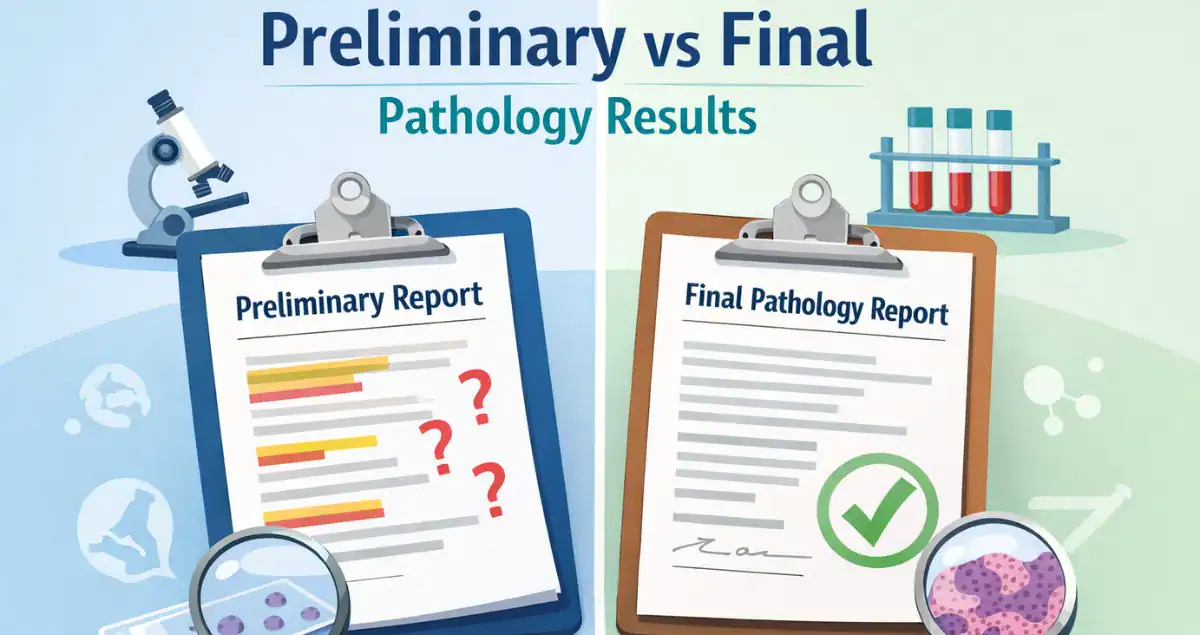
A preliminary pathology result is an early interpretation provided before all diagnostic information is available. It may arise during surgery from frozen section analysis or from an initial microscopic review when time-sensitive guidance is needed.
Preliminary results typically answer narrow questions. They may indicate whether tissue appears benign or malignant, whether margins look involved, or whether additional tissue should be sampled. They are not intended to define tumor subtype, grade, stage, or prognosis.
The word “preliminary” signals uncertainty by design. It reflects what can be responsibly stated at that moment, not what will ultimately be concluded.
Why Preliminary Results Exist
Medicine often requires immediate decisions. Surgeons may need information while a patient is still in the operating room. Clinicians may need early direction to plan next steps or prepare conversations. Preliminary pathology results exist to support these needs.
Their purpose is to guide care in real time without implying diagnostic finality. When used appropriately, they help clinicians act while preserving accuracy.
The Limitations of Early Interpretation
Frozen section analysis and early reviews have technical constraints. Freezing tissue can distort cells and obscure subtle features. Certain architectural patterns are more difficult to evaluate. Some diagnoses simply cannot be made reliably under these conditions.
Even outside frozen sections, preliminary interpretations may occur before immunohistochemistry, special stains, or molecular testing are completed. These additional studies are often essential for distinguishing similar entities or confirming a diagnosis.
Early interpretation is not incomplete because of carelessness. It is incomplete because the process is still underway.
What Final Pathology Results Mean
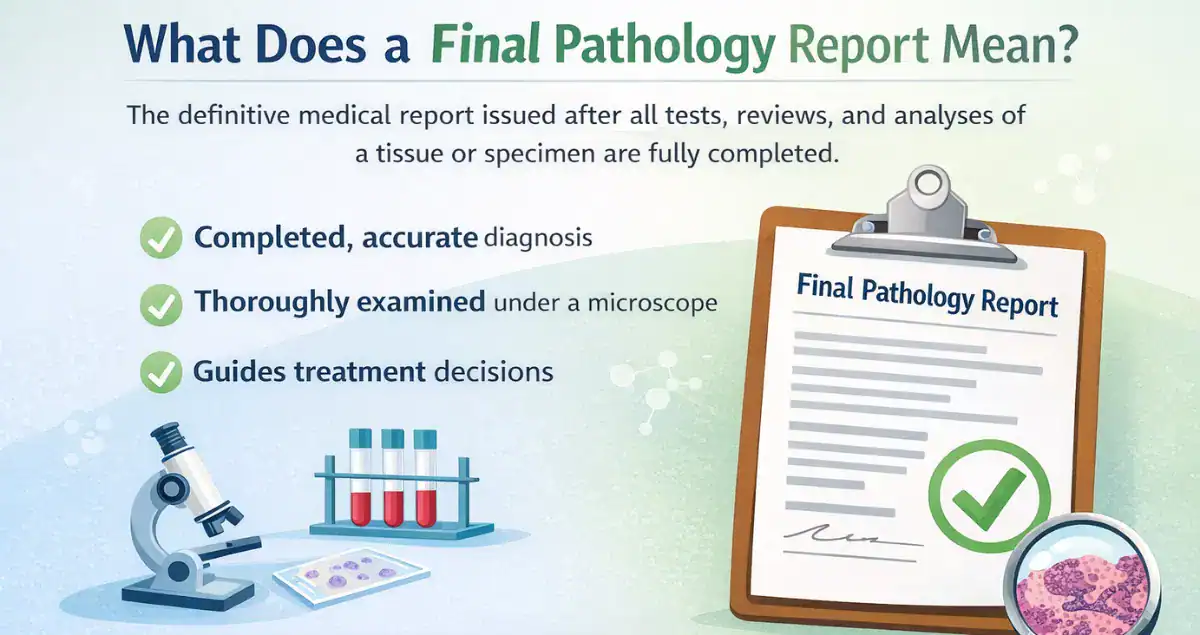
A final pathology report reflects the most complete understanding of a specimen. It incorporates permanent tissue sections, special stains, ancillary testing, and relevant clinical information. This is the diagnosis that becomes part of the permanent medical record.
Final pathology reports provide detail beyond naming a condition. They address size, margins, grade, invasion, lymphovascular involvement, and other features that influence treatment and prognosis. When additional studies are pending, results may be issued later as addenda.
Final means integrated, not rushed.
Why Final Results Take Time
Pathology takes time because accuracy matters. Tissue must be properly fixed to preserve cellular detail. Processing schedules ensure consistency. Special stains and immunohistochemistry require multiple steps and controls. Molecular testing may involve complex analysis and batching.
In some cases, additional review or consultation is appropriate, particularly when findings are subtle or uncommon. These steps are part of quality assurance, not delay.
When Preliminary and Final Results Differ
Occasionally, a preliminary interpretation changes after final review. While unsettling, this does not necessarily indicate an error. It reflects the addition of better-preserved tissue, further testing, or broader context.
Medicine advances by updating conclusions as new information becomes available. Preliminary results are not promised. Final results reflect the full weight of the evidence.
How Clinicians Use Preliminary Results
Clinicians understand that preliminary pathology results are provisional. Surgeons may use them to determine whether more tissue should be removed. Oncologists may use them to plan discussions rather than finalize treatment.
Clear communication between pathologists and clinicians is essential so that early impressions are not mistaken for definitive diagnoses.
How Patients Experience Preliminary Results
For patients, hearing a preliminary result can provoke strong reactions. Some feel immediate relief. Others feel alarm. Both responses are understandable, but neither is complete without context.
Patients benefit from knowing what questions a preliminary result answers and what remains unknown. Asking when final results are expected and whether additional testing is pending can help anchor expectations.
Addenda and Updates to Pathology Reports
Even after a final report is issued, pathology may evolve. Additional studies may return later and be documented as addenda. Rarely, an amendment may be issued if new information significantly changes interpretation.
These updates reflect diligence and transparency. They are part of maintaining an accurate medical record.
Why the Difference Matters
Treatment decisions rely on final pathology results. Staging, prognosis, eligibility for targeted therapy, and surgical planning all depend on detailed and complete information. Confusing preliminary impressions with final diagnoses can lead to unnecessary anxiety or premature conclusions.
Understanding the distinction protects patients and supports thoughtful decision-making.
A Word on Waiting
Waiting for final pathology results is difficult. In most cases, waiting means the specimen is being carefully evaluated, not delayed unnecessarily. Precision takes time, and time often serves accuracy.
Conclusion
Preliminary and final pathology results are not competing answers. They are sequential steps in a deliberate diagnostic process. Preliminary results guide immediate decisions. Final results define long-term care.
Understanding this difference allows patients and clinicians to approach pathology reports with clarity rather than confusion.
If you want to better understand your pathology report or need an independent review, Honest Pathology provides educational resources and second-opinion consultations focused on clarity, accuracy, and transparency.