
Worried by a serous borderline ovarian tumor diagnosis? Learn what it means, how it differs from cancer, and what to ask next.
Serous borderline ovarian tumor means an ovarian growth shows more abnormal cell growth than a benign cyst, but it does not show destructive invasion in the ovary. This diagnosis can feel frightening because the word “tumor” appears beside terms that sound close to ovarian cancer. Pathologists use very specific microscopic criteria to separate a borderline ovarian tumor from low-grade serous carcinoma, and that distinction can affect surgery, staging, follow-up, and sometimes treatment.
Receiving an ovarian pathology report with unfamiliar language often creates an immediate sense of uncertainty. Many patients see phrases such as “borderline,” “micropapillary,” “implants,” or “cannot exclude” and wonder whether the diagnosis is being minimized or whether something has been missed. The most helpful next step is careful clarification, not panic. A pathology diagnosis is like a map: The exact wording helps the care team understand where the disease is, how it behaves, and which route is safest.
Serous Borderline Ovarian Tumor — What It Actually Means
A Serous Borderline Ovarian Tumor is a type of epithelial ovarian tumor with abnormal serous-type cells that grow in a more complex pattern than a benign serous cystadenoma. Under the microscope, the lining cells show increased crowding, budding, and architectural complexity. The key point is that a serous borderline ovarian tumor lacks destructive stromal invasion in the ovary. In plain language, the cells look more active and atypical than normal, but they have not invaded the ovarian tissue in the way a carcinoma does.
A useful analogy is ivy growing on the surface of a wall versus roots breaking into the wall itself. A borderline ovarian tumor may form delicate branching structures and small clusters on the surface or within cyst spaces. Low-grade serous carcinoma, by contrast, shows evidence that tumor cells are infiltrating and destroying supporting tissue. This is why an ovarian pathology report often spends so much attention on architecture, invasion, surface involvement, and implants.
The diagnosis also matters because serous tumors can occur in one ovary, both ovaries, and sometimes on peritoneal surfaces. Pathologists examine many tissue sections to look for features that could change the diagnosis. The difference between serous borderline ovarian tumor and low-grade serous carcinoma is not based on one scary word, but on a pattern of findings across the specimen. Helpful background on how reports are structured is available in What Is a Pathology Report?, especially for patients trying to understand why microscopic descriptions can be so detailed.
Why Your Report Shows This Finding
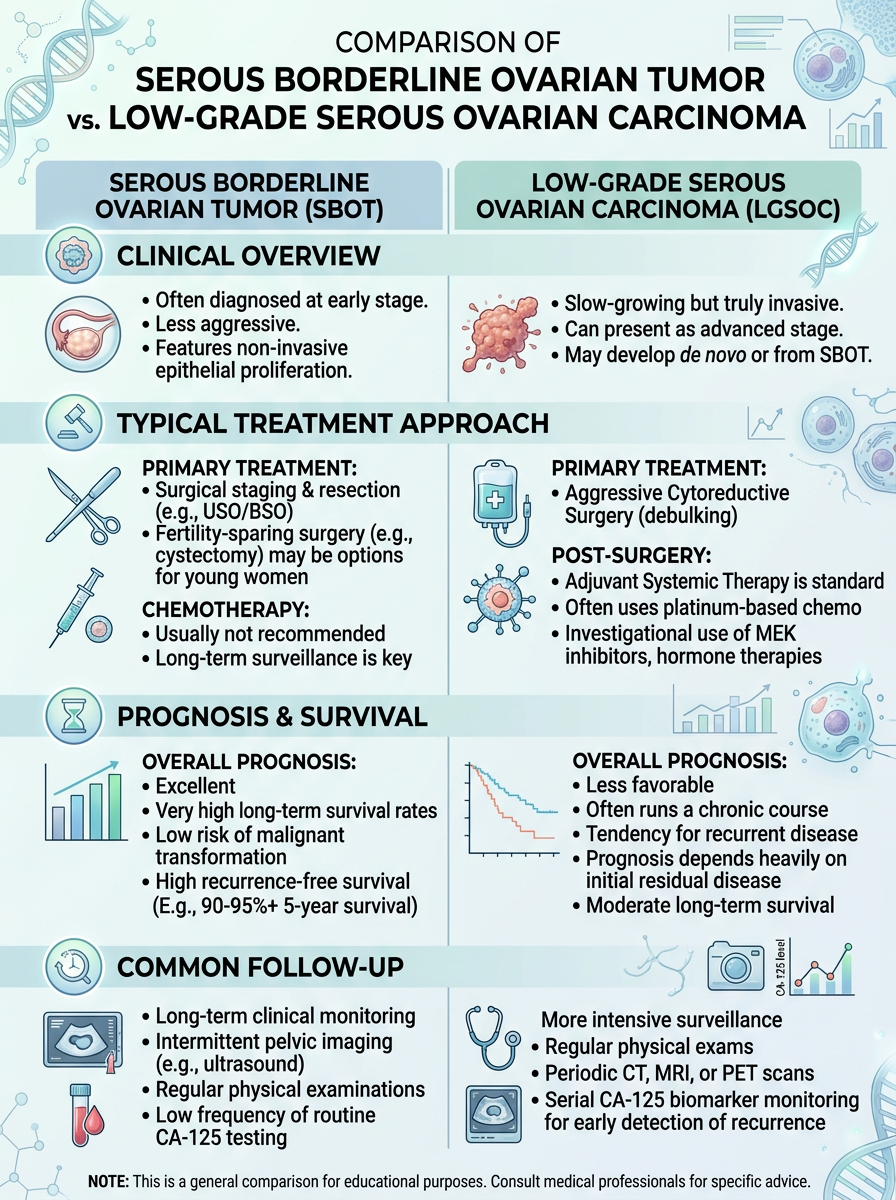
A report may show serous borderline ovarian tumor because the tumor has papillary or branching growth, epithelial proliferation, and mild to moderate cellular atypia without destructive stromal invasion. The pathologist is looking for the boundary between a tumor that is proliferative but noninvasive and a tumor that has become frankly invasive. Low-grade serous carcinoma is diagnosed when the microscopic pattern shows true invasion or, in some settings, invasive disease outside the ovary. This is why the words in the ovarian pathology report need to be read together rather than one phrase at a time.
Several specific features may appear in the microscopic description. A micropapillary pattern means the tumor forms slender, delicate, crowded structures that can be associated with a higher chance of extraovarian disease. Stromal invasion refers to tumor cells infiltrating the supportive ovarian tissue, which is one of the major features that can support carcinoma. Peritoneal implants are tumor deposits found on surfaces inside the abdomen or pelvis, and these may be described as noninvasive or invasive implants depending on their relationship to surrounding tissue.
These distinctions can be difficult even for experienced specialists because serous tumors exist along a biologic spectrum. A borderline ovarian tumor can be associated with peritoneal implants, and not all implants mean the same thing. Noninvasive implants generally behave differently from invasive implants, while invasive implants may lead the care team to manage the condition more like low-grade serous carcinoma. When wording is confusing, Understanding Your Pathology Report: How to Read It with Confidence can help patients organize the diagnosis, microscopic description, and final comment before a visit.
How Serious Is Serous Borderline Ovarian Tumor Compared With Cancer?
Serous borderline ovarian tumor is serious enough to require expert evaluation and appropriate follow-up, but it is not the same diagnosis as high-grade ovarian cancer. Many patients with disease limited to the ovary do very well after surgery, especially when the tumor is completely removed. The seriousness depends on stage, whether both ovaries are involved, whether the ovarian surface is involved, and whether peritoneal implants are present. The ovarian pathology report provides the details that allow the gynecologic oncologist to estimate risk more accurately.
The most important distinction is between serous borderline ovarian tumor and low-grade serous carcinoma. Low-grade serous carcinoma is a true invasive cancer, but it usually behaves differently from high-grade serous carcinoma. It often grows more slowly, may be less responsive to conventional chemotherapy, and may be managed with surgery, hormonal therapy, targeted therapy in selected cases, or surveillance depending on the clinical situation. A diagnosis of low-grade serous carcinoma usually changes the conversation from risk reduction and monitoring to cancer staging and long-term disease management.
Features that can increase concern include a micropapillary pattern, invasive implants, destructive stromal invasion, and residual disease after surgery. A micropapillary pattern does not automatically mean carcinoma, but it may prompt careful sampling and staging review. Invasive implants are particularly important because they can be associated with behavior closer to low-grade serous carcinoma. This is one reason a second pathology opinion may be helpful when the report uses cautious language or when treatment decisions depend on whether invasion is truly present.
What Happens Next: Surgery, Staging, and Monitoring
After a diagnosis of serous borderline ovarian tumor, the treating team usually reviews the operative findings, imaging, pathology, and whether formal surgical staging was performed. Staging may include assessment of the ovaries, fallopian tubes, uterus, omentum, lymph nodes in selected cases, and peritoneal surfaces. The goal is to determine whether the disease is confined to the ovary or whether peritoneal implants are present. For younger patients who wish to preserve fertility, surgery may sometimes be more conservative, but that decision depends on tumor extent and specialist judgment.
Monitoring often includes pelvic examinations, imaging when clinically indicated, and sometimes blood markers such as CA-125 if it was elevated before surgery. A borderline ovarian tumor can recur, and recurrence may be borderline or, less commonly, low-grade serous carcinoma. Follow-up is usually long term because serous tumors can recur years later. The frequency of monitoring depends on stage, completeness of surgery, fertility-sparing treatment, and whether any concerning microscopic findings were present.
When the diagnosis is low-grade serous carcinoma, the next steps may include oncologic staging, discussion of residual disease, and consideration of systemic therapy. The ovarian pathology report may also mention tests used for treatment planning, including immunohistochemistry or molecular testing in selected cases. Ki-67 is sometimes discussed in tumor reports as a proliferation marker, although it is not the sole basis for this diagnosis; patients seeing that term may find What Does Ki-67 Mean and How High Is Concerning? useful. The main principle is that treatment follows the whole clinical picture, not a single microscopic phrase.
Questions to Ask Your Doctor or Pathologist
- Does the final diagnosis say serous borderline ovarian tumor, low-grade serous carcinoma, or both in different sites?
- Was any destructive stromal invasion identified in the ovary?
- Does the report mention a micropapillary pattern, and if so, how extensive is it?
- Were peritoneal implants found, and were they noninvasive or invasive implants?
- Was the tumor present on the ovarian surface or in both ovaries?
- Was the specimen fully sampled enough to exclude a small focus of carcinoma?
- Would a gynecologic pathology second opinion change staging, treatment, or follow-up?
These questions are not meant to challenge the care team; they are meant to make the diagnosis understandable. A patient can ask for the final diagnosis, comment section, and synoptic report to be reviewed line by line. The most useful conversations often happen when the gynecologic oncologist and pathologist are using the same precise definitions.
A second review is especially reasonable when the report sits near the boundary between borderline ovarian tumor and low-grade serous carcinoma. It may also be useful when invasive implants, micropapillary pattern, or stromal invasion are mentioned. Practical guidance is available in When Should You Get a Second Pathology Opinion? and How to Get a Second Opinion on Your Pathology Diagnosis.
Frequently Asked Questions
Is serous borderline ovarian tumor cancer?
Serous borderline ovarian tumor is not classified the same way as invasive ovarian carcinoma because it lacks destructive invasion in the ovary. It is also not simply a benign cyst, because the cells show abnormal proliferation and the tumor can recur. The diagnosis sits between benign and malignant categories, which is why the word “borderline” is used. Stage and implants strongly influence the level of concern.
Can a serous borderline ovarian tumor turn into low-grade serous carcinoma?
A serous borderline ovarian tumor can recur, and some recurrences may be diagnosed as low-grade serous carcinoma. This does not mean every patient will have progression. The risk depends on stage, completeness of surgery, micropapillary pattern, and whether invasive implants are present. Long-term follow-up is recommended because recurrences can occur after many years.
What is the difference between borderline ovarian tumor and low-grade serous carcinoma?
The main difference is invasion. A borderline ovarian tumor shows abnormal growth without destructive stromal invasion, while low-grade serous carcinoma shows invasive growth or invasive disease in extraovarian sites. Pathologists make this distinction by examining tissue architecture, the supporting stroma, and any peritoneal implants. This distinction can affect staging, treatment, and follow-up.
Do invasive implants mean ovarian cancer?
Invasive implants are more concerning than noninvasive implants because they show tumor involving extraovarian tissue in an invasive pattern. In many clinical settings, invasive implants are managed similarly to low-grade serous carcinoma. The wording should be reviewed carefully by a gynecologic pathologist because implant classification can be challenging. The patient’s surgeon and oncologist then combine the pathology with operative findings.
Should I get a second opinion on serous borderline ovarian tumor?
A second opinion can be very helpful when serous borderline ovarian tumor is close to low-grade serous carcinoma in the report. Review is especially useful if the report mentions micropapillary pattern, stromal invasion, peritoneal implants, or invasive implants. A gynecologic pathology review may confirm the original diagnosis or refine the wording. Even when the diagnosis does not change, the explanation can make treatment discussions much clearer.
A diagnosis at the boundary between serous borderline ovarian tumor and low-grade serous carcinoma can feel emotionally exhausting, but the distinction is based on careful, reviewable microscopic criteria. Patients and families often feel more grounded once the report is translated into plain language and the key risk features are identified. Honest Pathology consultations can help clarify confusing wording, prepare questions, and support an informed discussion with the treating team.
References:
National Cancer Institute — Pathology Reports
National Cancer Institute — Borderline Tumor
NCBI Bookshelf — Medical Reference Texts