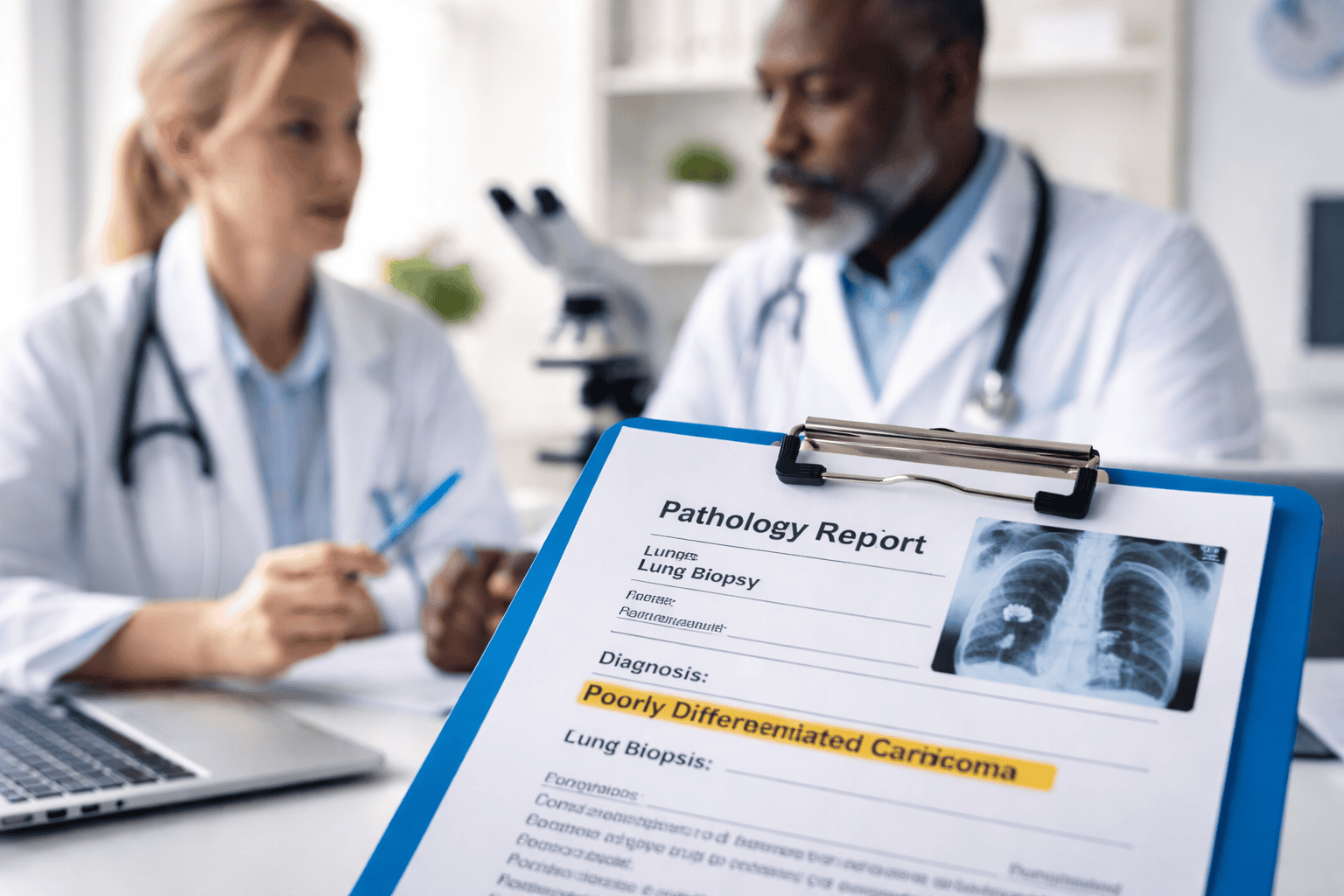
When reading a lung cancer pathology report, the phrase “poorly differentiated” can be especially unsettling. It sounds ominous and vague, and patients often worry that it automatically means the worst. In reality, “poorly differentiated” is a technical term used by pathologists to describe how cancer cells appear under the microscope. Understanding what this term means, why it is used, and how it affects diagnosis and treatment can help patients better interpret their report and have more informed conversations with their care team.
How Pathologists Use Differentiation
Differentiation refers to how closely cancer cells resemble normal, healthy cells from the tissue where the cancer began. Well-differentiated tumors look more like normal lung cells and often retain recognizable structures. Moderately differentiated tumors fall somewhere in between.
Poorly differentiated tumors, by contrast, look very different from normal lung tissue. The cancer cells may appear disorganized, primitive, or atypical, making it harder to determine exactly what type of cells they originated from.
 Why Lung Cancers Can Be Poorly Differentiated
Cancer cells change as they grow and divide. Over time, some tumors lose the defining features that link them to their cell of origin. In lung cancer, this can happen as tumors become more aggressive or evolve biologically.
Poor differentiation does not occur because of an error or lack of expertise. It reflects the biology of the tumor itself. Even with advanced tools and experienced pathologists, some tumors simply do not display clear characteristics that allow easy classification.
What Poor Differentiation Means for Diagnosis
When a lung cancer is poorly differentiated, making a precise diagnosis can be more challenging. Under the microscope, the tumor may not clearly resemble adenocarcinoma, squamous cell carcinoma, or another specific subtype.
In these cases, pathologists rely heavily on immunohistochemistry and molecular testing to gather more information. Special stains and markers can help reveal whether the tumor has glandular, squamous, neuroendocrine, or other features that are not obvious on routine examination.
Poor Differentiation and NSCLC, NOS
Poorly differentiated lung cancers are often labeled as non–small cell lung cancer, not otherwise specified, or NSCLC, NOS. This designation reflects uncertainty in subtype classification rather than uncertainty about whether the tumor is cancer.
NSCLC, NOS is commonly used when a tumor lacks clear features of adenocarcinoma or squamous cell carcinoma despite additional testing. This careful labeling helps avoid assumptions that could misguide treatment.
Does Poorly Differentiated Mean More Aggressive?
Poor differentiation is often associated with more aggressive behavior, but it is not a standalone predictor of outcome. Many factors influence prognosis, including cancer stage, molecular characteristics, response to treatment, and overall health.
Some poorly differentiated tumors respond very well to modern therapies, particularly when targetable molecular alterations or immunotherapy options are available. Poor differentiation describes appearance, not destiny.
How Poor Differentiation Affects Treatment Decisions
Treatment planning for poorly differentiated lung cancer focuses less on how the tumor looks and more on actionable features such as molecular mutations, PD-L1 expression, and clinical stage.
Because subtype classification may be uncertain, oncologists often prioritize comprehensive molecular testing and immunotherapy markers. This ensures that treatment decisions are based on the most meaningful predictive information available.
The Role of Molecular Testing in Poorly Differentiated Tumors
Molecular testing is especially important in poorly differentiated lung cancer. Even when histologic features are unclear, molecular alterations can provide definitive guidance for therapy.
Targeted therapies may be highly effective regardless of how differentiated the tumor appears under the microscope. This makes molecular testing a critical tool in turning an ambiguous diagnosis into a personalized treatment plan.
Why Small Biopsies Add Complexity
Poorly differentiated lung cancers are often diagnosed on small biopsies, which may capture only a limited portion of the tumor. Small samples can make it harder to see defining features and can restrict the number of tests that can be performed.
Pathologists must carefully balance the use of tissue for diagnosis, immunohistochemistry, and molecular testing. This is one reason expert pathology handling is so important in lung cancer care.
Why Expert Pathology Review Can Be Helpful
Poorly differentiated tumors are among the most challenging cases in pathology. Subtle findings, staining patterns, and test selection all matter. Expert pathology review can help confirm the diagnosis, ensure appropriate testing, and clarify uncertainties.
For patients facing complex or unclear pathology reports, an expert review can provide reassurance and deeper understanding.
What Patients Can Ask About a Poorly Differentiated Diagnosis
Patients who see “poorly differentiated” on their pathology report can ask their care team how confident the diagnosis is, what additional testing has been performed, and how the findings influence treatment options. These questions can help demystify the report and foster shared decision-making.
Understanding that poor differentiation reflects tumor biology rather than a lack of information can help reduce anxiety.
Finding Clarity in a Complex Diagnosis
A diagnosis of poorly differentiated lung cancer highlights the complexity of cancer biology and the sophistication of modern diagnostic tools. While the term may sound alarming, it often signals the need for deeper analysis rather than a definitive conclusion about outcome.
For patients seeking clarity and confidence in the face of a complex lung cancer diagnosis, Honest Pathology provides independent expert pathology review with clear, patient-centered explanations. Their goal is to help patients understand what their pathology report means and how it fits into the broader picture of personalized cancer care.