Worried by a kidney biopsy result? MEST-C score IgA nephropathy explains scarring, inflammation, and what to ask next.
MEST-C score IgA nephropathy is a biopsy scoring system that helps doctors describe how much kidney inflammation, scarring, and active injury are present. It appears in many reports for IgA nephropathy, a kidney disease in which IgA immune deposits collect in the filtering units of the kidney. The score does not replace kidney function tests, urine protein levels, blood pressure, or a specialist’s judgment, but it gives important tissue-level information.
Seeing letters, numbers, and terms such as M1, S1, or C2 can feel frightening, especially when the report arrives before a full explanation. A kidney biopsy report often sounds more severe than it feels because pathologists use precise shorthand. Clear translation can turn that shorthand into useful questions and a calmer next step.
For patients trying to understand the structure of a report, What Is a Pathology Report? can help explain why biopsy language is so detailed.
MEST-C Score IgA Nephropathy — What It Actually Means
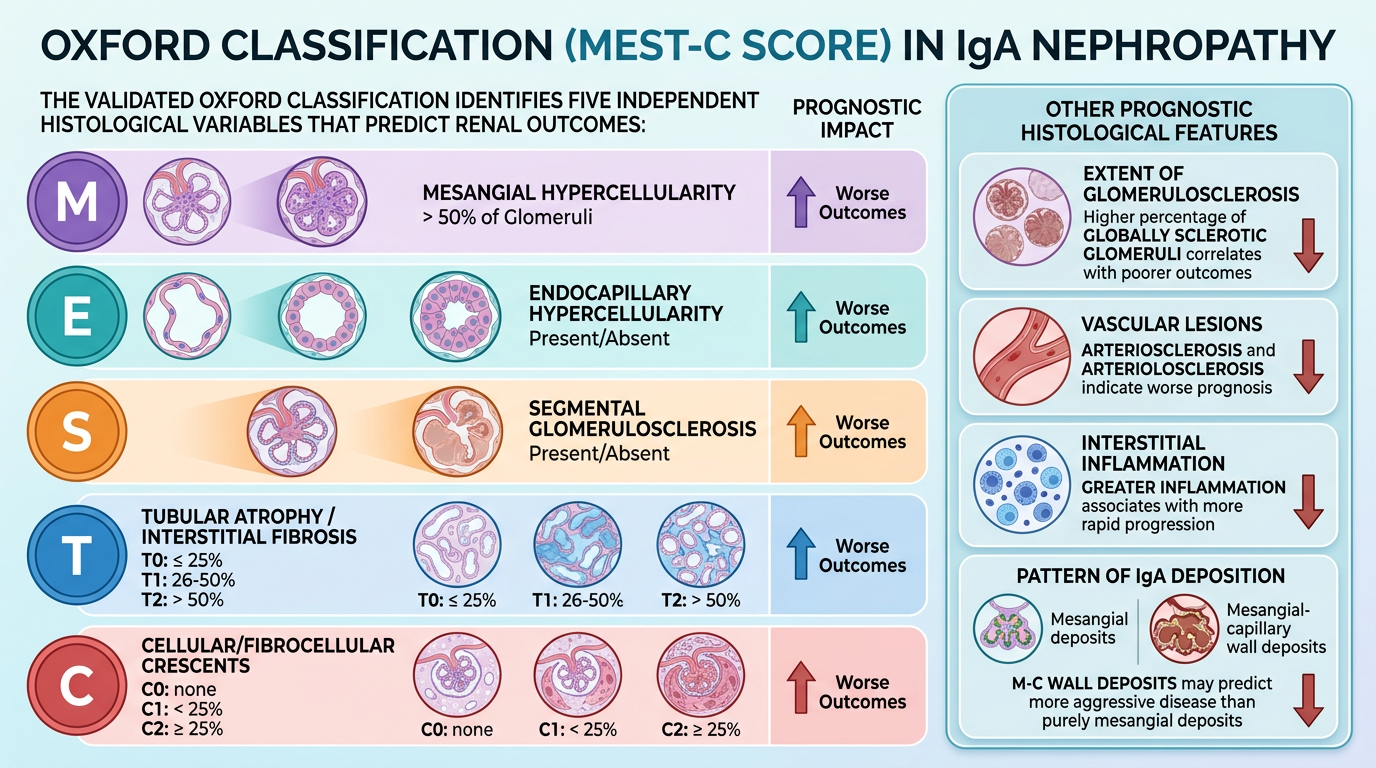
The MEST-C score IgA nephropathy system comes from the Oxford classification, a widely used method for describing specific microscopic findings in an IgA nephropathy biopsy. Each letter stands for a feature seen under the microscope: M for mesangial hypercellularity, E for endocapillary hypercellularity, S for segmental sclerosis, T for tubular atrophy and interstitial fibrosis, and C for crescents. The number after each letter shows whether that feature is absent, present, or present to a certain degree. In plain language, the score is a structured way of describing what the kidney tissue looks like.
A helpful analogy is a home inspection after a storm. One part of the report might describe fresh water damage, another might describe older structural damage, and another might describe whether the foundation has lasting weakness. The MEST-C score IgA nephropathy system works in a similar way by separating active inflammation from chronic scarring. This helps the kidney specialist decide which problems may still be treatable and which changes represent older, less reversible injury.
In a kidney pathology report, the MEST-C score is only one piece of the full picture. The pathologist also examines the number of glomeruli, the quality of the biopsy sample, immune deposits, and special stains. A kidney biopsy report may also include immunofluorescence findings showing IgA deposits and electron microscopy findings showing where those deposits sit. For many patients, Understanding Your Pathology Report: How to Read It with Confidence is a useful companion when reading this type of technical language.
Why The Kidney Biopsy Report Shows These Findings

IgA nephropathy develops when IgA-containing immune complexes become trapped in the glomeruli, the tiny filters that clean the blood. Over time, these deposits can trigger inflammation, blood in the urine, protein leakage, and scarring. An IgA nephropathy biopsy is performed because blood and urine tests can suggest kidney injury but cannot show the tissue pattern directly. The biopsy gives the most specific view of what is happening inside the kidney filters.
The Oxford classification was developed to make reports more consistent and clinically useful. Mesangial hypercellularity means there are too many cells in part of the glomerulus where IgA deposits often collect. Segmental sclerosis means part of a glomerulus has developed a scar, which can reflect previous injury. Crescent formation means a reaction has developed in Bowman’s space, often suggesting more active or recent glomerular damage.
The MEST-C score IgA nephropathy result may also reflect the timing of the disease. Some findings, such as endocapillary hypercellularity or crescent formation, may represent active inflammation. Other findings, such as tubular atrophy and interstitial fibrosis, point toward chronic scarring in the kidney tissue. This is why a kidney pathology report can describe both recent activity and older damage in the same biopsy.
How Serious Is MEST-C Score IgA Nephropathy?
The seriousness of MEST-C score IgA nephropathy depends on the specific pattern, not just the presence of a score. A report with only mild mesangial hypercellularity may carry a different meaning than a report showing extensive chronic scarring or many crescents. The score must be interpreted together with estimated glomerular filtration rate, urine protein level, blood pressure, age, medications, and clinical history. A single letter-number combination should not be treated as a complete prognosis by itself.
Some MEST-C findings are more concerning because they suggest permanent loss of kidney structure. T1 or T2 means there is a measurable amount of tubular atrophy and interstitial fibrosis, which generally reflects chronic kidney damage. Segmental sclerosis can also suggest prior injury and may be associated with a higher risk of progression, especially when proteinuria remains high. In contrast, some active findings may improve or stabilize with treatment when recognized early.
MEST-C score IgA nephropathy is most useful when it helps guide risk discussion and monitoring. For example, C1 means crescents are present in fewer than 25% of glomeruli, while C2 means crescents are present in at least 25% of glomeruli. Crescent formation can raise concern for active injury, but its meaning depends on kidney function, how many glomeruli were sampled, and whether treatment has already started. A careful IgA nephropathy biopsy review can help separate mild activity from findings that need urgent nephrology attention.
What Happens Next: Treatment And Monitoring
After the kidney biopsy report is finalized, the nephrologist usually combines the MEST-C score with clinical risk factors. Common next steps include controlling blood pressure, reducing urine protein, reviewing medications, and monitoring kidney function over time. Many patients are treated with supportive measures such as renin-angiotensin system blockade when appropriate. Some patients may need immunosuppressive therapy, but that decision depends on the whole clinical picture rather than the biopsy score alone.
Follow-up often includes repeat blood tests, urine protein measurements, urine microscopy, and blood pressure checks. The kidney pathology report helps explain why monitoring is needed and which risks deserve the most attention. If the Oxford classification shows more chronic scarring, the care plan may focus heavily on slowing further damage. If active inflammation is present, the nephrologist may discuss whether additional treatment could reduce ongoing injury.
A second pathology review can be helpful when the report is unclear, the sample is limited, or treatment decisions depend heavily on the biopsy interpretation. Kidney biopsies require special stains, immunofluorescence, and often electron microscopy, so expertise matters. Patients considering another review may find When Should You Get a Second Pathology Opinion? helpful. A second opinion does not mean the first report was wrong; it means the diagnosis and scoring are being checked before major decisions are made.
Questions To Ask Your Doctor Or Pathologist
- How many glomeruli were present in the kidney biopsy sample?
- What are the individual M, E, S, T, and C scores in the report?
- Does the IgA nephropathy biopsy show more active inflammation or more chronic scarring?
- How much tubular atrophy and interstitial fibrosis is present?
- Does the Oxford classification result change the treatment plan?
- How does the MEST-C score IgA nephropathy result compare with the urine protein level and kidney function?
- Would a kidney pathology report second opinion be useful before starting immunosuppressive treatment?
These questions can help turn a technical report into a focused medical conversation. Pathologists often describe what is seen in the tissue, while nephrologists connect those findings to symptoms, laboratory values, and treatment choices. Both perspectives matter, especially when the score includes chronic scarring or crescent formation.
When a report feels confusing, patients can ask for the full biopsy report, not only the summary line. A complete report usually includes light microscopy, immunofluorescence, and sometimes electron microscopy. For those seeking a formal review, How to Get a Second Opinion on Your Pathology Diagnosis explains the practical steps.
Frequently Asked Questions
What does MEST-C mean in IgA nephropathy?
MEST-C score IgA nephropathy refers to five biopsy features used in the Oxford classification. M describes mesangial hypercellularity, E describes endocapillary hypercellularity, S describes segmental sclerosis, T describes tubular atrophy and interstitial fibrosis, and C describes crescents. Each feature gives the doctor information about inflammation, scarring, or active damage. The score helps guide risk assessment but does not replace kidney function tests.
Is a MEST-C score a cancer result?
No. MEST-C score IgA nephropathy is not a cancer result and does not mean a tumor was found. It is a kidney biopsy scoring system used for an inflammatory kidney disease. The letters describe patterns of kidney filter injury, not malignant cells. A kidney biopsy report for IgA nephropathy is very different from a cancer pathology report.
Which MEST-C score is the worst?
There is no single “worst” score that applies to every patient. Higher chronic scarring, especially T1 or T2, often raises concern because scarred tissue is less reversible. C2 may also be concerning because it means crescents are present in a larger proportion of sampled glomeruli. The full kidney pathology report and clinical data are needed to understand risk.
Can IgA nephropathy biopsy results change treatment?
Yes. An IgA nephropathy biopsy can affect treatment by showing whether the kidney has mostly active inflammation, chronic scarring, or a mixture of both. The Oxford classification helps the nephrologist decide how aggressive monitoring or treatment should be. Treatment choices also depend on kidney function, urine protein, blood pressure, and overall health. The biopsy result is one strong piece of a larger decision.
Should I get a second opinion on my kidney biopsy report?
A second opinion may be helpful if the report is unclear, the sample is limited, or a major treatment decision depends on the MEST-C score. Kidney pathology can be technically complex because it may require light microscopy, immunofluorescence, and electron microscopy. A second review can confirm the diagnosis, refine the Oxford classification, or identify details that affect management. This is especially reasonable when immunosuppressive therapy is being considered.
A MEST-C score can feel intimidating, but it is meant to organize information, not frighten patients. The most useful next step is usually a careful discussion that connects the biopsy findings with kidney function, urine protein, and treatment options. Honest Pathology consultations can help patients and families understand the wording of a kidney biopsy report and prepare clearer questions for the treating nephrologist.
References:
National Cancer Institute — Pathology Reports Fact Sheet
MedlinePlus — Kidney Diseases
NCBI Bookshelf — Biomedical And Clinical Reference Library