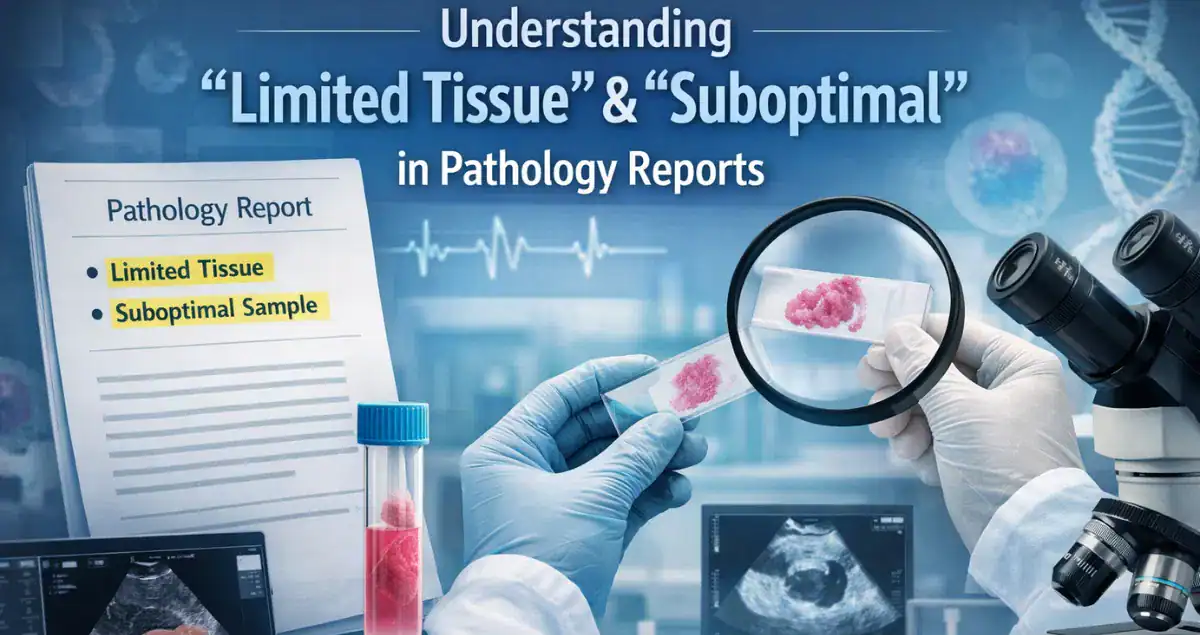
Seeing the words “suboptimal” or “limited tissue” in a pathology report can be unsettling. For many patients, these phrases sound like something went wrong or that the test failed to give a real answer. In reality, this language reflects the limits of what the sample can reliably show, not a lack of effort or attention. Understanding what these terms mean can help reduce confusion and guide next steps without unnecessary alarm.
Pathology reports are written to describe exactly what was examined and how confident the interpretation can be. When tissue is described as suboptimal or limited, the report is signaling boundaries, not mistakes.
What Pathologists Mean by “Limited Tissue”
A pathology diagnosis depends on both what is present and how much of it can be evaluated. “Limited tissue” means the sample contains only a small amount of diagnostic material. This may be because the lesion is small, difficult to reach, or sampled conservatively to reduce risk to the patient.
Limited tissue does not automatically mean the diagnosis is unreliable. In many cases, there is enough information to answer the clinical question. However, limited samples reduce the ability to assess features such as extent, margins, or subtle changes that require broader context.
What “Suboptimal” Tissue Refers To
“Suboptimal” refers to tissue quality rather than quantity. The sample may be small, distorted, poorly preserved, or affected by artifact. Crushing, cautery, fragmentation, or delayed fixation can all obscure important microscopic details.
Suboptimal tissue can still be diagnostic, but it may limit how confidently certain features can be assessed. Pathologists use this term to communicate that interpretation was performed under less-than-ideal conditions.
Why Tissue Can Be Limited or Suboptimal
Biopsies are designed to minimize harm while obtaining diagnostic material. Needles and forceps sample only a fraction of tissue, and in some locations aggressive sampling is not safe. In other cases, bleeding, patient discomfort, or an unexpected tissue texture may limit how much can be collected.
Technical factors also play a role. Tissue may be fragile, friable, or difficult to orient. In some procedures, cautery is necessary to control bleeding, even though it can affect tissue quality.
These realities reflect the balance between patient safety and diagnostic yield.
 How These Terms Affect the Diagnosis
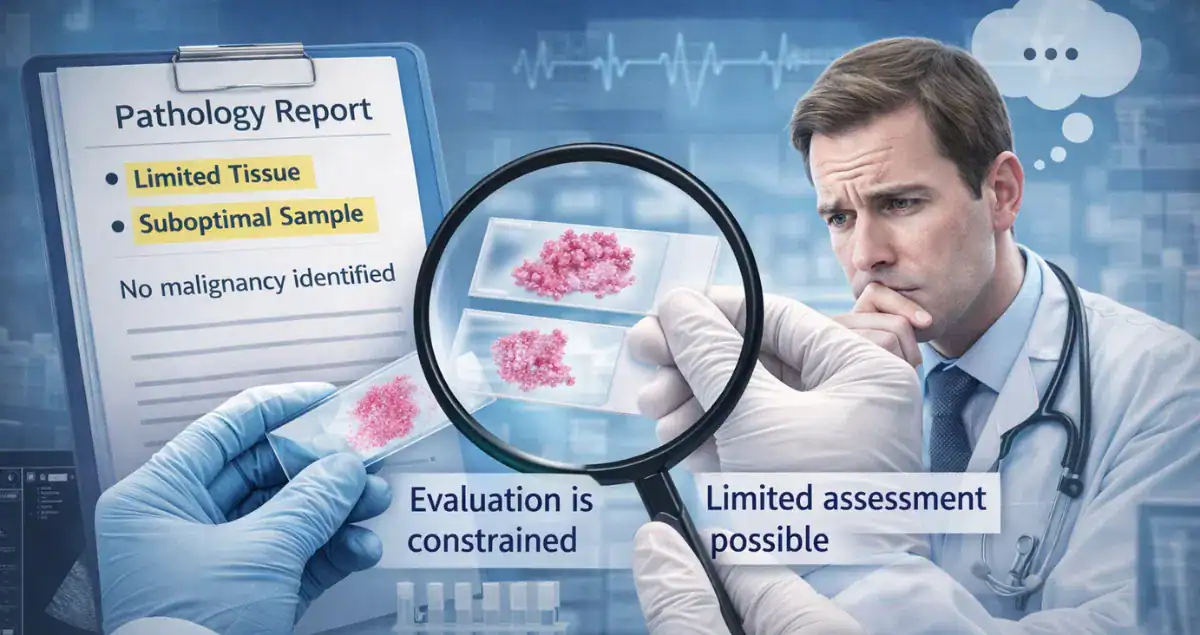
When tissue is limited or suboptimal, pathologists may still provide a diagnosis, but with carefully chosen language. Reports may state that no malignancy is identified in the tissue examined while acknowledging that evaluation is constrained.
This does not mean cancer was seen and hidden. It means conclusions are based strictly on what was available. Pathologists use this language to avoid overstating certainty when the sample cannot support it.
Why These Phrases Matter
These terms are important because they help clinicians interpret how much confidence to place in the result. A benign finding in a robust, well-preserved sample is more reassuring than the same finding in a tiny or damaged specimen.
By flagging limitations, the report invites correlation with clinical findings, imaging, and symptoms rather than passive acceptance.
When Limited Tissue Is Still Enough
In many situations, even a small sample can be diagnostic. Certain cancers and benign conditions have distinctive features that are recognizable even in minimal tissue. In these cases, limited tissue does not compromise the answer.
Pathologists are trained to extract as much information as possible from small samples while being honest about what cannot be assessed.
When Limited Tissue May Prompt Further Evaluation
If clinical suspicion remains high or imaging findings are concerning, limited or suboptimal tissue may prompt repeat biopsy, additional sampling, or alternative diagnostic approaches. This decision is made by the clinical team, informed by the pathology report.
The presence of these terms does not automatically mean another procedure is required. It means the possibility should be considered in context.
How Patients Often Misinterpret These Terms
Patients sometimes interpret “suboptimal” as meaning the sample was mishandled or that the test failed. In reality, it reflects transparency. The pathologist is clearly communicating the conditions under which the diagnosis was made.
This language protects patients from false reassurance and helps avoid overconfidence in uncertain situations.
Why Pathologists Use Careful Language
Pathology reports are legal and medical documents. Words are chosen deliberately. Phrases like “limited tissue” or “suboptimal sample” are used to define the boundaries of interpretation, not to evade responsibility.
Clear language allows clinicians to make informed decisions and supports shared discussions with patients.
The Role of Follow-Up
Follow-up is essential when tissue is limited. Monitoring symptoms, repeating imaging, or scheduling additional evaluation ensures that evolving conditions are detected. Many diagnoses are clarified over time rather than in a single test.
Limited tissue today does not mean limited answers forever.
Conclusion
Seeing “suboptimal” or “limited tissue” in a pathology report does not mean the test failed. It means the pathologist is being precise about what the sample can and cannot show. These terms reflect honesty, not uncertainty avoidance.
Understanding this language helps patients interpret reports more accurately and engage in informed discussions about next steps.
If you have questions about a pathology report or want help understanding whether tissue limitations affect your diagnosis, Honest Pathology offers educational guidance and second-opinion review recommendations focused on clarity and transparency.