Worried by unfamiliar lung cancer terms? A lepidic growth pattern can sound frightening; learn what it means and what to ask next.
lepidic growth pattern means that some lung adenocarcinoma cells are growing along the existing air spaces of the lung rather than immediately destroying them. This phrase is common in a pathology report for certain lung tumors, especially tumors found as a ground glass nodule on imaging. It does not, by itself, give the whole stage, prognosis, or treatment plan.
Seeing unfamiliar words after a lung biopsy or surgery can feel like being handed a map in another language during a crisis. The term lepidic growth pattern often causes fear because it appears next to the word cancer, yet it is actually a descriptive microscopic pattern, not a separate diagnosis. Pathologists use it to explain how the tumor is arranged under the microscope.
Clarity matters because treatment decisions in lung adenocarcinoma depend on several details working together. The size of the invasive component, tumor invasion, margins, lymph nodes, and molecular testing all matter. A patient who understands this term can ask more focused questions and feel less trapped by medical language.
Lepidic Growth Pattern — What It Actually Means
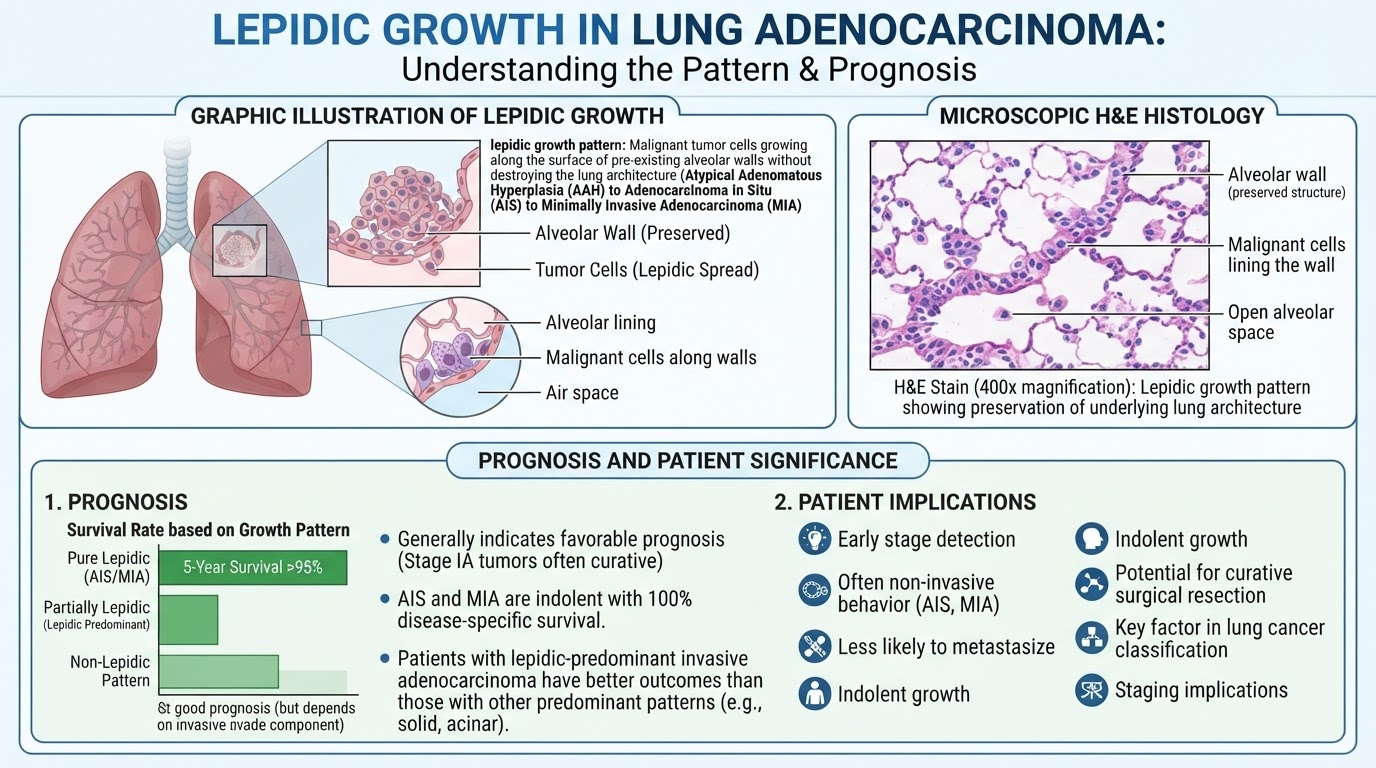
A lepidic growth pattern describes cancer cells spreading like a thin lining along preexisting alveolar walls, which are the delicate air-space structures inside the lung. A useful analogy is ivy growing along a fence: The fence is still present, but abnormal cells are coating its surface. In lung adenocarcinoma, this pattern can be part of a spectrum ranging from very limited disease to tumors that also have invasive areas.
Pathologists identify a lepidic growth pattern by examining stained tissue sections under a microscope. The key feature is that tumor cells follow the natural air-space architecture instead of forming a destructive mass in that specific area. The pathology report may mention the percentage of lepidic pattern, especially in a surgically removed tumor. That percentage helps separate lepidic growth from other patterns, such as acinar, papillary, micropapillary, or solid growth.
The phrase does not mean the cancer is harmless, and it does not mean the cancer has already spread. It is one piece of a larger diagnosis, much like one weather reading does not describe the whole forecast. A lepidic growth pattern is often associated with slower-growing areas, but the final interpretation depends on tumor invasion and the total tumor size. For patients trying to understand the overall document, a plain-language overview such as Understanding Your Pathology Report: How to Read It with Confidence can make the wording easier to sort through.
Why Your Report Shows This Finding

A pathology report shows this finding because the tissue sample contains areas where lung adenocarcinoma cells line the alveolar walls. The sample may come from a needle biopsy, a wedge resection, a segmentectomy, or a lobectomy. In a small biopsy, only part of the tumor is sampled, so the report may describe lepidic features without being able to measure the entire invasive component. In a surgical specimen, pathologists can usually assess the full tumor more accurately.
Radiology often connects with this microscopic pattern. A ground glass nodule on a CT scan may correspond to lepidic growth, because the air spaces are partly preserved rather than completely replaced by dense tumor. However, imaging cannot prove the exact pattern by itself. A ground glass nodule can contain noncancerous inflammation, preinvasive lesions, minimally invasive disease, or invasive adenocarcinoma, so tissue diagnosis remains central.
Pathologists also look carefully for tumor invasion, because that is one of the most important distinctions. Tumor invasion means cancer cells are no longer only lining alveolar walls; they are pushing into or destroying lung tissue, forming scars, or growing in more compact patterns. The report may mention invasive adenocarcinoma if an invasive component is present. Other important details may include the surgical margin, lymphovascular invasion, pleural invasion, lymph node status, and biomarker testing.
How Serious Is a Lepidic Growth Pattern?
A lepidic growth pattern can be associated with a more favorable outlook when it is the main pattern and when tumor invasion is absent or very small. In some early lung adenocarcinoma tumors, a lepidic-predominant pattern may behave less aggressively than solid or micropapillary patterns. That said, seriousness depends on the complete diagnosis, not the phrase by itself. The same report may contain both lepidic growth and a more invasive component.
The most reassuring scenario is a small tumor with lepidic growth only or with minimal tumor invasion, clear surgical margin, and no lymph node involvement. In that setting, the finding may support an early-stage diagnosis and a lower risk of recurrence. A ground glass nodule that corresponds mostly to lepidic growth may also be followed closely or removed depending on size, growth, symptoms, and patient health. The clinical team combines CT findings, pathology findings, and surgical results before recommending next steps.
A more serious scenario occurs when lepidic growth pattern is only a small part of a larger invasive adenocarcinoma. If the tumor has a sizable invasive component, lymph node spread, pleural involvement, or a positive surgical margin, those findings usually carry more weight than the lepidic portion. Tumor invasion is often the feature that changes staging and treatment planning. This is why a lepidic growth pattern should be read together with measurements, stage, margin status, and molecular results.
What Happens Next: Treatment and Monitoring
Next steps depend on whether the diagnosis came from a biopsy or a surgical resection. After a biopsy, the clinical team may recommend surgery, additional imaging, pulmonary function testing, or molecular testing, depending on whether the tumor appears removable and whether there is concern for spread. After surgery, the pathology report usually gives more complete information about tumor size, invasive size, lymph nodes, and surgical margin status. These details help determine whether observation, additional treatment, or oncology consultation is appropriate.
Monitoring may involve repeat CT scans, especially when the original imaging showed a ground glass nodule or part-solid nodule. Some nodules grow slowly, and changes over time can matter as much as the first measurement. In lung adenocarcinoma, follow-up schedules vary based on stage, treatment, smoking history, other lung disease, and institutional guidelines. Patients should receive a clear plan that explains when the next scan is due and what change would trigger action.
If the wording feels confusing or if the biopsy seems limited, a second pathology review can be helpful. A review may confirm the lepidic growth pattern, clarify whether invasive adenocarcinoma is present, or refine the estimated amount of tumor invasion. For cases in which treatment choices are significant, patients may find When Should You Get a Second Pathology Opinion? useful. The goal is not to create doubt; the goal is to make sure the diagnosis is as precise as possible before major decisions are made.
Questions to Ask Your Doctor or Pathologist
- Does the pathology report describe pure lepidic growth, lepidic-predominant lung adenocarcinoma, or invasive adenocarcinoma with a lepidic component?
- How large is the invasive component, and how was tumor invasion measured?
- Was the surgical margin clear, close, or positive?
- Did the lymph nodes show any cancer?
- Does the ground glass nodule on CT match the findings seen under the microscope?
- Are molecular tests, such as EGFR, ALK, ROS1, BRAF, MET, RET, NTRK, or KRAS, recommended?
- Would a second pathology review change staging, surgery planning, or oncology treatment?
These questions are meant to turn a frightening phrase into a structured conversation. A pathology report can contain many measurements and qualifiers, and some of them matter more than others. A basic explanation of report sections is available in What Is a Pathology Report?.
When the diagnosis comes from a small biopsy, uncertainty can be normal because only a small amount of tissue is available. A second opinion may be reasonable if the report uses cautious language, if the diagnosis affects surgery, or if the findings seem different from imaging. Practical steps are outlined in How to Get a Second Opinion on Your Pathology Diagnosis.
Frequently Asked Questions
Is lepidic growth pattern cancer?
A lepidic growth pattern is not a separate cancer type by itself. It is a microscopic growth pattern most often discussed in lung adenocarcinoma. The report should state whether the overall diagnosis is adenocarcinoma in situ, minimally invasive adenocarcinoma, or invasive adenocarcinoma. The seriousness depends on the invasive component and stage.
Does lepidic growth pattern mean lung cancer is early stage?
A lepidic growth pattern can be seen in early lung adenocarcinoma, especially when tumor invasion is absent or very small. However, it does not automatically mean early stage. Stage also depends on tumor size, lymph nodes, spread outside the lung, and other findings. The final stage should be discussed with the treating physician using the complete pathology report.
Is a ground glass nodule usually lepidic adenocarcinoma?
A ground glass nodule can correspond to lepidic growth, but imaging alone cannot prove that diagnosis. Some ground glass nodules are inflammatory, infectious, scar-related, or preinvasive. Others contain invasive adenocarcinoma. Tissue sampling or careful imaging follow-up helps determine what the nodule represents.
Can lepidic growth pattern come back after surgery?
Recurrence risk depends on the full tumor, not only the lepidic growth pattern. A small lepidic-predominant tumor with clear surgical margin and no lymph node spread often has a better outlook. A tumor with a larger invasive component, positive surgical margin, or lymph node involvement has a different risk profile. Follow-up CT scans are used to watch for recurrence or new lung nodules.
Should a pathology report with lepidic growth pattern get a second opinion?
A second opinion can be helpful when the report is based on a small biopsy, when the amount of tumor invasion is unclear, or when treatment decisions depend on the exact subtype. A lepidic growth pattern may be straightforward in some cases and more nuanced in others. Review by a pathologist experienced in lung tumors can confirm the diagnosis and clarify staging details. This can give the clinical team stronger information before surgery or oncology treatment.
A lepidic growth pattern is a description of how lung adenocarcinoma cells grow, not a complete prognosis on its own. The most useful interpretation comes from reading it beside the invasive size, stage, surgical margin, lymph nodes, imaging, and molecular results. Honest Pathology consultations can help patients and families understand how these pieces fit together before the next appointment.
References:
National Cancer Institute — Pathology Reports Fact Sheet
National Cancer Institute — NCI Dictionary of Cancer Terms: Adenocarcinoma
NCBI Bookshelf — Biomedical Books and Clinical References