
Seeing lamina propria invasion can feel frightening. Learn what a T1 bladder cancer finding means and what to ask next.
lamina propria invasion means bladder cancer cells have grown beneath the bladder lining into the supportive tissue layer, but not into the bladder muscle. In most bladder cancer reports, this corresponds to a T1 finding, which is more serious than a purely surface-level tumor but different from muscle-invasive disease. The key question is whether the report also identifies muscle invasion, because that finding changes staging and treatment planning.
This wording can feel abrupt and frightening, especially when it appears in a bladder pathology report without much explanation. A patient may see “invasion” and immediately fear the worst, while clinicians are often using that word in a very precise anatomic way. Clear interpretation matters because T1 bladder cancer often needs careful follow-up, repeat sampling, and risk assessment rather than guesswork. The pathology report is not just paperwork; it is a map showing where the tumor has reached and where it has not.
Lamina Propria Invasion — What It Actually Means
Lamina propria invasion describes cancer growing into the thin supportive tissue just under the inner surface lining of the bladder. The bladder lining is like wallpaper on a wall, and the lamina propria is similar to the backing layer beneath that wallpaper. When a tumor is limited to the surface, it has not entered this backing layer. When lamina propria invasion is present, the tumor has moved deeper, but it has not automatically reached the thick muscle layer of the bladder.
Most bladder cancers are a type called urothelial carcinoma, which begins in the urothelial cells lining the bladder. In a bladder pathology report, the pathologist examines thin sections of tissue under the microscope and looks for the deepest point the tumor reaches. This is why words such as “noninvasive,” “lamina propria,” and “muscularis propria” carry major meaning. T1 bladder cancer is the stage category usually used when the tumor invades the lamina propria but does not invade the bladder muscle.
The distinction can be subtle because tissue removed during a TURBT, or transurethral resection of bladder tumor, often arrives in small, fragmented chips. TURBT pathology therefore requires careful evaluation of architecture, tumor grade, cautery artifact, and whether the proper tissue layers are present. A helpful explanation of how pathology reports are structured is available in What Is a Pathology Report?. When lamina propria invasion is reported, the finding should be interpreted together with grade, presence of muscularis propria, carcinoma in situ, and any mention of lymphovascular invasion.
Why Your Report Shows This Finding
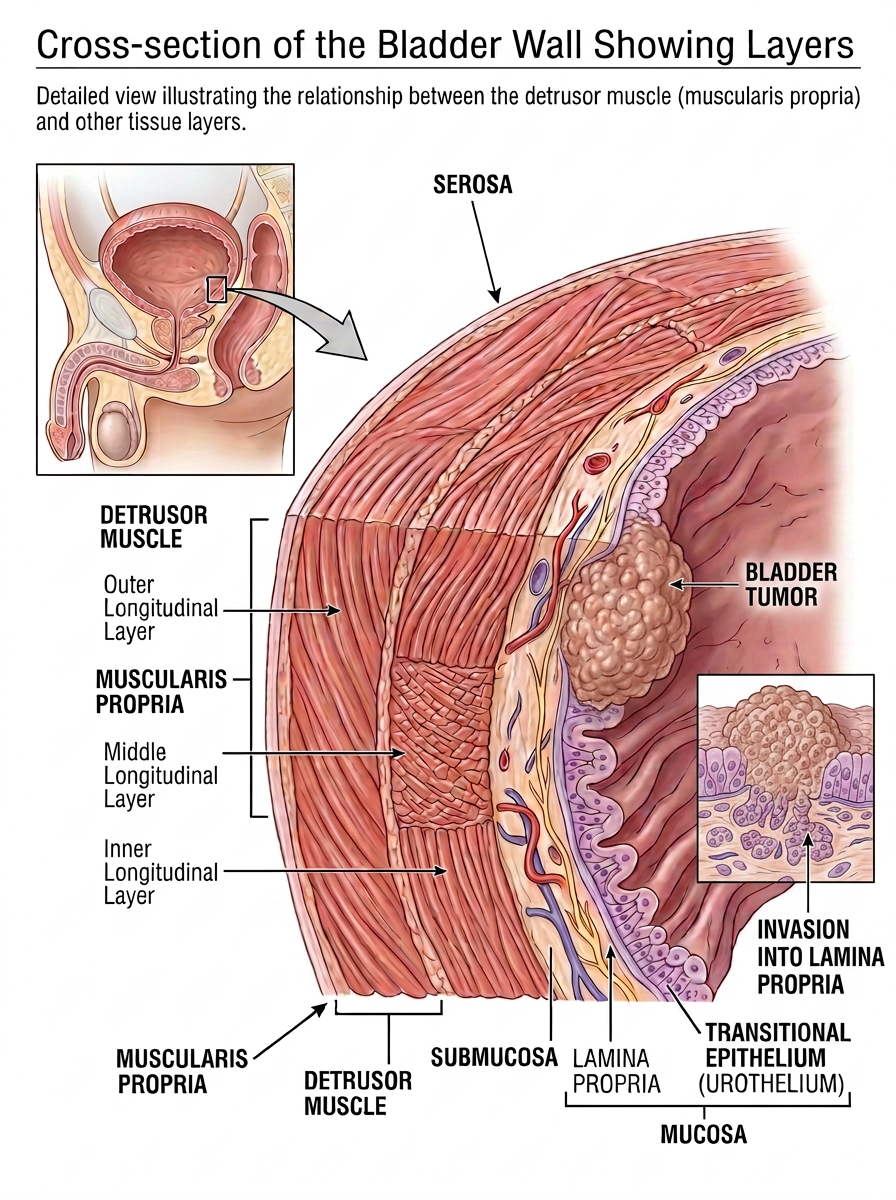
A report shows lamina propria invasion when the microscopic pattern proves that tumor cells have crossed beyond the surface lining and entered the underlying connective tissue. Pathologists look for irregular nests, cords, or single cancer cells within the lamina propria rather than only on the surface. In urothelial carcinoma, this distinction separates noninvasive papillary disease from T1 bladder cancer. That difference helps the treating urologist decide whether repeat TURBT, intravesical therapy, or more aggressive management should be considered.
The report may also comment on whether muscularis propria is present in the specimen. Muscularis propria is the thick bladder wall muscle, also called detrusor muscle, and its presence allows the pathologist to assess whether muscle invasion is present or absent. If muscularis propria is not present, the report may not be able to fully exclude muscle invasion. This is one reason a repeat resection is commonly recommended for many patients with T1 bladder cancer, especially when the initial TURBT pathology is limited or fragmented.
Other findings can influence risk. High-grade urothelial carcinoma behaves differently from low-grade disease, and carcinoma in situ can increase concern because it is a flat, high-grade lesion that may be present elsewhere in the bladder lining. The bladder pathology report may also mention lymphovascular invasion, which means tumor cells are seen in small vessels and may raise concern for spread. These details do not mean that every patient has advanced cancer, but they do explain why the report may lead to closer surveillance and additional treatment discussions. For patients trying to decode each line, Understanding Your Pathology Report: How to Read It with Confidence can make the wording less overwhelming.
How Serious Is Lamina Propria Invasion In Bladder Cancer?
Lamina propria invasion is a serious finding because it means the tumor is invasive, but it is not the same as muscle-invasive bladder cancer. In staging terms, T1 bladder cancer sits between noninvasive disease and cancers that have reached the muscularis propria. That middle position is the reason the finding can feel confusing: It is not the earliest category, but it is also not automatically the most advanced category. The presence or absence of muscle invasion is one of the most important dividing lines in bladder cancer care.
The seriousness of lamina propria invasion depends on several factors beyond the phrase itself. High-grade urothelial carcinoma, extensive invasion, carcinoma in situ, lymphovascular invasion, variant histology, and absent muscularis propria can all increase concern. A small focus of lamina propria invasion with clearly sampled muscle and no muscle invasion may be managed differently from a high-grade, extensive tumor with no muscle in the specimen. This is why the bladder pathology report should be read as a whole rather than by one phrase alone.
T1 bladder cancer often leads to close follow-up because recurrence and progression can occur. However, the purpose of careful follow-up is not to assume the worst; it is to catch persistent or recurrent disease early, when decisions can be made with better information. TURBT pathology may prompt repeat TURBT to confirm staging, remove residual tumor, and ensure that muscularis propria is adequately sampled. If the wording is unclear, if the tumor is high grade, or if treatment choices are significant, a second pathology opinion can be reasonable, especially when the diagnosis will affect bladder-sparing therapy versus more aggressive options.
What Happens Next: Treatment And Monitoring
After lamina propria invasion is found, the next step is usually a detailed conversation with the urologist about stage, grade, completeness of resection, and whether muscularis propria was present. Many patients with T1 bladder cancer are advised to have a repeat TURBT, particularly when the tumor is high grade or when muscle was not included in the first specimen. This repeat procedure helps confirm whether there is residual tumor and whether muscle invasion was missed in the first sample. It also gives the care team a stronger foundation for treatment planning.
When no muscle invasion is found, treatment may include intravesical therapy, which means medication placed directly into the bladder. Bacillus Calmette-Guérin, often called BCG, is a common option for high-risk non-muscle-invasive bladder cancer, including many cases of T1 bladder cancer. The exact plan depends on the patient’s full risk profile, not just a single line in the bladder pathology report. Follow-up usually includes cystoscopy, urine testing, and sometimes additional biopsies, because the bladder lining can develop new tumors over time.
Monitoring can feel repetitive, but it has a clear purpose. Bladder cancer is known for recurrence, and surveillance allows doctors to detect changes before symptoms become obvious. TURBT pathology findings are used to set the intensity of that surveillance. When a report contains lamina propria invasion and questions remain about staging, a pathology review can help confirm whether the invasive focus is real, whether muscularis propria is present, and whether any muscle invasion is identified.
Questions To Ask Your Doctor Or Pathologist
- Does the report diagnose T1 bladder cancer, or is the stage still uncertain?
- Was muscularis propria present in the specimen, and was muscle invasion excluded?
- Is the tumor low grade or high grade urothelial carcinoma?
- Is carcinoma in situ present anywhere in the bladder pathology report?
- Does the report mention lymphovascular invasion, variant histology, or extensive invasion?
- Is repeat TURBT recommended based on the TURBT pathology findings?
- Would a second pathology opinion change staging, risk category, or treatment options?
These questions help turn a frightening phrase into practical next steps. A patient does not need to understand every microscopic detail before the appointment, but knowing which details drive decisions can make the visit more productive. The most treatment-changing issues are usually stage, grade, presence of muscularis propria, and whether muscle invasion is truly absent.
When a diagnosis affects major treatment choices, an expert review can be helpful. A second opinion is not an accusation that the first report is wrong; it is a safeguard when the stakes are high and the tissue findings are nuanced. Helpful background is available in When Should You Get a Second Pathology Opinion? and How to Get a Second Opinion on Your Pathology Diagnosis.
Frequently Asked Questions
Does lamina propria invasion mean bladder cancer has spread?
Lamina propria invasion means the cancer has spread locally beneath the bladder lining into the supportive tissue layer. It does not, by itself, mean the cancer has spread to lymph nodes or distant organs. The report must be combined with imaging, cystoscopy findings, and clinical evaluation. The most important next question is whether muscle invasion is present.
Is T1 bladder cancer the same as muscle invasive bladder cancer?
No. T1 bladder cancer usually means the tumor invades the lamina propria but not the muscularis propria. Muscle-invasive bladder cancer begins when tumor reaches the bladder muscle, often staged as T2 or higher. If muscularis propria is absent from the TURBT pathology specimen, repeat sampling may be needed to make sure muscle invasion has not been missed.
Why is muscle in the bladder pathology report so important?
Muscle is important because it allows the pathologist to determine whether the cancer has reached the muscularis propria. If muscularis propria is present and uninvolved, that supports a non-muscle-invasive stage such as T1 bladder cancer. If muscularis propria is not present, the report may be less complete for staging. This is one reason repeat TURBT is often discussed after high-grade disease or lamina propria invasion.
Can lamina propria invasion be overcalled or undercalled?
Yes, in difficult cases, lamina propria invasion can be challenging to interpret. Cautery artifact, inflammation, fragmented tissue, and tangential sectioning can make TURBT pathology more complex. An experienced genitourinary pathologist may review the slides to confirm whether true invasion is present. This can matter when treatment decisions depend on the difference between noninvasive disease, T1 disease, and muscle invasion.
What should happen after a T1 bladder cancer diagnosis?
After T1 bladder cancer is diagnosed, the urologist usually reviews grade, completeness of resection, muscularis propria sampling, and risk features such as carcinoma in situ. Many patients are considered for repeat TURBT, especially when high-grade urothelial carcinoma is present. Treatment may include intravesical therapy and close cystoscopic surveillance if muscle invasion is not identified. The best plan depends on the full bladder pathology report and the patient’s overall health.
Lamina propria invasion is a meaningful finding, but it is not a complete story by itself. The most useful next step is to clarify stage, grade, muscle sampling, and whether any high-risk features are present. Honest Pathology consultations can help patients and families understand bladder pathology report wording and prepare focused questions for the treating team.
References:
National Cancer Institute — Pathology Reports
National Cancer Institute — Bladder Cancer
National Cancer Institute Dictionary of Cancer Terms — Transurethral Resection