A prostatectomy report can feel frightening. Extraprostatic extension prostatectomy findings are explained clearly, with next questions to ask.
Extraprostatic extension prostatectomy means prostate cancer has grown through the outer edge of the prostate into nearby tissue seen under the microscope. This is a pathology finding made after a radical prostatectomy, when the whole prostate is examined in thin sections. It usually affects prostate cancer stage, and it can influence whether doctors recommend observation, radiation, hormone therapy, or closer PSA monitoring.
Seeing this phrase on a report can feel like a sudden loss of control, especially after surgery was expected to remove the cancer. The words sound technical and severe, but they do not tell the whole story by themselves. Pathologists interpret extraprostatic extension together with Gleason grade group, surgical margin status, lymph nodes, seminal vesicles, and PSA trends.
A pathology report is like a detailed map after the operation: It shows where the cancer was, how far it reached, and whether there are features that may raise the chance of recurrence. For patients who want a broader primer on report structure, What Is a Pathology Report? explains the main sections and why they matter.
Extraprostatic Extension Prostatectomy — What It Actually Means
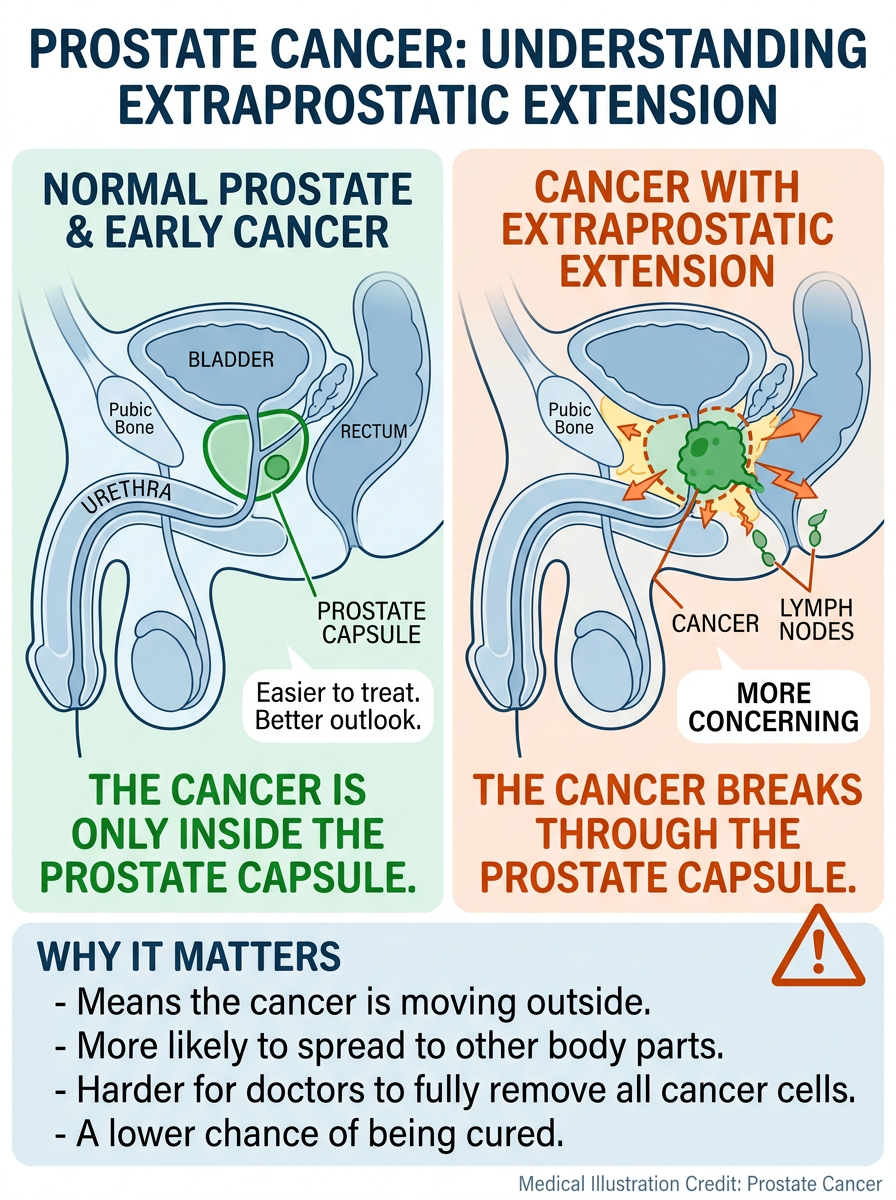
In plain language, extraprostatic extension prostatectomy means cancer cells are no longer completely confined within the prostate gland. The prostate has a capsule-like outer boundary, although it is not a perfect shell. When tumor grows beyond that boundary into periprostatic tissue, pathologists call it extraprostatic extension, often shortened to EPE.
A helpful analogy is a plant growing through the edge of a pot. If roots remain inside the pot, the spread is limited to that container. If roots push just beyond the pot into the surrounding soil, the finding is still local, but it shows the plant has crossed an important border. In prostate cancer, that border helps determine prostate cancer stage and treatment planning.
Pathologists identify this finding by examining stained tissue slides from the radical prostatectomy specimen. They look for cancer touching or invading fat, nerves, or connective tissue outside the expected prostate contour. The report may describe focal extraprostatic extension when the area is small, or nonfocal, established, or extensive extraprostatic extension when the area is larger. The Gleason grade group is also reviewed because a higher Gleason grade group can add risk beyond the anatomic spread alone.
Why Your Report Shows This Finding

Extraprostatic extension prostatectomy appears on a report because the pathologist saw cancer beyond the prostate boundary on microscopic review. This is not based on a blood test, a scan, or a surgeon’s impression alone. Imaging may suggest possible spread before surgery, but the final call after prostate removal comes from surgical pathology. The exact location is often listed, such as right posterior, left lateral, apex, base, or near the neurovascular bundle.
The finding happens because some prostate cancers grow outward from the gland into periprostatic tissue. Growth patterns vary widely, even among cancers with the same PSA level. A tumor with a higher Gleason grade group is more likely to behave aggressively, but lower-grade tumors can occasionally extend outside the prostate too. The report may also mention surgical margin status, because cancer outside the prostate and cancer at the inked cut edge are related but not identical findings.
Other features help place extraprostatic extension in context. Seminal vesicle invasion means cancer has entered the seminal vesicles, which is a different and more advanced pathologic stage than extraprostatic extension alone. Lymph node metastasis means cancer was found in lymph nodes removed during surgery, if lymph nodes were sampled. A report may therefore show extraprostatic extension without seminal vesicle invasion, without lymph node metastasis, and with negative surgical margin status, which is a different risk picture than when several adverse features are present together.
How Serious Is Extraprostatic Extension Prostatectomy?
Extraprostatic extension prostatectomy is a meaningful finding, but it is not the same as saying the cancer has spread throughout the body. In standard staging, extraprostatic extension usually corresponds to pathologic stage pT3a, unless there are other features that change the stage. It means the cancer has moved beyond the prostate locally, which can raise the chance of PSA recurrence compared with cancer fully confined to the prostate. The seriousness depends on how much extension is present and what the rest of the report shows.
A small focus of extraprostatic extension with negative surgical margin status, no seminal vesicle invasion, no lymph node metastasis, and a lower Gleason grade group may lead to careful monitoring rather than immediate additional therapy. In that setting, the post-surgery PSA result becomes very important. If PSA becomes undetectable and stays undetectable, doctors may continue surveillance. If PSA rises, the team may discuss salvage radiation or other treatment options.
Extraprostatic extension prostatectomy becomes more concerning when it is extensive, when surgical margin status is positive, when the Gleason grade group is high, or when seminal vesicle invasion is also present. These factors can stack together, like weather warnings: One cloudy sign may call for watching, while several warnings together may call for action. Lymph node metastasis adds another level of concern because it means cancer cells were found beyond the prostate region in sampled nodes. Patients often benefit from asking the treating team to explain the combined risk rather than focusing on one phrase in isolation.
What Happens Next: Treatment and Monitoring
After extraprostatic extension prostatectomy is reported, the next step is usually a discussion of the full pathology results and the first post-operative PSA. The PSA after radical prostatectomy should generally fall to an undetectable or very low level because the prostate has been removed. If PSA is undetectable, many clinicians recommend close monitoring, especially if other risk factors are favorable. If PSA remains detectable or later rises, additional treatment may be considered.
Treatment decisions often involve urology, radiation oncology, and medical oncology. Radiation may be discussed as adjuvant therapy soon after surgery in selected higher-risk cases, or as salvage therapy if PSA begins to rise. Hormone therapy may be added in some situations, especially when risk factors are stronger. The prostate cancer stage, surgical margin status, seminal vesicle invasion, and Gleason grade group all help shape that recommendation.
Patients may also hear about genomic tests performed on prostate cancer tissue, depending on the case and local practice. These tests do not replace the pathology report, but they may add recurrence-risk information in selected patients. A practical way to prepare for the visit is to bring the full report, PSA history, operative note, and any imaging results. For help reading report language before an appointment, Understanding Your Pathology Report: How to Read It with Confidence can make the terminology less overwhelming.
Questions to Ask Your Doctor or Pathologist
- Was the extraprostatic extension focal or extensive?
- Where exactly was the extraprostatic extension located in the prostatectomy specimen?
- What is the final prostate cancer stage, and what features determined it?
- Was the surgical margin status negative or positive, and was any margin positive near the extraprostatic extension?
- What is the Gleason grade group in the main tumor and any other tumor nodules?
- Was there seminal vesicle invasion or lymph node metastasis?
- How will the first post-operative PSA result affect the decision about radiation or monitoring?
These questions help turn a frightening phrase into a structured conversation. Extraprostatic extension prostatectomy is best understood as one part of a larger risk profile, not as a stand-alone verdict. The most useful discussion often connects the microscope findings with PSA behavior and the patient’s overall health.
A second pathology review can be valuable when the report is complex, when treatment recommendations depend on borderline findings, or when the patient wants more confidence before radiation or systemic therapy. Guidance on timing is available in When Should You Get a Second Pathology Opinion?. A review typically confirms the diagnosis, checks staging features, reassesses surgical margin status, and verifies the Gleason grade group.
Frequently Asked Questions
Is extraprostatic extension after prostatectomy cancer spread?
Extraprostatic extension prostatectomy means local spread outside the prostate into nearby tissue, not automatically distant spread to organs or bones. It is an adverse pathology feature because it can raise the risk of PSA recurrence. The report must be read with surgical margin status, lymph nodes, seminal vesicles, and grade. Many patients with this finding still do well after surgery and careful follow-up.
Does extraprostatic extension mean I need radiation?
Extraprostatic extension prostatectomy does not automatically mean every patient needs radiation immediately. Doctors usually consider the PSA after surgery, surgical margin status, Gleason grade group, and whether seminal vesicle invasion or lymph node metastasis is present. Some patients are monitored closely, while others are offered adjuvant or early salvage radiation. The decision is individualized.
What stage is prostate cancer with extraprostatic extension?
Extraprostatic extension is commonly staged as pathologic pT3a when cancer extends outside the prostate without seminal vesicle invasion. Seminal vesicle invasion usually corresponds to pT3b. If lymph node metastasis is present, the nodal stage is also reported separately. The final prostate cancer stage combines these anatomic findings with the full surgical pathology assessment.
What is the difference between extraprostatic extension and positive margins?
Extraprostatic extension means cancer has grown beyond the prostate into periprostatic tissue. A positive margin means cancer cells are present at the inked cut edge of the removed specimen. A patient can have extraprostatic extension with negative margins, positive margins without clear extraprostatic extension, or both. Surgical margin status matters because it helps estimate whether microscopic cancer may have been left behind locally.
Should I get a second opinion on my prostatectomy pathology report?
A second opinion can be reasonable when extraprostatic extension, grade, margins, or stage will affect treatment choices. Prostatectomy specimens can be complex, and small differences in interpretation may change risk discussions. The review usually requires the original glass slides or digital slides and the full report. Practical steps are outlined in How to Get a Second Opinion on Your Pathology Diagnosis.
Extraprostatic extension prostatectomy is a serious but interpretable finding, and clarity often reduces fear. The next conversation should focus on the whole report, the PSA trend, and whether any additional treatment is likely to help. Honest Pathology consultations can help patients and families understand the wording of a prostatectomy report before major treatment decisions are made.
References:
National Cancer Institute — Pathology Reports
National Cancer Institute — Definition of Prostatectomy
National Cancer Institute — Prostate Cancer Treatment