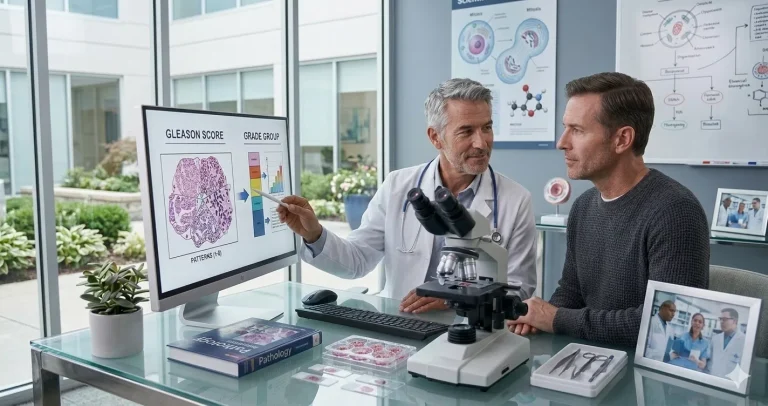
A cancer diagnosis rarely affects just one person. Family members often become caregivers, advocates, and emotional anchors, yet many struggle to understand the medical information that shapes treatment decisions. Among the most confusing documents is the pathology report. Dense language, unfamiliar terminology, and emotionally charged findings can make it difficult to explain what the report actually says.
At Honest Pathology, many patients express a desire to help their family understand their diagnosis without overwhelming or frightening them. Learning how to explain a cancer pathology report in clear, compassionate terms can ease anxiety, foster support, and improve shared decision-making.
Why Pathology Reports Are Hard to Explain
Pathology reports are written primarily for physicians. They are designed to communicate precise medical information, not to tell a story in plain language. As a result, even well-educated patients may struggle to translate these reports for family members.
Terms like carcinoma, grade, margins, and biomarkers carry specific meanings that do not easily translate into everyday conversation. Family members may latch onto individual words without understanding the broader context, leading to unnecessary fear or misunderstanding.
Understanding the purpose of the report is the first step in explaining it effectively.
Start With the Big Picture Before the Details
When explaining a pathology report to family members, it helps to begin with the overall conclusion rather than individual findings. Most pathology reports answer a few core questions: what type of cancer it is, how aggressive it appears, and what features may affect treatment.
Starting with these high-level points provides a framework that makes the rest of the information easier to understand. Without this context, family members may focus on technical phrases that sound alarming but are not central to the diagnosis.
Honest Pathology encourages patients to focus on meaning rather than wording when sharing information.
Explaining the Cancer Type in Simple Terms
One of the first sections of a pathology report identifies the cancer type. This often includes both the organ involved and the specific histologic subtype. While these distinctions matter medically, they can be simplified when explaining them to family.
Describing the cancer as “a breast cancer that starts in the milk ducts” or “a lung cancer that comes from gland-type cells” helps translate complex terminology into understandable concepts. Using analogies sparingly can also help without oversimplifying.
The goal is clarity, not technical accuracy at the level of a medical textbook.
How to Talk About Grade Without Causing Alarm
Tumor grade is often misunderstood and can sound frightening to family members. The word “high-grade” in particular may be interpreted as a judgment or a prediction of outcome.
When explaining grade, it can help to describe it as a measure of how different the cancer cells look compared to normal cells. Emphasizing that grade is one of many factors and not a standalone prediction can reduce anxiety.
At Honest Pathology, patients often learn language that frames grade as information doctors use to guide treatment, not as a definitive statement about the future.

Explaining Stage Versus What Pathology Shows
Family members frequently confuse stage with everything found in a pathology report. It can be helpful to clarify that pathology contributes to staging but does not always determine it completely.
Explaining that stage combines pathology, imaging, and clinical findings helps family members understand why the pathology report alone may not answer every question about spread or prognosis.
This distinction also helps manage expectations when additional tests are needed.
How to Explain Margins and Surgical Findings
If surgery has occurred, the pathology report often includes margin status. Family members may fixate on whether margins are positive or negative without understanding what that means.
Margins can be explained as whether cancer cells were seen at the edges of what was removed. Describing this in practical terms helps family members understand why additional treatment or monitoring may be recommended.
Clear explanations prevent family members from assuming that surgery alone always equals cure or, conversely, that a close margin means treatment has failed.
Talking About Biomarkers in Plain Language
Biomarkers are increasingly central to cancer care, but they are often the most confusing part of a pathology report for families. Explaining biomarkers as “features of the cancer that help doctors choose treatments” can provide clarity.
Rather than listing specific mutations or percentages, focusing on what the results mean for therapy is usually more helpful. For example, explaining that a result suggests a treatment is more likely to work or less likely to help keeps the conversation practical.
Honest Pathology specializes in translating biomarker results into language that patients can comfortably share with loved ones.
Addressing Uncertainty Honestly
Family members often look to patients for certainty and reassurance, but pathology reports do not always provide clear answers. Some findings are indeterminate or require further testing.
It is okay to acknowledge uncertainty rather than trying to explain everything perfectly. Saying that some results guide decisions over time helps family members understand why follow-up tests or additional opinions are sometimes necessary.
Honesty builds trust and reduces misinterpretation.
Managing Emotional Reactions During the Conversation
Explaining a pathology report is not just an intellectual exercise. Emotions often surface quickly, including fear, anger, guilt, or denial. These reactions can make it harder to communicate clearly.
Pausing when emotions rise and returning to the main points can help keep the conversation grounded. It is also helpful to remember that family members may need time to process information, just as patients do.
Honest Pathology emphasizes that understanding often happens in layers, not all at once.
Deciding How Much Detail to Share
Not every family member needs or wants the same level of detail. Some prefer a high-level summary, while others want to understand every term.
Tailoring explanations to the listener can reduce overwhelm and frustration. It is reasonable to set boundaries and say that certain details are best discussed with the medical team.
Sharing selectively does not mean withholding information; it means communicating effectively.
Using Written Summaries and Visual Aids
Some patients find it helpful to provide a short written summary or use diagrams to explain pathology findings. Visual explanations of where the cancer is located or how treatments target it can be more effective than verbal descriptions alone.
Honest Pathology often provides patients with language and explanations they can reuse when talking to family, reducing the pressure to translate complex reports on the spot.
When Family Members Have Conflicting Opinions
Family members may interpret pathology information differently and offer conflicting advice. This can create tension and confusion for patients.
Reinforcing that pathology guides medical decisions but does not dictate personal values can help reframe these conversations. It is okay to remind family that the care team uses the pathology report alongside many other factors.
Clear explanations can reduce conflict, but they do not eliminate differences in perspective.
How Honest Pathology Helps With Family Conversations
Honest Pathology exists to help patients understand their pathology reports well enough to explain them confidently to others. By breaking down reports into plain language and focusing on meaning rather than jargon, Honest Pathology supports patients in having clearer, calmer conversations with family.
This support can be especially valuable when family dynamics are complex or emotions are high.
Empowerment Through Understanding
When patients understand their pathology reports, they often feel more in control. This confidence translates into clearer communication with family members and more productive discussions with clinicians.
Understanding does not remove fear, but it replaces confusion with clarity and helps patients advocate for themselves while accepting support from loved ones.
Final Thoughts on Explaining Pathology to Family
Explaining a cancer pathology report to family members is one of the most challenging and emotionally loaded conversations a patient may face. The report contains critical information, but it also carries fear, uncertainty, and hope.
By focusing on meaning rather than terminology, acknowledging uncertainty, and using clear, compassionate language, patients can help family members understand without overwhelming them. With guidance from services like Honest Pathology, pathology reports become tools for connection rather than sources of confusion.
Clear understanding fosters trust, support, and shared strength during one of life’s most difficult journeys.