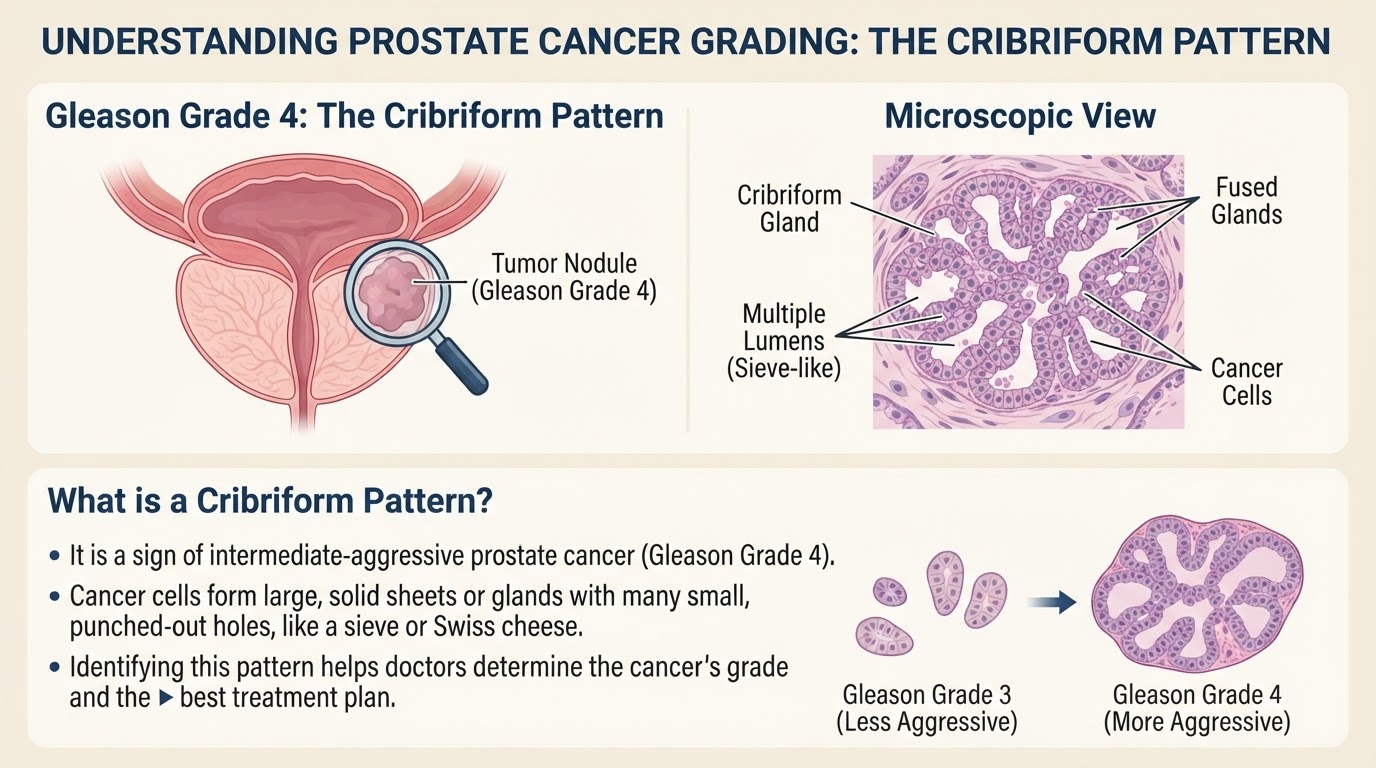
Seeing cribriform prostate cancer can feel frightening. Learn what this pattern means and what questions to ask before treatment.
Cribriform prostate cancer means the pathologist saw a growth pattern in prostate cancer that can carry higher risk than some other patterns. This wording often appears alongside terms such as intraductal carcinoma, Gleason pattern 4, Grade Group, and tumor volume. The meaning depends on the whole prostate biopsy report, not one phrase by itself.
For many patients and families, the word “cribriform” feels unfamiliar and alarming. That reaction is understandable because the report may use technical language without explaining how the finding affects treatment decisions. A pathology report is like a map: It does not make the journey easier by itself, but it can show where the important landmarks are. Clear interpretation helps patients ask better questions and avoid guessing in the dark.
When cribriform architecture or intraductal carcinoma appears in a prostate cancer report, it is reasonable to slow down and understand the details before making major decisions. A careful review may clarify whether the finding was small and limited or more extensive. Patients who want a broader foundation may also find it helpful to read what a pathology report is before reviewing the specific prostate cancer language.
Cribriform Prostate Cancer — What It Actually Means
Cribriform prostate cancer describes cancer glands that grow in rounded nests with punched-out spaces, almost like a sieve or a piece of Swiss cheese under the microscope. The word comes from the Latin idea of a sieve-like structure. In prostate pathology, this pattern is usually considered part of Gleason pattern 4, which is more concerning than Gleason pattern 3. A pathologist identifies this by examining stained tissue sections from the biopsy or surgical specimen.
The key issue is not just that the cells are cancerous, but how they are arranged. Prostate cancers that form simple, separate glands usually behave differently from cancers that form fused, poorly formed, or cribriform glands. That is why Gleason pattern 4 receives attention in the prostate biopsy report. The architecture gives clues about prostate cancer risk, much like the layout of a building can show whether the structure is simple or complex.
Cribriform prostate cancer may be reported as present, absent, focal, extensive, small, or large, depending on local reporting practice. Some reports separately mention intraductal carcinoma, while others describe it in a comment. These findings are related but not identical, and the distinction can matter. A patient reading the report should look at the Grade Group, the number of cores involved, the percentage of tumor, and whether other adverse features are mentioned.
Why Your Report Shows This Finding
A prostate biopsy report shows cribriform architecture because the sampled tumor has grown in that pattern. The pathologist does not infer it from the PSA level, MRI appearance, or symptoms; it is a direct microscopic observation. The tissue is processed, embedded, thinly sliced, stained, and examined under the microscope. In some cases, immunohistochemistry may help separate intraductal carcinoma from invasive carcinoma with a similar appearance.
Intraductal carcinoma means malignant prostate cancer cells are filling and expanding pre-existing prostate ducts or glands. This is different from ordinary high-grade prostatic intraepithelial neoplasia, which is usually less worrisome. Intraductal carcinoma is often associated with higher-volume or higher-grade disease elsewhere in the prostate. When intraductal carcinoma is present with invasive cancer, it often increases concern about prostate cancer risk.
Other findings in the same report help place cribriform prostate cancer in context. Grade Group summarizes the Gleason score into a clearer scale from 1 to 5, with higher groups generally linked to greater risk. Perineural invasion means cancer is seen tracking along or around a nerve, and it may be noted separately from cribriform architecture. Radical prostatectomy specimens can show whether cribriform pattern was limited to biopsy tissue or part of a larger tumor pattern in the prostate gland.
How Serious Is Cribriform Prostate Cancer?
Cribriform prostate cancer is generally considered an adverse microscopic feature, especially when it is extensive or associated with intraductal carcinoma. It does not automatically mean the cancer has spread, and it does not mean treatment will fail. It does mean the tumor may behave more aggressively than prostate cancer made only of Gleason pattern 3. The seriousness depends on the Grade Group, PSA, MRI findings, clinical stage, number of involved biopsy cores, and whether disease is localized.
In a low-volume biopsy, a tiny focus of cribriform prostate cancer may lead to a different conversation than widespread cribriform pattern in several cores. Some treatment teams are more cautious about active surveillance when cribriform architecture or intraductal carcinoma is present. That caution exists because studies have linked these patterns with higher prostate cancer risk, recurrence after treatment, and adverse findings at radical prostatectomy. Still, each case must be interpreted in the full clinical setting rather than through one microscope phrase alone.
Cribriform prostate cancer also affects how pathologists and clinicians think about Gleason pattern 4. Not every pattern 4 focus carries exactly the same implications, and cribriform architecture is one of the patterns that often receives special attention. Perineural invasion, tumor length in each core, and the percentage of Gleason pattern 4 may further refine risk. A clear explanation of the prostate biopsy report can help patients understand whether the finding changes treatment intensity, monitoring, or the need for additional review.
What Happens Next: Treatment and Monitoring

After cribriform prostate cancer is reported, the treating urologist or radiation oncologist usually combines the pathology results with PSA, MRI, physical examination, and sometimes genomic or imaging tests. The next step may be active treatment, further staging, or a second pathology review, depending on risk category. Treatment discussions may include radical prostatectomy, radiation therapy, androgen deprivation therapy, or combined approaches. The pathology finding helps shape the decision, but it does not make the decision alone.
Monitoring also depends on whether the patient has had biopsy only, surgery, radiation, or another treatment. After radical prostatectomy, the final surgical pathology report may confirm the Grade Group, margin status, extraprostatic extension, seminal vesicle invasion, and lymph node status. If cribriform architecture or intraductal carcinoma was seen on biopsy, the surgical specimen may show whether those patterns were part of a larger high-grade tumor. A detailed explanation of the report can make follow-up visits more productive.
Patients often benefit from organizing the prostate biopsy report, PSA history, MRI report, and treatment recommendations in one place. The article on understanding a pathology report explains how to read sections such as diagnosis, comment, and microscopic description. If the diagnosis includes cribriform prostate cancer, asking whether intraductal carcinoma is present can be clinically meaningful. It is also reasonable to ask whether the amount of Gleason pattern 4 was estimated and whether the finding changes prostate cancer risk grouping.
Questions To Ask Your Doctor Or Pathologist
- Was cribriform prostate cancer definitely present, or was the pattern only suspected?
- Was intraductal carcinoma identified separately from invasive prostate cancer?
- What Grade Group and Gleason score were assigned to each positive biopsy core?
- How much Gleason pattern 4 was present, and was it focal or extensive?
- How many biopsy cores contained cancer, and what percentage of each core was involved?
- Does perineural invasion or any other adverse feature appear in the prostate biopsy report?
- Would a second pathology opinion change treatment planning or risk grouping?
These questions are not meant to challenge the treating team. They help convert a technical diagnosis into a practical treatment discussion. When cribriform prostate cancer or intraductal carcinoma appears in a report, small wording differences can affect how risk is communicated.
A second review may be especially helpful when the report will influence active surveillance, surgery, radiation, or combined therapy. Information on when to get a second pathology opinion can help patients decide whether review is appropriate. For many families, confirmation brings peace of mind even when the diagnosis does not change.
Frequently Asked Questions
Is cribriform prostate cancer aggressive?
Cribriform prostate cancer is often treated as a higher-risk microscopic feature compared with some other prostate cancer patterns. It is commonly part of Gleason pattern 4 and may be associated with a higher Grade Group. The level of concern depends on how much of the pattern is present and whether intraductal carcinoma is also identified. The finding should be discussed in the context of PSA, MRI, biopsy extent, and clinical stage.
What is intraductal carcinoma in prostate cancer?
Intraductal carcinoma means malignant prostate cancer cells are growing within and expanding existing prostate ducts or glands. It is usually not treated as a harmless or incidental finding when invasive cancer is also present. Intraductal carcinoma can be associated with more significant disease elsewhere in the prostate. Pathologists may use special stains when the distinction from other patterns is difficult.
Does cribriform pattern change prostate cancer treatment?
Cribriform prostate cancer can influence treatment discussions, especially if active surveillance is being considered. Many clinicians become more cautious when cribriform architecture or intraductal carcinoma is present. The finding may support definitive treatment rather than observation in some cases. Treatment still depends on the full risk assessment, including Grade Group, PSA, imaging, and overall health.
Can a second opinion change a prostate biopsy report?
A second opinion can sometimes change the reported Grade Group, confirm or remove intraductal carcinoma, or clarify whether a pattern is truly cribriform. Prostate pathology has areas where expert interpretation matters. The diagnosis may also stay the same, which can still be valuable before major treatment. Practical steps are described in how to get a second opinion on a pathology diagnosis.
Is cribriform prostate cancer the same as metastatic cancer?
No. Cribriform prostate cancer describes how tumor glands look under the microscope, not whether cancer has spread to distant sites. A patient can have cribriform architecture and still have localized disease. Staging studies, MRI, lymph node assessment, and other clinical information determine spread. The finding matters because it can raise prostate cancer risk within the overall diagnosis.
Seeing cribriform architecture or intraductal carcinoma on a prostate report can feel heavy, but the wording is interpretable. The most useful next step is a clear, case-specific explanation of what the report says and what it does not say. Honest Pathology consultations can help patients and families understand whether the diagnosis, Grade Group, and risk features fit the treatment plan being offered.
References:
National Cancer Institute — Pathology Reports
National Cancer Institute — Gleason Score
MedlinePlus — Prostate Cancer