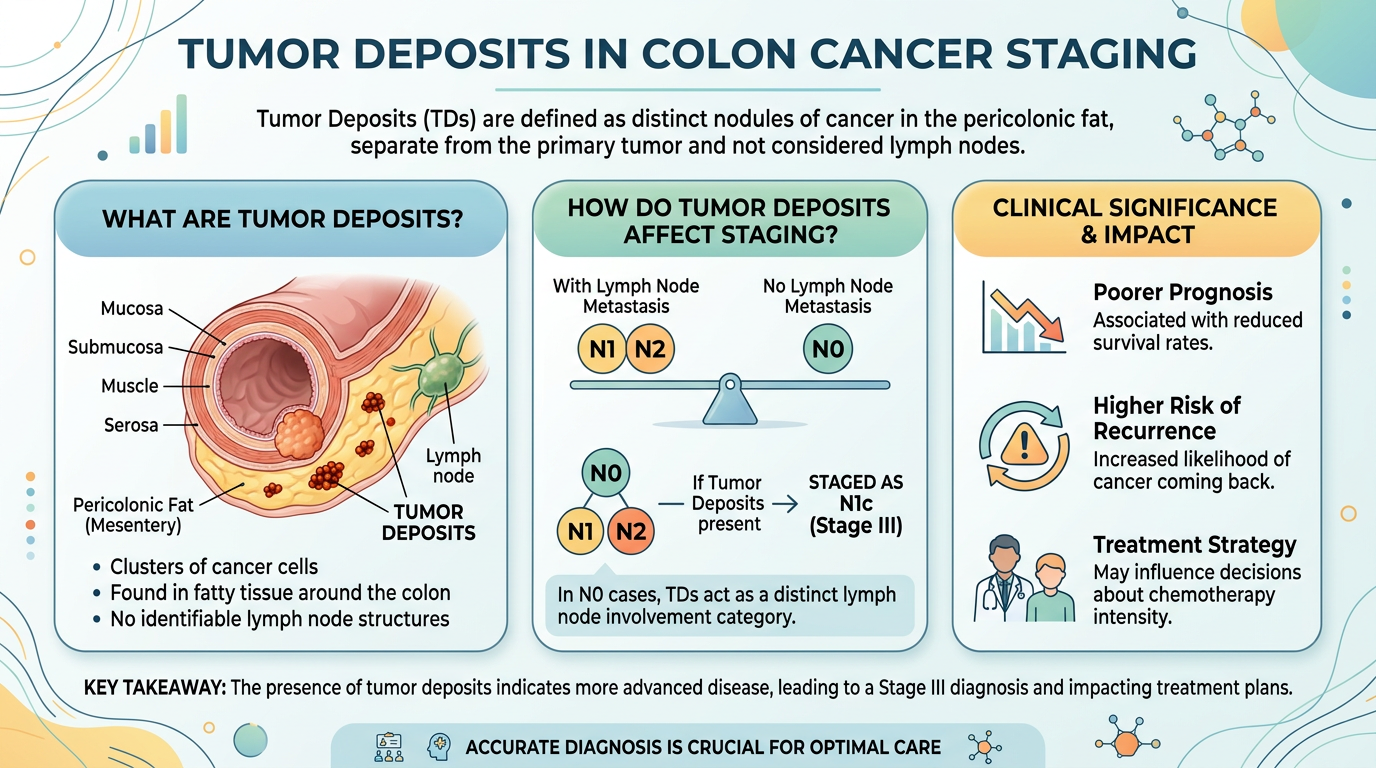
Worried by unfamiliar wording? tumor deposits colon cancer can affect staging and treatment. Learn what it means and what to ask next.
tumor deposits colon cancer means that small separate cancer nodules were found in the tissue around the colon, away from the main tumor and without clear lymph node structure. This wording usually appears after surgery, when a pathologist has examined the colon cancer specimen under the microscope. It can influence colon cancer staging, treatment planning, and the way the oncology team discusses recurrence risk.
Seeing this phrase on a pathology report can feel frightening because it sounds vague and serious at the same time. Many patients wonder whether tumor deposits are the same as spread, whether they mean treatment has failed, or whether they change everything. The most helpful starting point is to slow the wording down: Tumor deposits are a specific microscopic finding, not a complete summary of a person’s outlook. Their meaning depends on the whole report, including lymph nodes, margins, tumor depth, and other risk features.
Tumor Deposits Colon Cancer — What It Actually Means
In tumor deposits colon cancer, the word “deposit” refers to a small focus of cancer found in the fat or soft tissue near the colon, separate from the main tumor. Under the microscope, it looks like a separate island of cancer cells rather than a direct extension of the main mass. The key feature is that the deposit does not have the organized structure of a lymph node. This distinction matters because lymph node metastasis and tumor deposits are recorded differently in colon cancer staging.
A practical analogy is a main campfire with small embers found nearby. The main campfire is the primary colon cancer, and the embers are small separate areas of cancer in nearby tissue. The presence of embers suggests that cancer cells had a way to move beyond the main tumor area, but it does not automatically mean cancer is everywhere in the body. A pathologist uses the surgical specimen, microscopic slides, and established staging rules to decide whether these separate nodules meet the definition of tumor deposits colon cancer.
The pathology report often lists tumor deposits in a section near lymph nodes, tumor extension, lymphovascular invasion, perineural invasion, and surgical margin status. These report elements are connected because they all help estimate how the cancer behaved locally. For patients trying to understand the larger document, a clear overview of what a pathology report is can make the terminology less overwhelming. In many reports, tumor deposits colon cancer is not a stand-alone diagnosis but one piece of the final pathologic stage.
Why Your Report Shows This Finding
A report shows tumor deposits because the pathologist found separate cancer nodules in the tissue around the colon during microscopic examination. These nodules may represent cancer spread through small veins, lymphatic channels, or nerves, or they may reflect irregular growth patterns at the edge of the main tumor. Sometimes the original pathway cannot be proven on a single slide, so the finding is recorded as a tumor deposit according to staging criteria. This is why the same pathology report may also mention lymphovascular invasion or perineural invasion.
The lab process is careful and methodical. After surgery, the colon specimen is examined by sight and touch, the tumor is measured, lymph nodes are searched for, and multiple tissue samples are placed into small blocks for microscopic review. Pathologists look for lymph node metastasis by examining lymph nodes separately, and they look for tumor deposits in the surrounding fat and soft tissue. When a nodule of cancer lacks residual lymph node tissue, it may be counted as a tumor deposit rather than a positive lymph node.
Colon cancer staging uses the TNM stage system, where T describes tumor depth, N describes nodal involvement, and M describes distant spread. Tumor deposits can affect the N category in certain situations, especially when no regional lymph nodes contain cancer. The final TNM stage also considers whether the cancer has grown through the bowel wall, whether lymph node metastasis is present, and whether distant metastasis has been identified by imaging or other testing. A structured resource on understanding a pathology report can help patients connect these separate pieces without assuming the worst from one term.
How Serious Are Tumor Deposits Colon Cancer Findings?
Tumor deposits colon cancer is a meaningful finding because it can be associated with a higher risk of cancer returning compared with otherwise similar tumors without deposits. That does not mean a recurrence will happen, and it does not mean the situation is hopeless. It means the cancer showed a pattern of spread beyond the main tumor that doctors take seriously when choosing treatment and follow-up. The seriousness depends on the full colon cancer staging picture, especially tumor depth, lymph node status, surgical margin status, and whether there is any distant spread.
When tumor deposits are present but lymph nodes are negative, staging rules may classify the cancer as N1c in the TNM stage system. This matters because N1c often places the cancer into stage III, even without lymph node metastasis. Many patients find this confusing because they hear “no positive lymph nodes” but then see stage III in the report. The reason is that tumor deposits colon cancer is treated as evidence of regional spread for staging purposes in that specific setting.
When lymph node metastasis is also present, tumor deposits still add important risk information, but the N category is usually driven by the number of positive lymph nodes. Other features may further shape the risk discussion, including lymphovascular invasion, perineural invasion, high-grade tumor pattern, tumor perforation, and close or positive surgical margin status. A clear surgical margin means cancer was not seen at the cut edge of the removed tissue, while a positive surgical margin may raise concern for cancer left behind locally. Tumor deposits colon cancer should always be interpreted with these other findings, not in isolation.
What Happens Next: Treatment And Monitoring
After tumor deposits are found, the oncology team usually reviews the entire surgical pathology report alongside imaging, operative findings, and the patient’s overall health. Treatment decisions often include whether chemotherapy is recommended, which regimen fits the risk level, and how soon treatment should begin after recovery from surgery. For many patients with stage III colon cancer, chemotherapy is discussed because it can reduce recurrence risk. Tumor deposits colon cancer may be one reason that treatment is recommended even when the lymph nodes are negative.
Monitoring usually includes scheduled visits, physical examination, blood tests such as carcinoembryonic antigen when appropriate, and imaging at intervals chosen by the care team. Colonoscopy follow-up is also part of care because the remaining colon needs surveillance for new polyps or cancers. Colon cancer staging helps determine how intensive this follow-up should be. The goal of monitoring is not to create constant fear but to create a safety net that can detect treatable problems early.
Patients may also hear the care team discuss molecular testing, especially for mismatch repair status or microsatellite instability, because these results can influence prognosis, inherited cancer risk assessment, and treatment options in some settings. These molecular results are different from tumor deposits, but they may appear in the same pathology report. Surgical margin status may also be reviewed carefully if the tumor was close to an edge or if the operation was technically difficult. When the report feels internally confusing, a second pathology review may clarify whether a nodule is truly a tumor deposit, a replaced lymph node, direct tumor extension, or another finding.
Questions To Ask Your Doctor Or Pathologist
- How many tumor deposits were found in the colon cancer specimen?
- Were any lymph nodes positive for lymph node metastasis?
- Did the tumor deposits change the final colon cancer staging or TNM stage?
- Was the surgical margin clear, close, or positive?
- Were lymphovascular invasion or perineural invasion also present?
- Does this finding change the recommendation for chemotherapy?
- Would a second pathology opinion help confirm the tumor deposit interpretation?
These questions are useful because tumor deposits colon cancer is not interpreted by counting one word alone. The answer depends on how the deposit fits with tumor depth, lymph nodes, margins, and the rest of the pathology report. A patient can ask whether the deposit was discussed at a tumor board, where surgeons, oncologists, radiologists, and pathologists review the case together.
A second opinion is especially reasonable when staging affects a major treatment decision, when wording seems unclear, or when a patient feels that the explanation did not match the report. Honest Pathology has patient-focused information on when to get a second pathology opinion and how to get a second opinion on a pathology diagnosis. This type of review typically checks the original slides, the block selection, lymph node interpretation, surgical margin assessment, and whether the tumor deposit criteria were applied correctly.
Frequently Asked Questions
Are tumor deposits in colon cancer the same as lymph nodes?
No. Tumor deposits are separate cancer nodules in the tissue around the colon that do not show definite lymph node structure. Lymph node metastasis means cancer is found within a lymph node. The distinction matters because staging rules count these findings in different ways. In tumor deposits colon cancer, the report should ideally state both the number of tumor deposits and the number of lymph nodes examined.
Do tumor deposits mean stage 4 colon cancer?
Not by themselves. Stage 4 colon cancer means there is distant metastasis, such as spread to the liver, lung, peritoneum, or another distant site. Tumor deposits are usually a regional finding near the colon and are part of colon cancer staging, not automatic proof of distant spread. Imaging and clinical evaluation are needed to determine whether distant metastasis is present.
Can tumor deposits change my treatment plan?
Yes, tumor deposits can change treatment planning because they may change the pathologic stage or increase the estimated risk of recurrence. In some patients with negative lymph nodes, tumor deposits colon cancer can lead to an N1c classification. That staging change may make chemotherapy more likely to be recommended. The final decision also depends on age, recovery from surgery, other medical conditions, molecular testing, and patient preferences.
How many tumor deposits are concerning?
Any confirmed tumor deposit is a finding the oncology team will take seriously. A higher number of deposits may add concern, but the meaning depends on the rest of the pathology report. Positive lymph nodes, lymphovascular invasion, perineural invasion, tumor depth, and surgical margin status all affect the risk discussion. The most useful question is not only how many deposits were found, but how they changed the final TNM stage and treatment recommendation.
Can a second opinion change tumor deposit interpretation?
Yes, a second pathology opinion can sometimes change or clarify the interpretation. The reviewing pathologist may decide that a nodule is a true tumor deposit, a lymph node metastasis with little remaining lymph node tissue, direct extension from the main tumor, or a different process. In tumor deposits colon cancer, this distinction can matter because staging and treatment recommendations may be affected. A second opinion is most helpful when the report wording is unclear or when treatment decisions depend on the exact stage.
Tumor deposits are serious enough to deserve a careful explanation, but they are not the whole story of a colon cancer diagnosis. The most reliable interpretation comes from the complete pathology report, the staging workup, and a thoughtful oncology discussion. Honest Pathology consultations can help patients and families translate difficult report language into clear questions for the treating team.
References:
National Cancer Institute — Pathology Reports Fact Sheet
National Cancer Institute — NCI Dictionary of Cancer Terms: Pathologist
National Cancer Institute — Colorectal Cancer