
An ovarian tumor report can feel frightening. inhibin FOXL2 positive often points to a specific tumor type. Learn what to ask next.
inhibin FOXL2 positive on an ovarian tumor report usually means the pathologist found evidence supporting a sex cord stromal tumor, most often a granulosa cell tumor. These words are not a stage, and they are not the same as saying whether a tumor has spread. They are diagnostic clues, like fingerprints, that help identify what kind of ovarian neoplasm is present.
Seeing technical markers such as inhibin, FOXL2, and immunohistochemistry can make a report feel cold and overwhelming. Many patients first read these terms before having a full conversation with the gynecologic oncologist, which can leave a painful gap between the report and real understanding. A pathology result is easier to face when each word is translated into what it actually contributes to the diagnosis.
Pathologists often use several ovarian tumor markers together, not one marker alone. The meaning of inhibin FOXL2 positive depends on the tumor appearance under the microscope, the patient’s age, the surgical findings, and whether other immunohistochemistry stains support the same conclusion.
Inhibin FOXL2 Positive — What It Actually Means
Inhibin FOXL2 positive means two different kinds of diagnostic information are pointing in a similar direction. Inhibin is a protein that can be detected by immunohistochemistry stains, while FOXL2 is a gene-related marker strongly associated with adult-type granulosa cell tumor. In many ovarian tumor reports, inhibin staining supports sex cord stromal differentiation, and FOXL2 testing or FOXL2 immunostaining adds another layer of evidence. Together, these findings help separate a granulosa cell tumor from more common ovarian epithelial cancers.
A useful analogy is a security check with several forms of identification. The tumor’s appearance under the microscope is like the face on the identification card, while ovarian tumor markers are like the supporting documents. If the microscopic pattern, inhibin staining, and FOXL2 result all fit, the diagnosis becomes much more secure. This is why pathologists rarely rely on a single stain when classifying an ovarian neoplasm.
A granulosa cell tumor belongs to a group called sex cord stromal tumor. These tumors arise from ovarian supporting cells rather than from the surface lining cells that cause many more common ovarian cancers. The phrase inhibin FOXL2 positive does not automatically describe the tumor’s behavior, size, stage, or prognosis. It mainly helps answer the first and most essential question: What type of tumor is this? For patients trying to decode the layout of the report, a plain-language overview such as What Is a Pathology Report? can make the surrounding terminology easier to understand.
Why The Report Shows These Markers
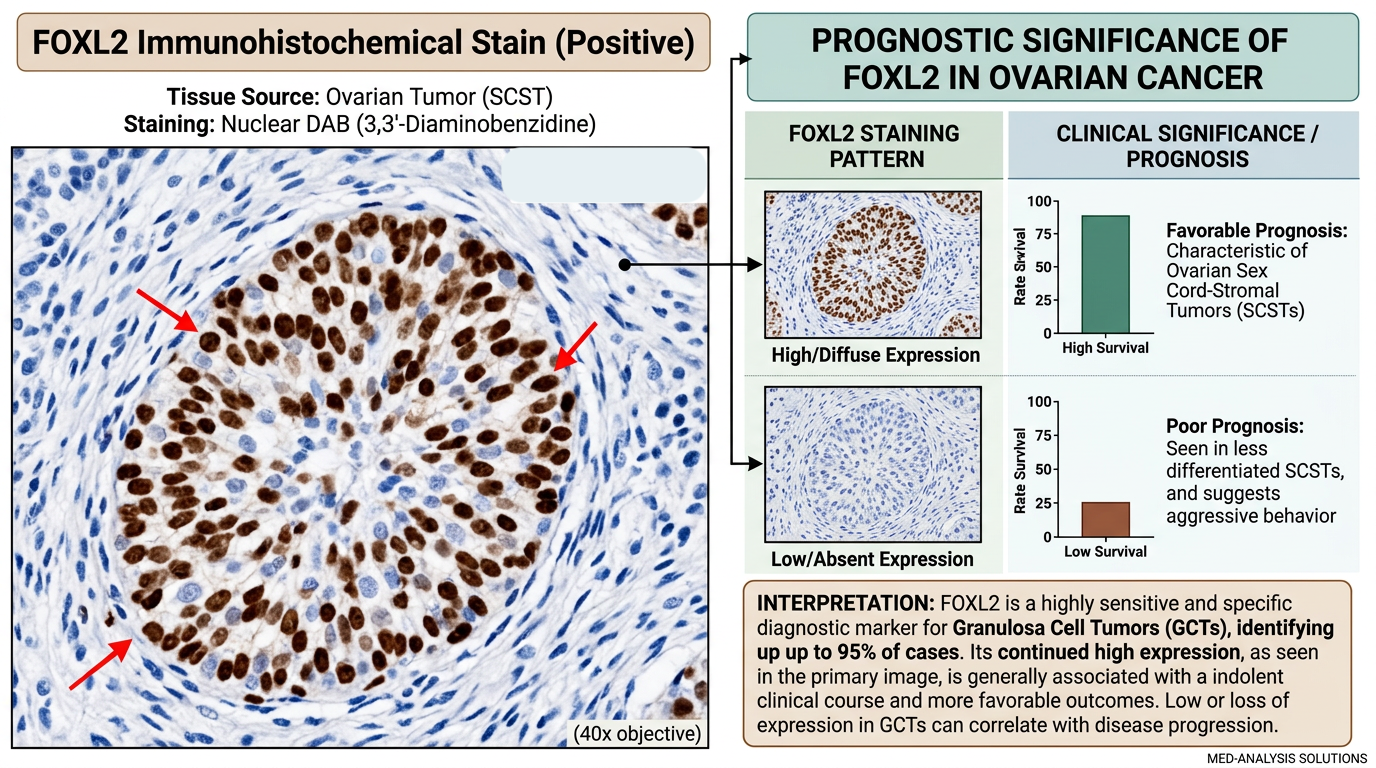
Pathology reports show markers such as inhibin and FOXL2 because ovarian tumors can look similar in small samples or in unusual patterns. Some epithelial ovarian cancers, metastatic tumors, carcinoid tumors, and sex cord stromal tumor types can overlap in appearance. Immunohistochemistry stains help the pathologist test the tumor’s identity by showing which proteins are present in the cells. Inhibin staining is especially useful when the pathologist suspects sex cord stromal differentiation.
FOXL2 is important because many adult-type granulosa cell tumor cases have a characteristic FOXL2 mutation. Some laboratories test directly for the FOXL2 mutation, while others use FOXL2 immunohistochemistry as part of a broader marker panel. A positive result supports the diagnosis, but the exact wording matters because “FOXL2 positive” can refer to protein expression rather than direct mutation testing. When the report is unclear, the treating team or pathologist can clarify whether molecular testing for the FOXL2 mutation was performed.
Ovarian tumor markers are interpreted in the context of the whole case. A pathologist studies the architecture of the ovarian neoplasm, the cell shape, mitotic activity, necrosis, and any associated cystic or solid areas. The report may also include other immunohistochemistry stains, such as calretinin, SF-1, WT1, cytokeratins, EMA, or Ki-67, depending on the differential diagnosis. Ki-67 is sometimes used to estimate how actively tumor cells are dividing, and a related explanation is available at What Does Ki-67 Mean and How High Is Concerning?. The final diagnosis comes from the pattern of all findings, not from inhibin FOXL2 positive in isolation.
How Serious Is Inhibin FOXL2 Positive In An Ovarian Tumor?
Inhibin FOXL2 positive is serious because it usually points to a real ovarian tumor diagnosis that needs specialist review, but it does not automatically mean an aggressive or advanced cancer. Many granulosa cell tumor cases are found at an early stage, especially when the tumor is confined to the ovary. These tumors can behave differently from high-grade serous ovarian carcinoma, which is the ovarian cancer type many people fear most. The most meaningful risk information usually comes from stage, rupture status, tumor size, microscopic features, and completeness of surgery.
The seriousness of inhibin FOXL2 positive also depends on whether the report describes an adult-type granulosa cell tumor or another sex cord stromal tumor. Adult-type granulosa cell tumor can be slow-growing, but it is known for the possibility of late recurrence, sometimes years after treatment. That long time course can sound unsettling, yet it also means follow-up can be planned thoughtfully and consistently. A patient’s care team may monitor symptoms, imaging, and sometimes hormone-related blood tests based on the exact diagnosis.
A report that says inhibin FOXL2 positive should be read alongside the final diagnosis line and the synoptic summary, if present. If the tumor is described as confined to the ovary with an intact capsule, that is very different from a tumor involving the ovarian surface, fallopian tube, peritoneum, or other sites. If the diagnosis is uncertain, if the tumor is rare, or if treatment would change based on the subtype, a second pathology review can be very reasonable. The article When Should You Get a Second Pathology Opinion? explains why rare tumors and unexpected diagnoses are common reasons for expert review. Inhibin FOXL2 positive is a clue with weight, but the full story comes from the complete pathology and surgical context.
What Happens Next: Treatment And Monitoring
After a report shows inhibin FOXL2 positive, the next step is usually a discussion with a gynecologic oncologist or another specialist experienced in ovarian tumors. Treatment often depends on stage, patient age, fertility goals, tumor rupture, and whether all visible disease was removed. Some early-stage granulosa cell tumor cases are treated primarily with surgery and observation, while higher-risk situations may lead to additional therapy or closer surveillance. The pathology report helps guide that discussion, but it does not replace individualized clinical judgment.
Monitoring may include physical examinations, imaging when needed, and blood tests chosen by the treating physician. Some granulosa cell tumor cases produce hormones, so doctors may use markers such as inhibin A, inhibin B, or anti-Müllerian hormone in follow-up when they were elevated before treatment. These blood tests are different from tissue inhibin staining on the pathology slide, even though the word “inhibin” appears in both settings. That distinction can prevent confusion when laboratory results and pathology results are reviewed together.
Patients often benefit from asking whether the diagnosis was reviewed by a gynecologic pathologist, especially when the tumor is rare. Sex cord stromal tumor diagnoses are less common than epithelial ovarian cancers, and experience with these patterns can matter. Additional immunohistochemistry stains or FOXL2 mutation testing may be recommended if the findings are not classic. If a formal outside review is desired, How to Get a Second Opinion on Your Pathology Diagnosis outlines the usual steps for requesting slides, blocks, and reports.
Questions To Ask The Doctor Or Pathologist
- Does the final diagnosis say adult-type granulosa cell tumor, juvenile granulosa cell tumor, or another sex cord stromal tumor?
- Was FOXL2 tested by immunohistochemistry only, or was a FOXL2 mutation test performed?
- Which ovarian tumor markers were positive and negative in the full immunohistochemistry stains panel?
- Was the tumor completely removed, and was it confined to the ovary?
- Did the capsule rupture, or was tumor present on the ovarian surface?
- Is the Ki-67 level reported, and does it affect the risk assessment in this case?
- Should the slides be reviewed by a gynecologic pathologist before final treatment decisions?
These questions help turn a frightening phrase into a focused medical conversation. A patient does not need to master every detail of ovarian pathology to ask clear, useful questions. The goal is to understand whether inhibin FOXL2 positive confirms the tumor type, whether any uncertainty remains, and how the finding affects treatment planning.
A structured review of the report can also reduce the feeling of being lost in medical language. Resources such as Understanding Your Pathology Report: How to Read It with Confidence can help families identify the diagnosis, margins, stage-related details, and special studies. When the words in the report carry major treatment implications, expert pathology consultation can provide an added layer of confidence.
Frequently Asked Questions
Does inhibin FOXL2 positive mean ovarian cancer?
Inhibin FOXL2 positive often supports a diagnosis of granulosa cell tumor or another sex cord stromal tumor of the ovary. These tumors are considered ovarian neoplasms and may be malignant or have malignant potential depending on the exact type and stage. The phrase does not by itself tell whether the tumor has spread. The final diagnosis and staging information provide the more complete answer.
What is a granulosa cell tumor?
A granulosa cell tumor is an ovarian tumor arising from cells involved in the ovary’s hormone-producing support system. It is a type of sex cord stromal tumor, not the same category as the most common epithelial ovarian cancers. Some granulosa cell tumor cases produce estrogen or other hormones, which can cause abnormal bleeding or other symptoms. Treatment and follow-up depend heavily on stage and surgical findings.
Is FOXL2 positive the same as a FOXL2 mutation?
FOXL2 positive is not always the same as a confirmed FOXL2 mutation. In some reports, FOXL2 positive refers to immunohistochemistry showing FOXL2 protein in tumor cell nuclei. In other cases, molecular testing may identify the characteristic FOXL2 mutation seen in many adult-type granulosa cell tumors. The report or treating physician can clarify which type of test was performed.
Can inhibin FOXL2 positive be wrong?
Any pathology interpretation can require refinement when a tumor is rare or has overlapping features. Inhibin FOXL2 positive is strong supportive evidence when the microscope findings and other immunohistochemistry stains match. However, pathologists usually interpret these markers as part of a panel rather than as isolated proof. A second opinion by a gynecologic pathologist may be helpful if the diagnosis is unexpected or treatment decisions are significant.
What should happen after an inhibin FOXL2 positive report?
After an inhibin FOXL2 positive report, the treating team usually reviews the final tumor type, stage, surgical details, and any need for further testing. The next step may be observation, additional surgery, oncology consultation, or a surveillance plan, depending on the case. Follow-up may include examinations, imaging, and selected blood tests. The exact plan should be tailored to the complete pathology report and the patient’s clinical situation.
Inhibin and FOXL2 are technical words, but they are meant to bring the diagnosis into sharper focus rather than create more fear. A rare ovarian tumor report deserves careful explanation, and uncertainty should be addressed directly. Honest Pathology consultations can help patients and families understand what the pathology findings support, what remains unclear, and what questions may matter most before treatment decisions.
References:
National Cancer Institute — Pathology Reports
National Cancer Institute — Immunohistochemistry
NCBI Bookshelf — Medical Reference Texts