Worried by cervical results? ASC-H vs HSIL can sound frightening, but the meaning is specific. Learn what to ask your doctor next.
ASC-H vs HSIL describes two abnormal cervical screening results that both need follow-up, but they do not mean exactly the same thing. These terms usually appear on a Pap test or cervical cytology report, and they tell the clinician how concerning the sampled cervical cells look under the microscope. An abnormal Pap smear can feel especially frightening because the wording sounds technical, serious, and close to cancer language.
Receiving ASC-H vs HSIL results can make a patient feel as if a diagnosis has already been made, even when the report is describing risk rather than confirming cancer. Pathologists use these categories to guide the next step, often a colposcopy exam and sometimes a cervical biopsy. The goal is not to create panic; the goal is to identify precancerous cells early enough that they can be watched closely or treated before they become dangerous.
ASC-H Vs HSIL — What It Actually Means
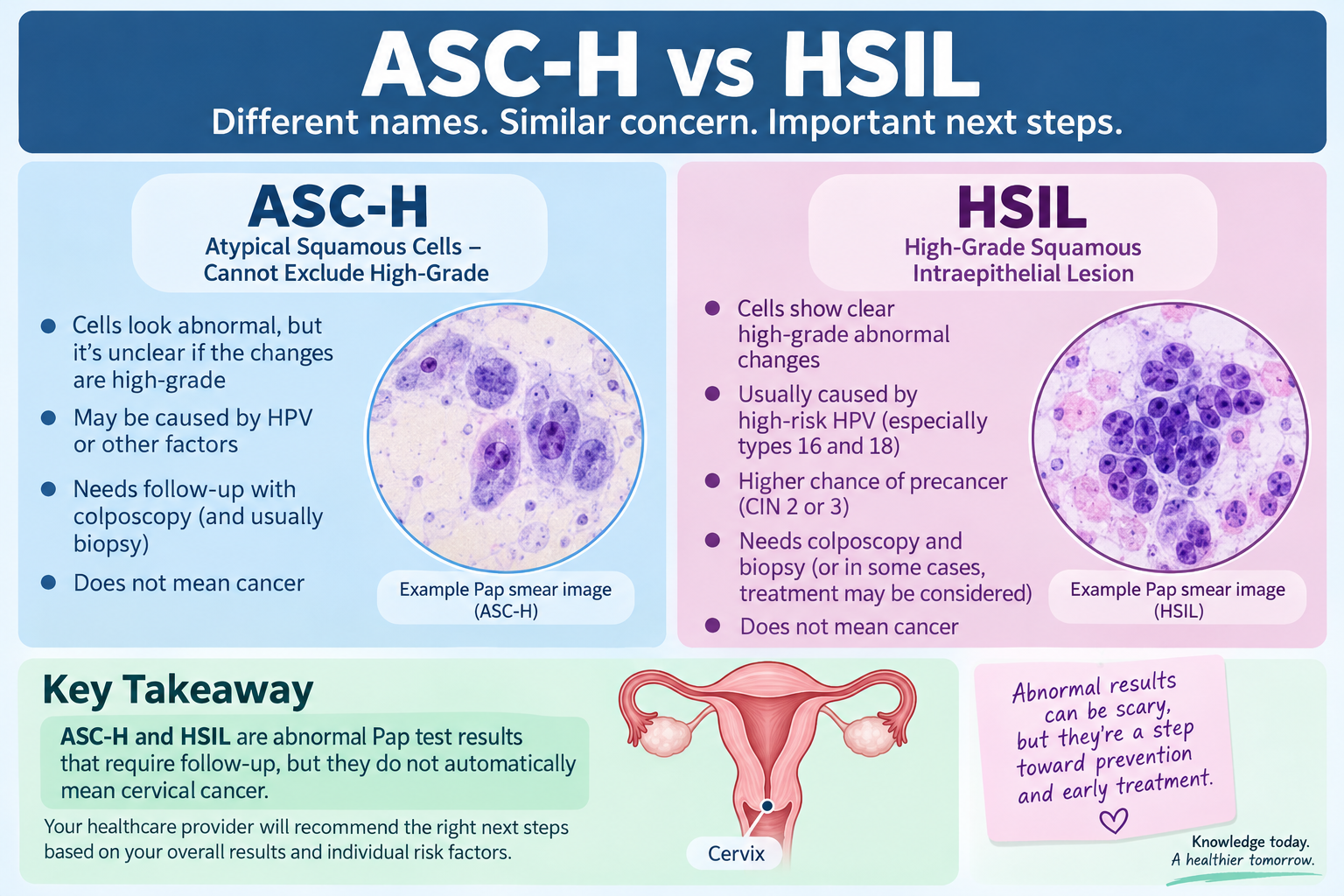
ASC-H vs HSIL is best understood as a comparison between uncertainty and stronger suspicion. ASC-H stands for atypical squamous cells, cannot exclude HSIL. In plain language, the cells are abnormal enough that a high-grade lesion cannot be ruled out, but the sample does not show all the features needed to call it HSIL with confidence. HSIL stands for high-grade squamous intraepithelial lesion, which means the abnormal cells more clearly resemble precancerous cells. Both categories usually involve squamous cells from the surface lining of the cervix.
A useful analogy is a smoke alarm. ASC-H is like smelling smoke but not yet seeing the fire clearly; HSIL is like seeing enough smoke and heat to strongly suspect a real problem that needs evaluation. Neither term automatically means invasive cervical cancer. Instead, both terms signal that the cervix needs closer examination because cervical dysplasia may be present. This distinction matters because an abnormal Pap smear is a screening result, not the same as a final tissue diagnosis.
From the laboratory perspective, pathologists and cytotechnologists examine cell size, nuclear shape, nuclear darkness, and the relationship between the nucleus and cytoplasm. With ASC-H vs HSIL, the difference often comes down to how many abnormal features are present and how convincing those features are. A cervical biopsy can then show whether the abnormal Pap smear corresponds to low-grade change, high-grade cervical dysplasia, or rarely something more serious. For patients trying to read reports more confidently, Understanding Your Pathology Report: How to Read It with Confidence can help explain how wording, uncertainty, and diagnosis lines fit together.
Why Your Report Shows This Finding
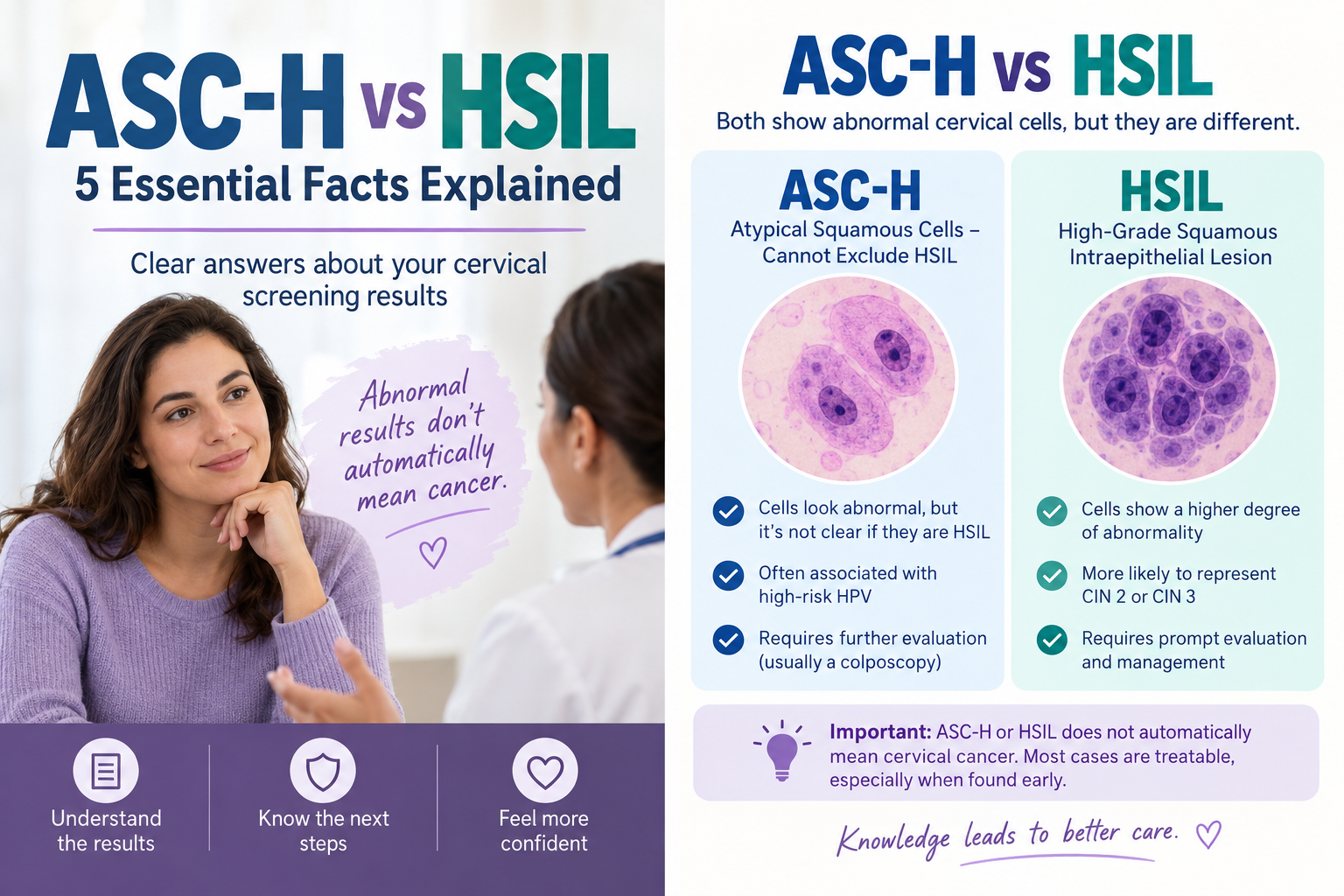
Most ASC-H vs HSIL results are connected to HPV infection, especially high-risk HPV types. HPV infection can affect the DNA control systems of cervical squamous cells, causing them to mature abnormally. Over time, those changes may appear as cervical dysplasia on cytology or biopsy. The immune system clears many HPV infections, but persistent high-risk HPV infection can increase the chance of precancerous cells developing. This is why HPV testing is often paired with Pap testing or used in follow-up decisions.
A report may show ASC-H when the abnormal cells are limited in number, partly obscured by inflammation, or not perfectly preserved on the slide. Blood, mucus, atrophy after menopause, infection, or reactive repair can sometimes make interpretation more difficult. A pathologist may avoid overcalling HSIL when the cells are worrisome but not definitive. That careful wording protects patients from both under-treatment and over-treatment. In this setting, a cervical biopsy often provides the tissue architecture needed to clarify the finding.
HSIL is reported when the cytology features are more convincing for high-grade abnormality. The cells often show enlarged, dark, irregular nuclei and less mature cytoplasm than expected. These changes reflect significant cervical dysplasia, usually corresponding to CIN 2 or CIN 3 if confirmed on cervical biopsy. A colposcopy exam allows the clinician to look at the cervix under magnification and sample suspicious areas. ASC-H vs HSIL therefore represents a risk-based pathway: The Pap test raises concern, and the biopsy helps determine what is truly present.
How Serious Is ASC-H Vs HSIL?
ASC-H vs HSIL should be taken seriously, but serious does not mean hopeless or already cancer. The main concern is that high-grade precancerous cells may be present and could progress over time if missed. HSIL generally carries a higher immediate likelihood of significant cervical dysplasia than ASC-H. ASC-H still requires prompt follow-up because a meaningful percentage of patients with ASC-H have CIN 2 or CIN 3 on cervical biopsy. The safest interpretation is that both results deserve timely evaluation, not panic.
The seriousness also depends on the whole clinical picture. Age, pregnancy status, immune system health, prior Pap results, prior HPV infection results, and previous cervical procedures all matter. A first abnormal Pap smear in a young patient may be managed differently from a persistent abnormality in an older patient. A colposcopy exam helps move the result from a category of risk toward a more specific diagnosis. When ASC-H vs HSIL appears in a report, the next question is usually not, “Is this cancer?” but, “What does the cervix show on careful examination and biopsy?”
In many patients, ASC-H vs HSIL leads to detection of a treatable precancerous condition rather than invasive cancer. That is exactly what cervical screening is designed to do. Finding precancerous cells before they invade deeper tissue gives clinicians the chance to remove or monitor the abnormal area according to established guidelines. If a cervical biopsy confirms HSIL, treatment such as excision may be recommended to remove the transformation zone where these changes arise. If the biopsy is negative or lower grade, the care team may recommend close surveillance because the original abnormal Pap smear still needs to be respected.
What Happens Next: Treatment And Monitoring
After ASC-H vs HSIL, the next step is usually a colposcopy exam. During this procedure, the clinician applies solutions to the cervix that highlight abnormal areas and then examines the cervix with magnification. If a suspicious area is seen, a cervical biopsy is taken. Some patients also have an endocervical sample, which checks cells from the canal of the cervix. These samples are then reviewed by a pathologist to determine whether cervical dysplasia is present and how severe it is.
Treatment depends on the biopsy result, not just the Pap test wording. If the cervical biopsy confirms HSIL, the clinician may recommend a procedure such as LEEP or cone biopsy to remove the abnormal tissue. If the biopsy shows low-grade changes or no definite precancerous cells, follow-up testing may be recommended instead. HPV infection status often influences how closely follow-up is scheduled. The plan may include repeat Pap testing, HPV testing, another colposcopy exam, or treatment if abnormalities persist.
Monitoring can feel frustrating because patients naturally want one clear answer immediately. Cervical pathology sometimes requires matching cytology, HPV results, colposcopy findings, and biopsy findings like pieces of the same puzzle. A report that seems contradictory does not always mean an error occurred; it may mean that different tests sampled different areas or answered different questions. For patients who want a foundation before a visit, What Is a Pathology Report? explains the basic structure and purpose of pathology reporting. When uncertainty remains, a second review of the slides can sometimes help clarify ASC-H vs HSIL terminology and the biopsy interpretation.
Questions To Ask Your Doctor Or Pathologist
- Does the report show ASC-H, HSIL, or both terms in different parts of the evaluation?
- Was high-risk HPV infection detected, and which HPV testing method was used?
- Does the abnormal Pap smear need a colposcopy exam, and how soon should it be scheduled?
- If a cervical biopsy was done, did it confirm CIN 2, CIN 3, or another grade of cervical dysplasia?
- Were the biopsy sample and endocervical sample adequate for interpretation?
- If treatment is recommended, what tissue will be removed and how will it be examined?
- Would a second pathology opinion be helpful if the Pap result, biopsy result, and clinical findings do not match?
These questions help turn ASC-H vs HSIL from a frightening phrase into a structured conversation. The most helpful appointment is often the one where the cytology result, HPV infection result, colposcopy exam findings, and cervical biopsy diagnosis are discussed together. Patients can bring a copy of the report and ask which line contains the diagnosis and which lines describe background information.
A second opinion is reasonable when the diagnosis is high grade, when treatment is being planned, or when the report language feels unclear. Pathology second opinions involve review of the actual slides, not just the written report. When Should You Get a Second Pathology Opinion? explains common situations where review can be useful, and How to Get a Second Opinion on Your Pathology Diagnosis outlines the practical steps.
Frequently Asked Questions
Is ASC-H worse than HSIL?
ASC-H is not usually considered worse than HSIL. ASC-H means the cells are suspicious and high-grade disease cannot be excluded, while HSIL means the cells more clearly look high grade. In ASC-H vs HSIL, HSIL generally carries a stronger likelihood of significant precancerous cells. Both results need follow-up because ASC-H can still be associated with important cervical biopsy findings.
Does HSIL mean cervical cancer?
HSIL does not automatically mean cervical cancer. It usually means high-grade precancerous cells are suspected or present, depending on whether the result is from cytology or biopsy. The purpose of follow-up is to identify and treat cervical dysplasia before it becomes invasive. A cervical biopsy is the key test for confirming the exact diagnosis.
Can ASC-H go away on its own?
ASC-H may be followed by a biopsy that shows low-grade change, no definite high-grade lesion, or a high-grade lesion. Some HPV-related abnormalities can regress, especially in younger patients, but ASC-H is not ignored because high-grade disease may be present. In ASC-H vs HSIL, both categories require careful follow-up rather than watchful waiting without evaluation. A clinician will usually recommend a colposcopy exam to clarify the result.
What causes ASC-H and HSIL?
The most common cause is persistent high-risk HPV infection. This infection can alter squamous cells and lead to cervical dysplasia over time. Other factors, including immune suppression and smoking, can affect the risk of persistence and progression. Inflammation or sampling issues may also influence whether a result is categorized as ASC-H instead of HSIL.
Should cervical biopsy slides be reviewed again?
A second review can be helpful when the findings are borderline, when treatment is planned, or when the Pap test and cervical biopsy do not match. Pathologists may review the original cytology slides, biopsy slides, and any special stains if available. This does not mean the first result was wrong; it means cervical pathology can be nuanced. A second opinion may provide more confidence before a procedure or surveillance plan.
ASC-H vs HSIL can sound overwhelming, but these terms are part of a prevention system designed to find risk early. Clear follow-up, careful biopsy interpretation, and good communication often turn uncertainty into a practical plan. Honest Pathology consultations can help patients and caregivers understand the wording of cervical pathology reports and prepare focused questions for the treating clinician.
References:
National Cancer Institute — Abnormal HPV and Pap Test Results
National Cancer Institute — Definition of Pap Test
MedlinePlus — HPV Test