
Feeling scared by MMR deficient endometrial cancer on a report is common. Learn what it means and what to ask next.
MMR deficient endometrial cancer means the tumor shows loss of a DNA repair system that normally helps cells correct certain mistakes when DNA is copied.
This result is usually found through mismatch repair testing performed on the tumor tissue, most often by immunohistochemistry. It does not automatically mean the cancer was inherited, and it does not by itself determine the stage or the full treatment plan. It is one important piece of endometrial cancer pathology that helps doctors understand the tumor more clearly.
Seeing a phrase like MMR deficient endometrial cancer can feel frightening because it sounds technical and serious. Many patients read the report before a doctor has had time to explain it, and the words can seem to raise more questions than answers. A pathology report is a map, not a final verdict by itself, and each marker needs to be interpreted with the tumor type, grade, stage, surgical findings, and medical history.
Clear explanation can make this result less overwhelming. MMR deficient endometrial cancer often leads to additional testing, genetic counseling questions, and treatment discussions, but it also gives the care team useful information. For patients still learning the structure of a report, understanding a pathology report with confidence can make the next appointment more productive.
MMR Deficient Endometrial Cancer — What It Actually Means
MMR deficient endometrial cancer refers to endometrial carcinoma in which the tumor cells have lost normal function of mismatch repair proteins. These proteins act like a proofreading team during DNA copying. When the proofreading system is missing or not working, small DNA mistakes can accumulate inside tumor cells. This pattern is closely related to microsatellite instability, a type of DNA change often seen when mismatch repair is abnormal.
Pathologists usually identify this through mismatch repair testing using immunohistochemistry. In this test, thin sections of tumor are stained for proteins such as MLH1, PMS2, MSH2, and MSH6. If one or more proteins are absent in the cancer cells but present in nearby normal cells, the immunohistochemistry results support mismatch repair deficiency. The normal cells serve as a built-in control, like a working light switch next to one that is not turning on.
This finding is common enough in endometrial cancer pathology that many institutions test most or all newly diagnosed endometrial cancers. The result may help identify patients who should be evaluated for Lynch syndrome risk, and it may also matter if cancer returns or spreads. MMR deficient endometrial cancer is not the same as saying the cancer is definitely inherited. It means the tumor has a repair-system abnormality that needs the right follow-up steps.
Why Your Report Shows This Finding
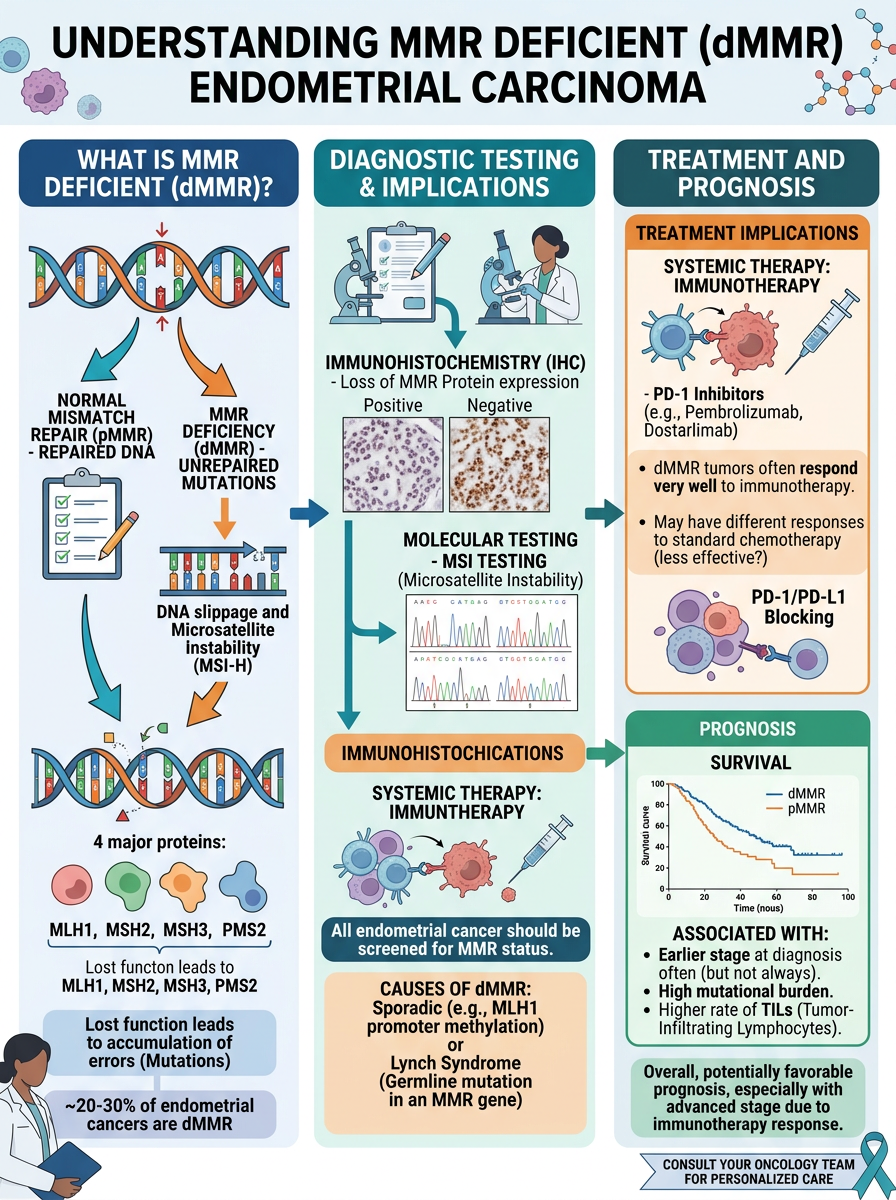
A report may show MMR deficient endometrial cancer because the tumor tissue was tested as part of routine practice. Endometrial cancer pathology often includes tumor type, grade, depth of invasion, lymphovascular invasion, lymph node status if sampled, and biomarker studies. Mismatch repair testing is one of those biomarker studies. It gives information that cannot be seen reliably from the microscope appearance alone.
There are two major reasons a tumor can be mismatch repair deficient. In many endometrial cancers, the abnormality is acquired only in the tumor, often due to MLH1 methylation, which silences the MLH1 gene in the cancer cells. This is not the same as being born with a harmful inherited change. In other cases, MMR deficient endometrial cancer can be related to an inherited condition such as Lynch syndrome, where tumor suppressor genes involved in mismatch repair are altered in the body’s cells.
The pattern of lost proteins guides the next step. Loss of MLH1 and PMS2 often leads to MLH1 methylation testing, because MLH1 methylation strongly supports a sporadic, non-inherited cause in many patients. Loss of MSH2 and MSH6, isolated loss of MSH6, or isolated loss of PMS2 may raise Lynch syndrome risk more directly and often prompts genetic counseling. Microsatellite instability can also be tested by molecular methods, and those results may support the same biological conclusion as the immunohistochemistry results.
How Serious Is MMR Deficient Endometrial Cancer?
MMR deficient endometrial cancer is medically meaningful, but it should not be read as a separate cancer stage. Stage still depends on where the tumor is located, how deeply it invades, whether it involves the cervix, ovaries, lymph nodes, or distant sites, and what the surgeon and pathologist find. A small, early-stage tumor can be MMR deficient, and an advanced tumor can also be MMR deficient. The marker describes tumor biology, not the full extent of disease.
The seriousness of MMR deficient endometrial cancer depends on the whole report. Tumor grade, histologic type, myometrial invasion, lymphovascular invasion, margin status, and lymph node findings all matter. Endometrial cancer pathology is similar to weather forecasting: A single number matters, but the full pattern gives the more reliable forecast. Mismatch repair testing is one cloud on the radar, not the entire storm map.
There are also potentially helpful implications. Tumors with mismatch repair deficiency can be more visible to the immune system because accumulated DNA errors may create abnormal proteins. This is one reason immunotherapy can be considered in certain advanced, recurrent, or metastatic settings, depending on the patient’s complete clinical situation. The immunohistochemistry results may also protect relatives by identifying when Lynch syndrome risk should be evaluated. For that reason, MMR deficient endometrial cancer is not only a tumor result; it can be a clue that affects both treatment planning and family risk assessment.
What Happens Next: Treatment and Monitoring
The next step after MMR deficient endometrial cancer is usually not a single automatic treatment. The care team first integrates the finding with the surgical pathology report, imaging, operative findings, and overall health. Some patients need only surgery and observation, while others may need radiation, chemotherapy, immunotherapy, hormonal therapy, or a combination. Treatment depends on risk category, stage, histologic subtype, and recurrence risk.
If MLH1 and PMS2 are lost, many laboratories recommend MLH1 methylation testing. If MLH1 methylation is present, the tumor is more likely sporadic, although the treating team still interprets that in context. If MLH1 methylation is absent, or if the protein-loss pattern involves MSH2, MSH6, or PMS2 in a concerning way, referral for genetic counseling is often recommended. Genetic counseling can clarify Lynch syndrome risk and determine whether blood or saliva germline testing is appropriate.
Monitoring after diagnosis usually follows the treatment plan rather than the MMR result alone. Follow-up may include pelvic examinations, symptom review, imaging when indicated, and evaluation of any new bleeding, pain, weight loss, or other concerning symptoms. Mismatch repair testing may become especially relevant if the cancer recurs or spreads, because it can guide systemic therapy choices. Patients uncertain about the wording of a report may benefit from reviewing what a pathology report is before discussing the results with the oncology team.
Questions To Ask Your Doctor Or Pathologist
- Which mismatch repair proteins were lost on the immunohistochemistry results?
- Was MLH1 methylation testing performed, and what did it show?
- Does this pattern raise Lynch syndrome risk for this patient or relatives?
- How does MMR deficient endometrial cancer affect the overall stage or risk category, if at all?
- Does the tumor also have other important features, such as high grade, deep invasion, or lymphovascular invasion?
- Would this result affect eligibility for immunotherapy if the cancer recurs or is advanced?
- Should a second pathology opinion review the slides, blocks, or biomarker testing?
These questions help separate what the marker means from what it does not mean. Mismatch repair testing is powerful, but it must be matched to the rest of the diagnosis. Patients may want the exact protein-loss pattern written down, because that detail often determines whether MLH1 methylation testing or genetic counseling is recommended.
A second review can be helpful when the diagnosis is complex, the histologic type is unusual, the stage-defining features are close to a cutoff, or the biomarker pattern seems unclear. A pathology second opinion does not mean the original report was careless; it means another expert reviews the same tissue and data. For patients considering that step, knowing when to get a second pathology opinion can help frame the decision.
Frequently Asked Questions
Is MMR deficient endometrial cancer inherited?
MMR deficient endometrial cancer is not always inherited. Many cases are caused by changes that occur only inside the tumor, especially when MLH1 methylation is present. Inherited Lynch syndrome risk becomes more concerning with certain protein-loss patterns or when MLH1 methylation is absent. Genetic counseling is the usual way to sort out whether germline testing is needed.
Does MMR deficient mean my cancer is worse?
MMR deficient does not automatically mean the cancer is worse. Stage, grade, depth of invasion, lymph node status, and tumor type are still central parts of risk assessment. MMR deficient endometrial cancer describes a DNA repair abnormality in the tumor. The result may affect genetic evaluation and treatment options, especially in advanced or recurrent disease.
What is mismatch repair testing in endometrial cancer?
Mismatch repair testing checks whether the tumor cells show normal or abnormal mismatch repair protein expression. The most common method is immunohistochemistry, which stains the tumor for MLH1, PMS2, MSH2, and MSH6. If one or more proteins are missing in tumor cells, the immunohistochemistry results may support mismatch repair deficiency. Molecular testing for microsatellite instability may also be used in some settings.
What does MLH1 methylation mean?
MLH1 methylation means the MLH1 gene has been chemically silenced in the tumor cells. In endometrial cancer pathology, this often supports a sporadic cause of MLH1 and PMS2 protein loss. It usually lowers the likelihood of Lynch syndrome risk, although clinical history still matters. Doctors may combine MLH1 methylation results with age, family history, and tumor findings.
Should I get a second opinion on this pathology result?
A second opinion may be reasonable if the diagnosis is unexpected, the tumor type is high risk or unusual, or treatment decisions depend heavily on the pathology details. MMR deficient endometrial cancer often involves several connected test results, so expert review can confirm the protein-loss pattern and related recommendations. The review typically looks at slides, blocks when needed, and the original report. Patients can also read how to get a second opinion on a pathology diagnosis before requesting records.
MMR deficient endometrial cancer is a result that deserves careful explanation, not panic. It can guide genetic risk evaluation, clarify tumor biology, and sometimes affect treatment options. Honest Pathology consultations can help patients and families understand how this finding fits with the full pathology report and the next medical decisions.
References:
National Cancer Institute — Pathology Reports
National Cancer Institute — Mismatch Repair Deficiency
MedlinePlus Genetics — Lynch Syndrome