
Seeing p53 abnormal endometrial cancer can feel frightening. Learn what this result means and what to ask the care team next.
p53 abnormal endometrial cancer means the tumor cells show an abnormal p53 protein pattern that often points to a change in the TP53 gene and may affect risk assessment, staging discussions, and treatment planning. This finding usually comes from p53 immunohistochemistry, a special stain performed on tumor tissue under the microscope. It does not mean that every case behaves the same way, but it does tell the care team that the cancer may belong to a higher-risk molecular group.
Seeing the word “abnormal” in an endometrial cancer pathology report can feel alarming, especially when the report already contains unfamiliar terms. Many patients read the phrase and wonder whether it means the cancer is aggressive, inherited, or untreatable. The clearest answer is that p53 is one piece of a larger puzzle, not the entire story.
Pathologists interpret p53 alongside the tumor type, tumor grade, depth of invasion, lymphovascular invasion, mismatch repair results, and surgical stage. A focused review of the whole report helps turn a frightening phrase into usable information.
P53 Abnormal Endometrial Cancer — What It Actually Means
In p53 abnormal endometrial cancer, the pathology report is describing how tumor cells reacted to a laboratory stain for the p53 protein. Normal cells usually show a scattered, variable p53 pattern, almost like a dimmer switch with some cells staining and others not. Abnormal patterns are different: The stain may be very strong in nearly all tumor cells, completely absent in tumor cells, or rarely show an unusual cytoplasmic pattern. These patterns often suggest a TP53 mutation, although the stain is a screening tool rather than full DNA sequencing.
The p53 protein normally acts like a quality-control inspector inside cells. When DNA damage occurs, p53 helps slow cell growth, repair damage, or trigger cell death if the damage is too severe. When TP53 mutation is present, that protective function can be lost or altered. In endometrial cancer pathology, this matters because tumors with abnormal p53 are often grouped differently from tumors with normal p53 patterns.
Pathologists often use p53 immunohistochemistry as part of a broader panel, not as a stand-alone diagnosis. The report may also include mismatch repair testing, estrogen receptor staining, progesterone receptor staining, Ki-67, and other markers depending on the case. For patients trying to understand the layout of a report, a plain-language overview of what a pathology report is can make the terminology less overwhelming. The key point is that p53 abnormal endometrial cancer is a marker of tumor biology, not a separate cancer name by itself.
Why Your Report Shows This Finding
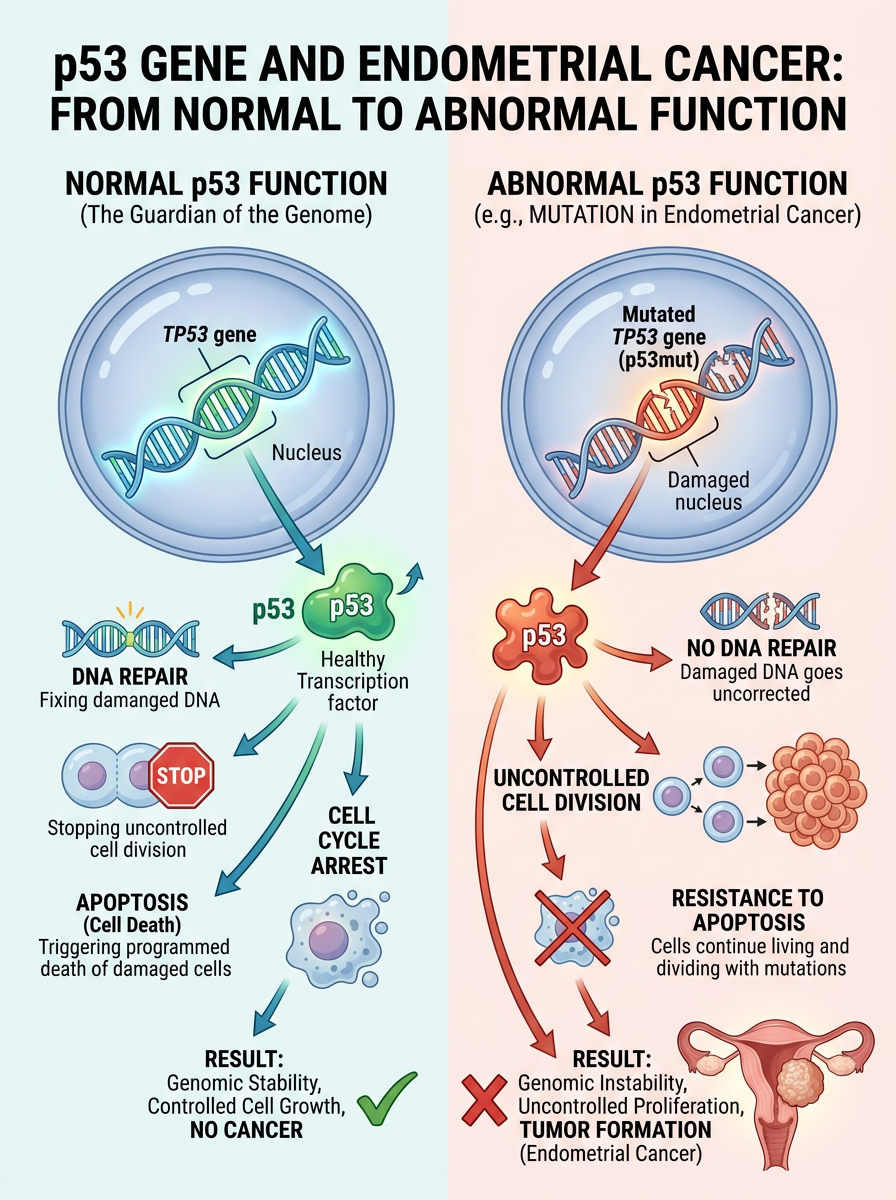
A report shows this finding because the pathologist ordered or interpreted p53 immunohistochemistry on a biopsy, hysterectomy specimen, or outside slide review. The stain helps classify endometrial tumors into biologically meaningful groups. Modern endometrial cancer pathology increasingly uses molecular classification, which combines microscopic appearance with selected biomarker results. This approach helps separate tumors that may look similar under the microscope but behave differently in real life.
Abnormal p53 is classically associated with uterine serous carcinoma, a high-grade type of endometrial cancer. It can also appear in some high-grade endometrioid carcinomas, carcinosarcomas, clear cell carcinomas, and mixed tumors. This is why the exact tumor type still matters: A p53 abnormal result does not automatically mean uterine serous carcinoma, but it raises that possibility in the right microscopic context. Tumor grade, architecture, cell shape, necrosis, and invasion pattern all help the pathologist decide how the diagnosis should be worded.
The report may also mention mismatch repair because that test answers a different question. Mismatch repair testing looks for loss of proteins involved in DNA repair and may identify cancers with possible Lynch syndrome implications or immunotherapy relevance. Molecular classification often combines p53 status, mismatch repair status, POLE mutation status when available, and histologic features. A p53 abnormal result is therefore one lane in a larger diagnostic highway, not the whole road.
How Serious Is P53 Abnormal Endometrial Cancer?
p53 abnormal endometrial cancer is taken seriously because it is often associated with a higher-risk tumor biology. In many clinical guidelines, abnormal p53 places a tumor into a group that may need more careful staging, closer attention to spread, and stronger consideration of additional treatment after surgery. That said, seriousness depends on the entire case, not the stain alone. A small tumor confined to the uterus is very different from a tumor with deep invasion, lymphovascular invasion, lymph node involvement, or spread outside the uterus.
Patients often fear that p53 abnormal endometrial cancer automatically means a hopeless situation. That is not accurate. It means the care team should treat the diagnosis with appropriate caution and should use all available information to estimate risk. Endometrial cancer pathology includes many details that refine that risk, including tumor grade, myometrial invasion, cervical stromal involvement, serosal involvement, lymphovascular invasion, and margin status when relevant.
There are also situations where p53 abnormal endometrial cancer changes how a tumor is classified. For example, a tumor that looks mostly endometrioid but has abnormal p53 may be assigned a more aggressive molecular category than expected from appearance alone. In other cases, p53 immunohistochemistry supports a diagnosis of uterine serous carcinoma when the microscopic features fit. When the result seems surprising or when treatment recommendations depend heavily on the wording, a second pathology opinion can be valuable; guidance on when to get a second pathology opinion may help patients decide whether review is reasonable.
What Happens Next: Treatment and Monitoring
After a p53 abnormal result, the next step is usually not a single automatic treatment. The gynecologic oncology team typically reviews the complete pathology report, imaging, surgical findings, stage, overall health, and patient preferences. Treatment may include surgery, radiation therapy, chemotherapy, immunotherapy in selected settings, or a combination of approaches. The role of p53 immunohistochemistry is to help inform that planning, especially when risk categories are being assigned.
If the diagnosis was made on an endometrial biopsy before surgery, the hysterectomy specimen may provide more complete information. A biopsy samples part of the tumor, while the surgical specimen allows assessment of tumor size, depth of invasion, cervix, tubes, ovaries, lymph nodes if sampled, and other structures. Endometrial cancer pathology can change or become more specific after the full specimen is examined. This does not mean the biopsy was “wrong”; it means more tissue often gives a clearer map.
Monitoring after treatment depends on stage and treatment plan. Follow-up often includes pelvic examinations, symptom review, and imaging when clinically indicated. Blood tests may be used in some cases, but there is no single p53 blood test that monitors most patients with endometrial cancer. Patients who want help reading the sequence of biopsy, surgery, biomarkers, and staging may benefit from understanding a pathology report with confidence.
Questions To Ask Your Doctor Or Pathologist
Specific questions can make a stressful visit more productive. Bringing the pathology report, operative note, imaging reports, and any outside slides or blocks information can help the care team explain the diagnosis accurately. For p53 abnormal endometrial cancer, the most useful questions are targeted to classification, stage, and treatment impact.
- Does the p53 abnormal result change the tumor type or final diagnosis?
- Does the report favor uterine serous carcinoma, high-grade endometrioid carcinoma, or another subtype?
- Was p53 immunohistochemistry interpreted as overexpression, complete absence, or cytoplasmic staining?
- Were mismatch repair proteins tested, and what were the results?
- Is POLE mutation testing recommended for this tumor?
- How do tumor grade, invasion depth, and lymphovascular invasion affect the treatment plan?
- Would a gynecologic pathology second opinion change management in this case?
A pathology consultation is often most helpful when the diagnosis is high-grade, mixed, unusual, or treatment-changing. The goal is not to create doubt for its own sake; the goal is to make sure the tumor is classified as precisely as possible.
Patients can ask whether the slides were reviewed by a gynecologic pathologist, especially when p53 immunohistochemistry, TP53 mutation implications, or uterine serous carcinoma are central to the report. If outside review is needed, practical steps for getting a second opinion on a pathology diagnosis can make the process easier.
Frequently Asked Questions
What does p53 abnormal mean in endometrial cancer?
p53 abnormal endometrial cancer means the tumor shows an abnormal staining pattern for the p53 protein. This pattern often suggests a TP53 mutation in the cancer cells. It can place the tumor into a higher-risk molecular classification, but the full stage and pathology details still matter. The result should be interpreted with the tumor type, tumor grade, invasion, and other biomarker tests.
Does p53 abnormal mean serous cancer?
Abnormal p53 is common in uterine serous carcinoma, but it does not prove that diagnosis by itself. Some high-grade endometrioid carcinomas and other endometrial cancers can also show abnormal p53 immunohistochemistry. Pathologists make the final diagnosis by combining the stain pattern with the tumor’s microscopic appearance. If the wording is unclear, expert gynecologic pathology review can be helpful.
Is p53 abnormal endometrial cancer curable?
p53 abnormal endometrial cancer can still be treatable, and in some cases it may be treated with curative intent. The chance of cure depends on stage, spread, surgical findings, tumor type, and response to treatment. The p53 result adds risk information, but it does not replace staging. A gynecologic oncologist can explain how the result affects the individual treatment plan.
Is p53 abnormal inherited?
Most TP53 mutation changes found in endometrial tumors are acquired only in the cancer cells and are not inherited. Rare inherited TP53 syndromes exist, but they are not the usual explanation for abnormal tumor staining. Family history, age at diagnosis, and other cancer patterns may guide whether genetic counseling is appropriate. Mismatch repair results are often more directly connected to Lynch syndrome screening in endometrial cancer.
Can a second opinion change a p53 abnormal diagnosis?
A second opinion can sometimes change or refine the diagnosis, especially when the tumor is high-grade, mixed, or difficult to classify. The p53 abnormal endometrial cancer result itself may be confirmed, but the final tumor type or risk category may be clarified. Review by a gynecologic pathologist can be particularly useful when treatment depends on the distinction between uterine serous carcinoma and other high-grade tumors. The most useful review includes the original slides, immunostains, and the full pathology report.
A p53 abnormal result can feel like one more frightening phrase in an already difficult diagnosis. Clear explanation, careful classification, and the right questions can turn that phrase into a practical part of treatment planning. Honest Pathology consultations can help patients and families understand whether the report is complete, whether the diagnosis fits, and whether expert review may be appropriate.
References:
National Cancer Institute — Pathology Reports Fact Sheet
National Cancer Institute — Endometrial Cancer Treatment
National Cancer Institute — TP53 Gene Definition