
Worried by muscularis propria not identified on a bladder biopsy? Learn why it matters, what it can limit, and what to ask next.
Muscularis propria not identified means the pathologist did not see the thick bladder wall muscle needed to fully assess how deep some bladder tumors may have grown. This phrase is common in a bladder biopsy report or TURBT specimen, and it often raises immediate concern because bladder cancer treatment depends heavily on depth of invasion. The finding does not automatically mean that cancer has been missed or that the procedure failed, but it can make bladder cancer staging less complete.
Receiving this wording can feel unsettling, especially when the report already contains unfamiliar terms such as urothelial carcinoma, lamina propria invasion, or tumor grade. A pathology report is meant to guide care, but its language can sound cold and technical at the exact moment a patient needs clarity. The most helpful next step is to understand what tissue was present, what tissue was absent, and how that affects confidence in the diagnosis. For a broader explanation of report structure, patients may find Understanding Your Pathology Report helpful.
Muscularis Propria Not Identified — What It Actually Means
Muscularis propria not identified is a descriptive pathology statement, not a separate disease. The muscularis propria is the thick muscle layer of the bladder wall, also called the detrusor muscle. In a bladder biopsy report, the pathologist lists the tissue layers that are present because those layers determine how far a tumor can be evaluated. If the detrusor muscle is absent, the deepest part of the bladder wall cannot be assessed in that sample.
A useful analogy is a core sample taken from layered soil. If the sample includes the surface and middle layers but not the deep rock layer, the report can describe what is present, but it cannot prove what is happening below the sampled depth. In bladder pathology, the surface lining is urothelium, the supportive layer beneath it is lamina propria, and the deeper thick muscle is muscularis propria. When muscularis propria not identified appears, the report is saying that the microscope slide does not contain that deep muscle layer.
This matters most when the diagnosis involves urothelial carcinoma, especially when there is concern for invasion. A TURBT specimen may contain tumor fragments, cauterized tissue, blood clot, inflamed tissue, and sometimes detrusor muscle. The pathologist examines all submitted tissue and reports whether muscle is present and whether tumor involves it. If the TURBT specimen lacks muscularis propria, the clinical team may need to decide whether the sampling was enough for safe treatment planning.
Why A Bladder Biopsy Report Shows This Finding
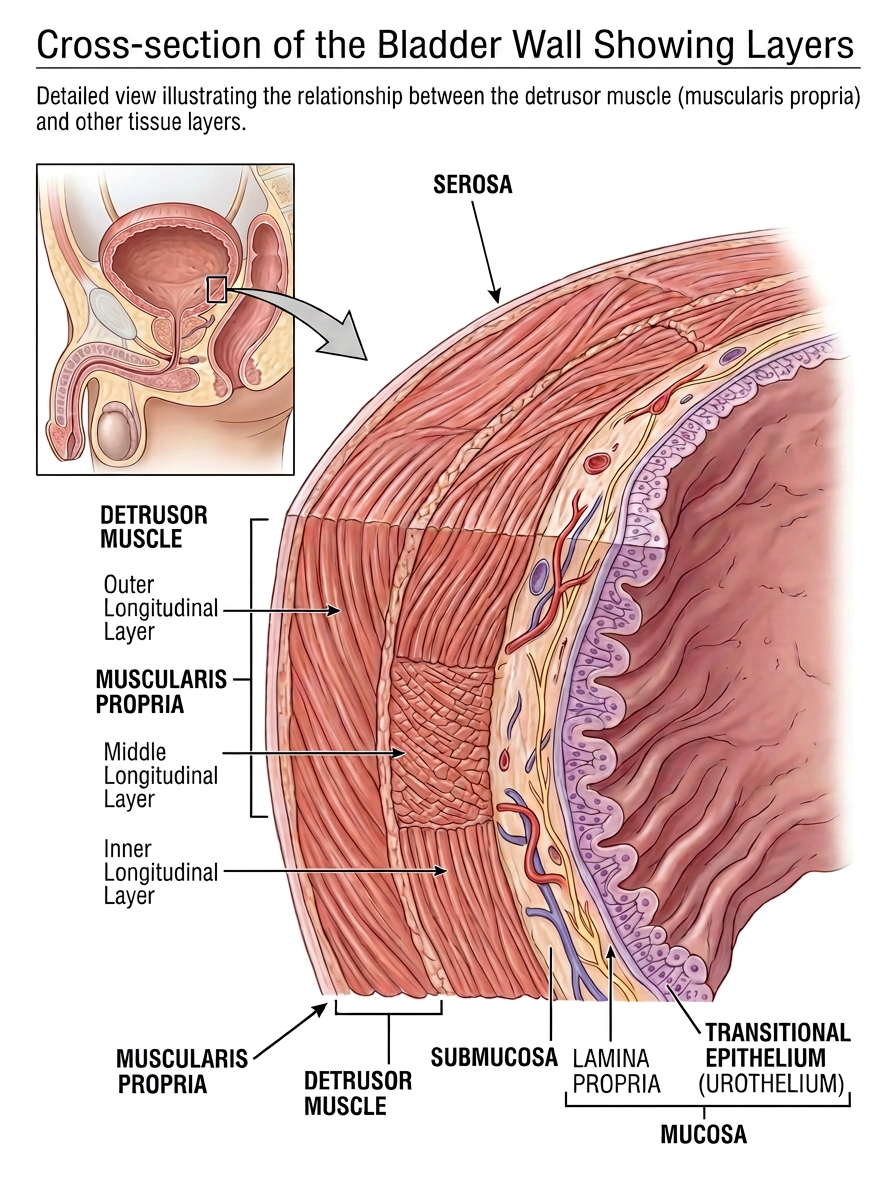
A bladder biopsy report may show muscularis propria not identified for several reasons. Sometimes the biopsy was intentionally shallow because the urologist sampled a flat red area, a small papillary tumor, or suspicious mucosa rather than attempting a deep resection. Sometimes tissue handling, tumor location, bleeding, or cautery artifact limits the amount of deep tissue that can be removed safely. In other cases, the TURBT specimen was meant to be deep, but the submitted fragments simply did not include detrusor muscle.
The lab does not know exactly what the bladder looked like during cystoscopy unless the procedure note is provided. Pathologists often rely on the tissue itself: Whether it contains urothelium, lamina propria, detrusor muscle, inflammation, cautery effect, and tumor. The distinction between lamina propria invasion and muscle invasion is central to bladder cancer staging. Tumor grade also matters because high-grade tumors are more likely to require careful confirmation of depth.
Muscularis propria not identified can also appear when the tissue is fragmented or thermally damaged. During transurethral resection, electrical current can distort cells and tissue planes, making it harder to identify layers. A TURBT specimen from a bulky tumor may have many fragments, but depth can still be difficult to prove if fragments are not oriented. The finding is therefore a limitation of the sample, not a judgment about the patient or the urologist.
How Serious Is Muscularis Propria Not Identified?
The seriousness of muscularis propria not identified depends on the rest of the diagnosis. If the bladder biopsy report shows a low-grade, noninvasive papillary urothelial carcinoma with no lamina propria invasion, absence of detrusor muscle may be less concerning in some clinical settings. If the report shows high-grade urothelial carcinoma, lamina propria invasion, or suspicious deep invasion, the absence of muscle becomes much more important. The central question is whether bladder cancer staging is complete enough to guide treatment safely.
Muscularis propria not identified is especially important because treatment changes dramatically when tumor invades the detrusor muscle. Non-muscle-invasive bladder cancer may be treated with resection, surveillance, and intravesical therapy such as BCG or chemotherapy placed into the bladder. Muscle-invasive disease often requires more intensive treatment discussions, which may include surgery, systemic therapy, radiation-based approaches, or combined treatment. Without detrusor muscle in the TURBT specimen, a pathologist may not be able to exclude muscle invasion.
That does not mean every patient with muscularis propria not identified has hidden muscle-invasive cancer. It means the report has a staging blind spot. The risk is higher when tumor grade is high, when lamina propria invasion is present, when the tumor is large, when the resection was incomplete, or when imaging and cystoscopy suggest deeper disease. In those situations, the care team may recommend repeat TURBT to obtain better sampling and more reliable bladder cancer staging.
What Happens Next: Treatment And Monitoring
After muscularis propria not identified appears in a report, the next step usually depends on tumor type, tumor grade, invasion status, cystoscopy findings, and imaging. A low-grade noninvasive tumor may be managed differently from a high-grade tumor with lamina propria invasion. The urologist may compare the bladder biopsy report with the operative note to determine whether deep tissue was expected. If there is uncertainty, repeat resection is a common and practical way to obtain detrusor muscle.
For high-grade urothelial carcinoma or any tumor with lamina propria invasion, many treatment teams prefer a repeat TURBT specimen that includes muscularis propria. This repeat procedure can confirm whether the first staging impression was accurate. It can also remove residual tumor that may remain after the first resection. When detrusor muscle is present and uninvolved, confidence in non-muscle-invasive bladder cancer staging improves.
Monitoring may include cystoscopy, urine cytology, imaging, and additional biopsies depending on the clinical picture. Pathology results are only one part of the decision, but they are a critical part. Patients who want to understand the role of each line in the report may also benefit from What Is a Pathology Report?. When wording remains unclear, an expert review can confirm whether the available slides truly lack muscle and whether any small focus of invasion is present.
Questions To Ask The Doctor Or Pathologist
- Did the bladder biopsy report show noninvasive tumor, lamina propria invasion, or possible muscle invasion?
- Was the tumor grade low-grade or high-grade, and how does tumor grade affect the next step?
- Was detrusor muscle absent from all tissue fragments, or was it present but not involved by tumor?
- Was the TURBT specimen considered complete based on the operative note?
- Does muscularis propria not identified mean repeat TURBT is recommended in this case?
- Are imaging findings or cystoscopy findings concerning for deeper invasion?
- Would a second pathology opinion change confidence in bladder cancer staging?
These questions help turn a frightening phrase into a practical discussion. The goal is not to challenge the treating team, but to make sure staging, sampling, and treatment planning are aligned. A second review may be especially helpful when the report mentions high-grade urothelial carcinoma, lamina propria invasion, equivocal invasion, or cautery artifact.
A second pathology opinion can sometimes clarify whether a tiny focus of detrusor muscle is present, whether invasion is truly in lamina propria, and whether tumor grade is best classified as low or high. Guidance on timing and logistics is available in When Should You Get a Second Pathology Opinion? and How to Get a Second Opinion on Your Pathology Diagnosis.
Frequently Asked Questions
What does muscularis propria not identified mean on bladder biopsy?
Muscularis propria not identified means the thick bladder muscle layer was not seen in the tissue examined under the microscope. The report can still diagnose tumor type, tumor grade, and sometimes lamina propria invasion. The limitation is that muscle invasion cannot be assessed unless detrusor muscle is present. This wording should be discussed with the urologist in the context of the cystoscopy and operative findings.
Does muscularis propria not identified mean the biopsy was bad?
No. Muscularis propria not identified does not automatically mean the biopsy was bad or improperly done. Some biopsies are intentionally superficial, and some bladder areas cannot be deeply sampled without added risk. The key issue is whether the missing detrusor muscle affects bladder cancer staging in that specific case. High-grade tumors and tumors with lamina propria invasion usually require more careful attention to this limitation.
Can bladder cancer be staged without muscularis propria?
Bladder cancer staging can be partly assessed without muscularis propria, but it may not be complete. A pathologist can often determine whether tumor is noninvasive or whether lamina propria invasion is present. However, muscle invasion cannot be excluded confidently if no detrusor muscle is available. That is why a repeat TURBT specimen may be recommended when staging confidence is limited.
Is repeat TURBT needed when muscle is missing?
Repeat TURBT is often considered when muscularis propria is absent and the tumor is high-grade, invasive into lamina propria, large, or incompletely resected. The purpose is to obtain deeper tissue and improve bladder cancer staging. Repeat resection may also find residual tumor. The final decision depends on the full clinical picture, not the pathology phrase alone.
Can a second opinion help with muscularis propria not identified?
Yes, a second opinion can help when muscularis propria not identified creates uncertainty about staging or treatment. Another pathologist can review all slides to confirm whether detrusor muscle is truly absent and whether invasion has been classified correctly. This is particularly useful in high-grade urothelial carcinoma or borderline cases. A second opinion may not always change the diagnosis, but it can increase confidence in the next treatment decision.
Muscularis propria not identified is a limitation that deserves attention, not panic. Clear staging depends on matching the pathology findings with the procedure details, cystoscopy impression, and clinical risk factors. Honest Pathology consultations can provide an independent pathology review when patients or families need clearer language, better context, or added confidence before the next appointment.
References:
National Cancer Institute — Pathology Reports
National Cancer Institute — Definition of Muscularis Propria
National Cancer Institute — Definition of Transurethral Resection