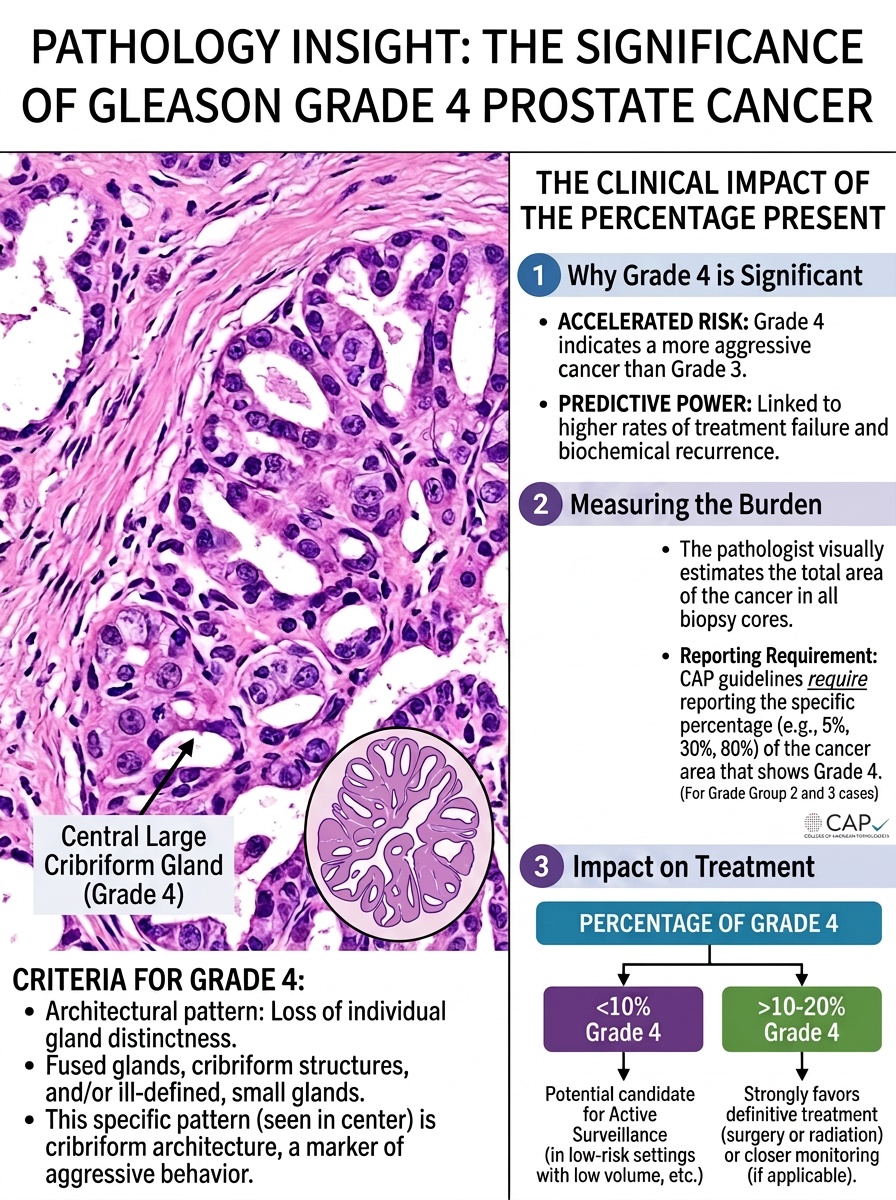
Worried by percentage Gleason pattern 4 in a prostate biopsy report? Learn what it means and what questions to ask next.
Percentage Gleason pattern 4 is included in a prostate biopsy report because it helps show how much of the cancer has a more aggressive microscopic pattern. This number gives doctors more detail than the Gleason score alone, especially for cancers in Grade Group 2 or Grade Group 3. It can affect discussions about active surveillance, surgery, radiation, and the need for a second pathology review.
Seeing a percentage in a cancer report can feel unsettling, as if the report is reducing a life-changing diagnosis to a math problem. In reality, this detail is meant to add clarity, not fear. A pathologist includes it so the treating team can better estimate prostate cancer risk and match treatment decisions to the biology seen under the microscope.
A prostate biopsy report often contains unfamiliar terms, and percentage Gleason pattern 4 is one of the most commonly misunderstood. The goal is not to make the diagnosis sound worse. The goal is to describe the cancer as accurately as possible so the next conversation with the urologist or oncologist can be more focused and practical.
Percentage Gleason Pattern 4 — What It Actually Means
Percentage Gleason pattern 4 describes the estimated amount of cancer in the biopsy that shows Gleason pattern 4 architecture. In prostate cancer, pathologists grade the cancer by looking at how the tumor forms glands under the microscope. Pattern 3 cancer usually still forms more recognizable glands, while pattern 4 shows more fused, poorly formed, cribriform, or glomeruloid gland patterns. This difference matters because pattern 4 is generally associated with higher prostate cancer risk than pattern 3.
A useful analogy is comparing a neighborhood map. Pattern 3 may look like separate houses on organized streets, while pattern 4 may look like crowded buildings that have fused together or lost the usual layout. The percentage Gleason pattern 4 is the pathologist’s estimate of how much of the cancer shows that less organized pattern. It is not the percentage of the whole prostate involved by cancer, and it is not the same as the percentage of biopsy cores involved by cancer.
This distinction is one reason a prostate biopsy report can feel confusing. One section may list the number of positive cores, another may list the amount of cancer in each core, and another may mention the Gleason score or Grade Group. For a broader explanation of how reports are structured, patients may find What Is a Pathology Report? helpful. In practical terms, percentage Gleason pattern 4 adds detail inside the grade itself, especially when the Gleason score includes both pattern 3 and pattern 4.
Why Your Report Shows This Finding
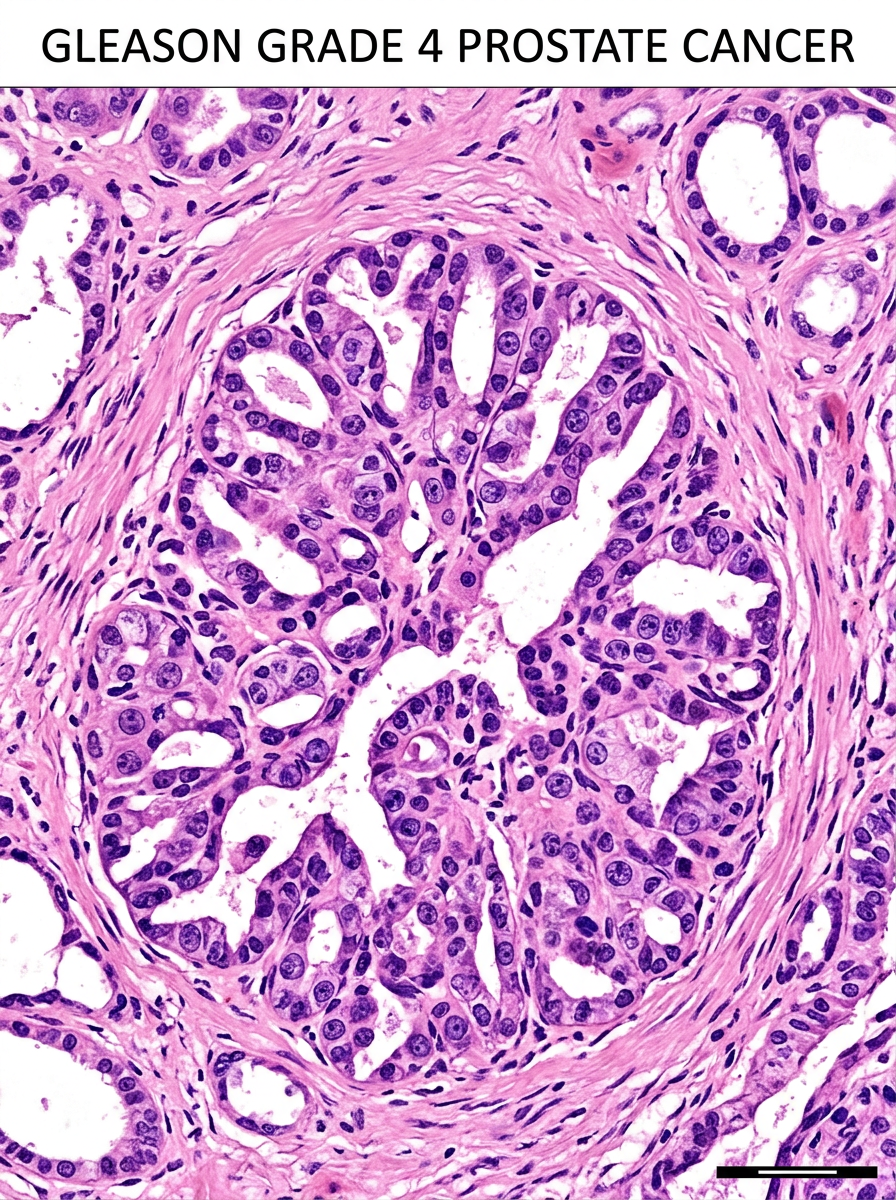
The percentage appears because not all Gleason 3+4=7 or Gleason 4+3=7 cancers behave the same way. A Gleason score of 3+4=7 with 5% pattern 4 is different from a Gleason score of 3+4=7 with 45% pattern 4. Both may fall under related grading categories, but the biology suggested by the microscope is not identical. Reporting the percentage Gleason pattern 4 helps the clinical team understand where the cancer falls within that spectrum.
Pathologists assess pattern 4 during tumor grading by scanning the biopsy cores and estimating the relative amount of each architectural pattern. This estimate is based on the cancer present in the sampled tissue, not on imaging or blood tests. The Grade Group is then assigned using the Gleason score: Gleason 3+3=6 is Grade Group 1, Gleason 3+4=7 is Grade Group 2, Gleason 4+3=7 is Grade Group 3, Gleason 8 is Grade Group 4, and Gleason 9 to 10 is Grade Group 5. A detailed comparison is available in Gleason Score vs Grade Group in Prostate Cancer.
The report may also mention features such as cribriform pattern, intraductal carcinoma, perineural invasion, or the number of cores involved. These findings can influence prostate cancer risk alongside the percentage Gleason pattern 4. Active surveillance decisions often depend on the overall pattern, including PSA level, MRI findings, tumor volume, and patient health. Because a prostate biopsy report is only one part of the full picture, the percentage should be interpreted with the entire clinical situation.
How Serious Is Percentage Gleason Pattern 4?
Percentage Gleason pattern 4 can be serious, but the meaning depends strongly on the exact percentage and the rest of the diagnosis. A small amount of pattern 4 in an otherwise low-volume Gleason 3+4 cancer may support a less aggressive approach in carefully selected patients. A higher amount of pattern 4 may suggest a greater chance that the cancer could grow, spread, or require definitive treatment. This is why the number is included: it helps refine risk rather than simply label the cancer as “good” or “bad.”
In many clinical settings, lower percentage Gleason pattern 4 may make active surveillance a possible discussion, especially when the cancer is limited, PSA density is favorable, MRI findings are not concerning, and no high-risk microscopic features are present. Active surveillance does not mean ignoring cancer; it means monitoring with a structured plan that may include PSA testing, MRI, repeat biopsy, and clinical exams. A prostate biopsy report with a very small amount of pattern 4 may therefore lead to a different conversation than a report with extensive pattern 4. The Grade Group remains essential, but the percentage provides a finer level of detail.
Higher percentage Gleason pattern 4 usually raises concern because it means a larger share of the tumor has a more aggressive growth pattern. For example, Gleason score 4+3=7, which is Grade Group 3, means pattern 4 is the dominant pattern. That is generally treated differently from Gleason score 3+4=7, which is Grade Group 2. The percentage also matters within Grade Group 2 because a cancer with 10% pattern 4 may not carry the same prostate cancer risk as one with 49% pattern 4.
What Happens Next: Treatment And Monitoring
After percentage Gleason pattern 4 appears in a report, the next step is usually a risk-based discussion with the treating physician. The doctor typically combines the prostate biopsy report with PSA results, digital rectal exam findings, MRI results, age, general health, and patient preferences. This combined assessment helps determine whether active surveillance, prostatectomy, radiation therapy, focal therapy, or another plan should be considered. No single number should be used alone to make the decision.
For some patients, the percentage Gleason pattern 4 supports close monitoring rather than immediate treatment. For others, especially when pattern 4 is extensive or paired with other concerning findings, treatment may be recommended. Tumor grading helps estimate behavior, but it does not predict the future with perfect certainty. Pathology is one powerful piece of evidence, and clinical judgment connects that evidence to a safe plan.
A second pathology opinion may be helpful when the treatment choice hinges on a small amount of pattern 4. Distinguishing pattern 3 from pattern 4 can be challenging in some biopsy samples, particularly when the cancer focus is tiny, crushed, inflamed, or tangentially cut. A review by a pathologist with prostate expertise can confirm the Gleason score, Grade Group, and percentage estimate. Information about when a review is useful is available at When Should You Get a Second Pathology Opinion?.
Questions To Ask Your Doctor Or Pathologist
The most helpful questions are specific to the wording in the report. A patient does not need to master every pathology term before the appointment. The aim is to understand how the percentage Gleason pattern 4 changes the risk category and treatment discussion.
- What is the exact Gleason score and Grade Group in each positive biopsy core?
- How much percentage Gleason pattern 4 is present overall and in the highest-grade core?
- Does the prostate biopsy report mention cribriform pattern or intraductal carcinoma?
- How many biopsy cores contain cancer, and how much of each core is involved?
- Does this amount of pattern 4 affect eligibility for active surveillance?
- How do PSA level, MRI findings, and tumor grading fit together in this case?
- Would a second pathology opinion change treatment planning or confidence in the diagnosis?
These questions can turn a frightening report into a more organized conversation. Many patients find it helpful to bring a printed copy of the prostate biopsy report and mark the lines that are unclear. For practical support with report language, Understanding Your Pathology Report: How to Read It with Confidence can help patients prepare.
If the percentage is low and the treatment options are very different, an expert pathology review can be especially valuable. If the percentage is high, a review can still confirm the diagnosis and make sure no additional features were missed. Clarity does not remove every worry, but it can make the next step feel less uncertain.
Frequently Asked Questions
What does percentage Gleason pattern 4 mean?
Percentage Gleason pattern 4 means the estimated proportion of the prostate cancer in the biopsy that shows Gleason pattern 4 architecture. Pattern 4 is less organized than pattern 3 and is generally linked with higher prostate cancer risk. The percentage helps refine the meaning of the Gleason score and Grade Group. It does not mean that the same percentage of the entire prostate contains cancer.
Is 10 percent Gleason pattern 4 bad?
A 10 percent pattern 4 finding may be considered relatively low within a Gleason 3+4 cancer, but it still needs context. The number of involved cores, PSA level, MRI findings, and any cribriform pattern all matter. Some patients with low-volume Grade Group 2 cancer may still discuss active surveillance. The prostate biopsy report should be reviewed as a whole rather than by one number alone.
Can percentage Gleason pattern 4 change treatment?
Yes, percentage Gleason pattern 4 can influence treatment discussions, especially in Grade Group 2 prostate cancer. A very small amount of pattern 4 may support consideration of monitoring in selected patients, while a higher amount may support definitive treatment. The final recommendation also depends on overall health, PSA, MRI, and tumor volume. This is why doctors often pay close attention to the percentage.
Can a pathologist misread Gleason pattern 4?
Prostate tumor grading is highly specialized, and some borderline areas can be difficult to classify. Experienced pathologists usually agree on clear-cut cases, but small or subtle pattern 4 areas may benefit from expert review. A second opinion can confirm the Gleason score, Grade Group, and percentage estimate. This is most useful when the result affects eligibility for active surveillance or a major treatment decision.
Does Grade Group 2 always need treatment?
Grade Group 2 does not always require immediate treatment, but it does require careful evaluation. Some favorable Grade Group 2 cancers with low percentage Gleason pattern 4 may be candidates for active surveillance. Other Grade Group 2 cancers have higher volume, more pattern 4, or additional concerning features. The safest plan comes from combining pathology, PSA, MRI, and patient-specific factors.
Percentage Gleason pattern 4 is included to make the diagnosis more precise, not to make the report more frightening. When the number is interpreted with the Gleason score, Grade Group, tumor volume, PSA, and imaging, it can help patients and clinicians choose a plan with more confidence. Honest Pathology consultations can provide an expert review of prostate biopsy findings when the wording or treatment implications remain unclear.
References:
National Cancer Institute — Pathology Reports
National Cancer Institute — Gleason Score
National Cancer Institute — Active Surveillance