Worried by ASAP prostate biopsy results? Learn what atypical small acinar proliferation means and what to ask before the next step.
ASAP prostate biopsy means the pathologist saw a small area that looks suspicious for prostate cancer but is not definite enough to diagnose as cancer. ASAP stands for atypical small acinar proliferation, a phrase that can feel alarming because it sits in an uncomfortable gray zone. It is a diagnosis about uncertainty, not proof that cancer is present.
For many patients and families, the word “atypical” can sound like bad news before anyone has explained what it means. A prostate pathology report may use technical language because pathologists must be precise, but that precision can make the result feel colder and more frightening than it should. Clear explanation matters because ASAP prostate biopsy findings usually lead to careful follow-up, not immediate treatment.
Pathologists often treat ASAP as a signal to look again, sample again, or review the case carefully. The goal is to avoid both overcalling cancer and missing a real cancer that was only partly sampled. Helpful background on report structure is available in What Is a Pathology Report?.
ASAP Prostate Biopsy — What It Actually Means

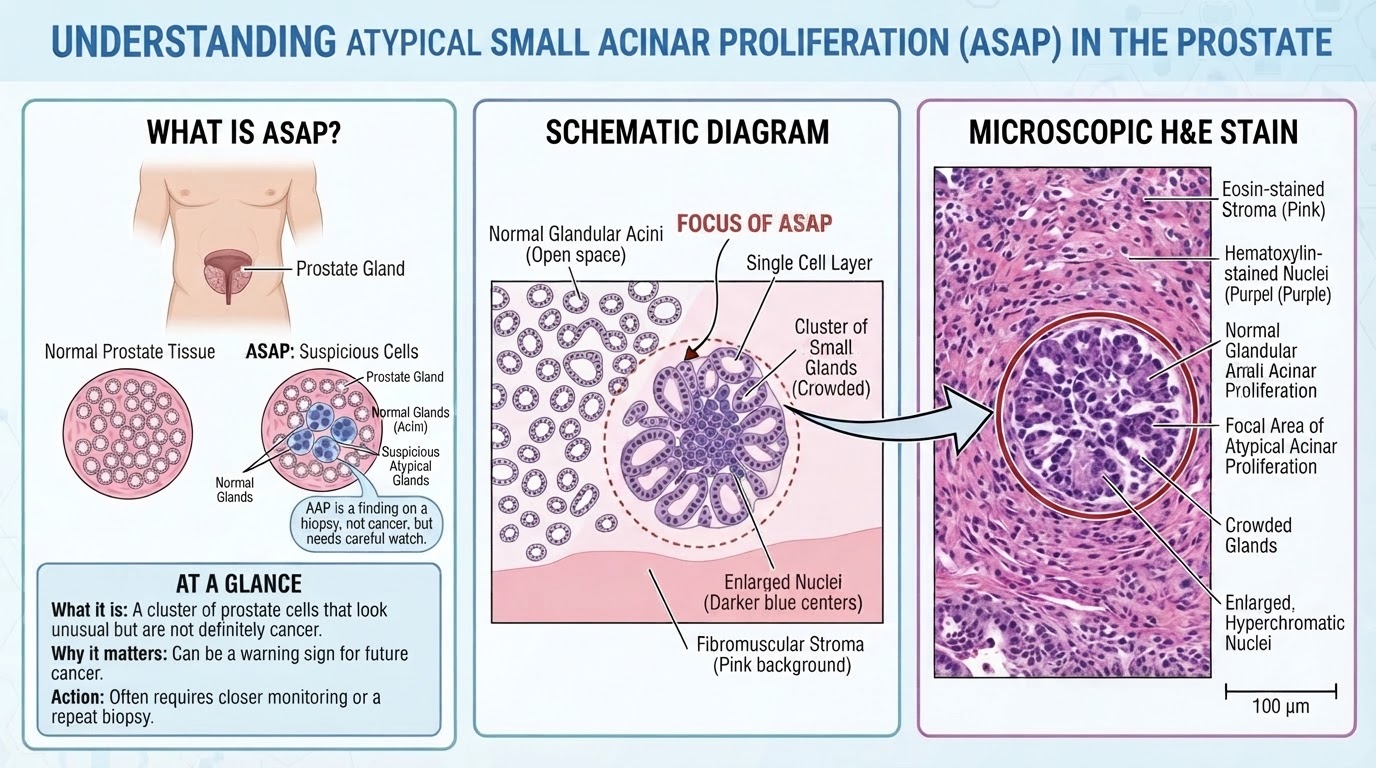
ASAP prostate biopsy is a pathology diagnosis used when a tiny cluster of glands looks abnormal but does not meet all criteria for prostate cancer. The longer term, atypical small acinar proliferation, describes the microscopic pattern: small glands that raise suspicion because of their shape, crowding, or appearance. The finding is usually very focal, sometimes involving only a few glands on one biopsy core. That limited amount of tissue is exactly why the diagnosis can remain uncertain.
A practical analogy is a blurry photograph of a license plate. The pathologist can see enough to know the image may matter, but not enough to read it with certainty. In a prostate biopsy, small glands may look like cancer, but inflammation, partial sampling, tissue distortion, or benign mimics can cloud the picture. A careful prostate pathology report is designed to communicate that uncertainty honestly rather than force a diagnosis that the tissue does not fully support.
ASAP prostate biopsy does not mean the entire prostate has cancer, and it does not assign a Gleason score or Grade Group. Those grading systems are used only when prostate cancer is actually diagnosed. ASAP is instead a warning flag that the sampled area deserves attention because prostate cancer risk is higher than after a completely benign biopsy. Many patients with atypical small acinar findings later have no cancer found, while others are diagnosed with a small focus of cancer on repeat prostate biopsy.
Why Your Report Shows This Finding
A report shows ASAP when the pathologist sees suspicious microscopic features but one or more required pieces of evidence are missing. Prostate cancer is usually diagnosed by recognizing crowded small glands, loss of normal architecture, nuclear changes, and supportive staining patterns. Sometimes the suspicious focus is so small that only a few small glands are available for judgment. When the tissue fragment is tiny, crushed, inflamed, or cut at an awkward angle, certainty becomes harder.
Pathologists may order immunohistochemistry stains to help separate benign glands from cancer. These tests often include basal cell markers because benign prostate glands normally have a basal cell layer, while most prostate cancers do not. If basal cell markers are absent around suspicious glands and another marker such as AMACR is positive, the concern for cancer increases. However, immunohistochemistry stains are supportive tools, not magic answers, and staining may be limited when only a very small focus is present.
Benign mimics can also create an atypical small acinar pattern. Inflammation, atrophy, adenosis, prior procedures, and tangential sectioning can all make small glands look more worrisome than they are. The prostate pathology report may mention the location of ASAP, the biopsy core involved, or whether additional levels and stains were reviewed. These details help the treating urologist decide whether prostate cancer risk is high enough to recommend repeat prostate biopsy, MRI correlation, or expert pathology review.
How Serious Is ASAP Prostate Biopsy?
ASAP prostate biopsy is serious enough to require follow-up, but it is not the same as a prostate cancer diagnosis. Studies have shown that a meaningful percentage of patients with ASAP are later found to have prostate cancer, often on repeat prostate biopsy targeted to the same region or guided by imaging. Many detected cancers are low grade, but some patients can have clinically significant disease. The seriousness depends on the patient’s PSA level, digital rectal exam, MRI findings, family history, age, prior biopsy history, and the exact microscopic appearance.
The most helpful way to understand ASAP prostate biopsy is as a risk category rather than a final label. A completely benign biopsy usually lowers concern, while a clear cancer diagnosis leads to grading and staging discussions. ASAP sits between those outcomes because the pathologist saw something real but not definitive. In that sense, ASAP prostate biopsy functions like a smoke alarm that needs investigation, not like proof of a fire.
Prostate cancer risk is not identical for every patient with atypical small acinar proliferation. A single tiny suspicious focus with reassuring MRI and stable PSA may be managed differently from multiple atypical cores with rising PSA and a concerning MRI lesion. The prostate pathology report should be interpreted alongside the clinical picture, not in isolation. When the wording feels unclear, Understanding Your Pathology Report: How to Read It with Confidence can help patients identify which lines of the report carry the most weight.
What Happens Next: Treatment and Monitoring
Most patients with ASAP are not treated immediately because there is no confirmed cancer to treat. Instead, the next step is usually closer evaluation. This may include PSA follow-up, prostate MRI, review of the original slides, or repeat prostate biopsy within a timeframe chosen by the urologist. The exact plan depends on how much atypical small acinar proliferation was seen and how concerning the overall clinical picture appears.
A repeat prostate biopsy may sample the same area more thoroughly, especially if the original suspicious focus was limited. If MRI shows a lesion, the urologist may recommend targeted cores in addition to systematic sampling. This approach increases the chance of finding a true cancer if one is present and decreases the chance that a small hidden lesion is missed. If no cancer is found on repeat prostate biopsy, continued PSA monitoring may still be recommended.
A second pathology review can be useful when the diagnosis will change management or when the language in the prostate pathology report feels especially uncertain. Expert genitourinary pathologists review the slides, the levels, and any immunohistochemistry stains to decide whether the focus is benign, ASAP, high-grade prostatic intraepithelial neoplasia, or definite cancer. Information about timing and reasons for review is available in When Should You Get a Second Pathology Opinion?. A review cannot change the tissue that was sampled, but it can clarify whether the original interpretation is the best-supported diagnosis.
Questions to Ask Your Doctor or Pathologist
- Which biopsy core showed ASAP, and where in the prostate was that core taken?
- How many glands were suspicious, and was the atypical small acinar focus very limited?
- Were immunohistochemistry stains performed, and what did the basal cell markers show?
- Does the prostate pathology report mention high-grade PIN, inflammation, atrophy, or another mimic?
- Based on PSA, MRI, and exam findings, what is the estimated prostate cancer risk?
- Is a repeat prostate biopsy recommended, and should it be MRI-targeted?
- Would an expert genitourinary pathology second opinion change the next step?
These questions help turn a frightening phrase into a practical plan. ASAP prostate biopsy results are best handled by connecting the microscopic finding with the patient’s PSA trend, imaging, and overall risk profile. A patient can also ask whether the original slides and blocks are available for outside review.
A second opinion is especially reasonable when the next decision involves another biopsy, surveillance, or a major shift in care. The process usually involves requesting slides from the original laboratory and sending them to another pathologist or consultation service. Step-by-step guidance is available in How to Get a Second Opinion on Your Pathology Diagnosis.
Frequently Asked Questions
Does ASAP on prostate biopsy mean cancer?
No. ASAP prostate biopsy means the tissue is suspicious but not diagnostic of cancer. The pathologist saw atypical small acinar glands that raised concern, but the evidence was not strong enough for a definite prostate cancer diagnosis. Follow-up is recommended because prostate cancer risk is higher than after a clearly benign biopsy.
How often does ASAP turn into prostate cancer?
ASAP does not “turn into” cancer in the way that a precancerous growth might progress. Instead, ASAP may represent a tiny cancer focus that was only partly sampled, or it may be a benign mimic. Published studies have reported cancer on repeat prostate biopsy in a substantial minority of patients. The exact risk depends on PSA, MRI findings, exam findings, and the details of the prostate pathology report.
Do I need another biopsy after ASAP?
Many urologists recommend repeat prostate biopsy after ASAP, often within months rather than years. The reason is that ASAP prostate biopsy can reflect a nearby cancer that the first sampling did not fully capture. MRI-targeted biopsy may be considered if imaging shows a suspicious area. Some patients may follow a different plan when clinical risk is low, so the decision should be individualized.
Can a second opinion change an ASAP diagnosis?
Yes, a second pathology opinion can sometimes change an ASAP diagnosis. After reviewing deeper levels, basal cell markers, and immunohistochemistry stains, an expert pathologist may classify the focus as benign, persistent ASAP, or definite prostate cancer. This can affect whether repeat prostate biopsy is urgent or whether monitoring is reasonable. A second opinion is most useful when the result will influence the next clinical step.
Is ASAP the same as high-grade PIN?
No. ASAP and high-grade prostatic intraepithelial neoplasia, often called high-grade PIN, are different pathology findings. ASAP describes suspicious small glands that may represent under-sampled cancer, while high-grade PIN involves abnormal cells within preexisting prostate ducts and glands. Both can appear in a prostate pathology report, but they carry different meanings and follow-up recommendations. The distinction is one reason expert slide review may be helpful.
An ASAP result can feel unsettling because it names uncertainty rather than resolving it. The reassuring part is that uncertainty has a pathway: slide review, clinical correlation, imaging, and repeat sampling when needed. Honest Pathology consultations can help clarify what the report says, what it does not say, and which questions deserve attention next.
References:
National Cancer Institute — Pathology Reports Fact Sheet
National Cancer Institute — Definition of Pathologist
National Cancer Institute — Definition of Biopsy