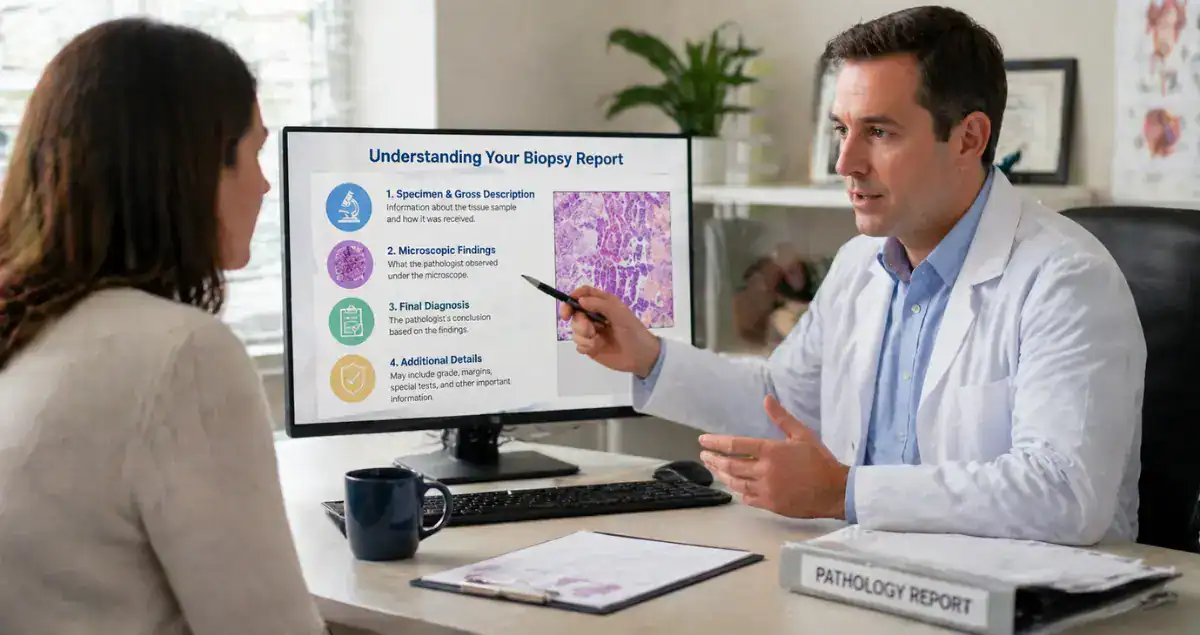
A pathology biopsy report is one of the most important documents in modern medicine. It often provides the first definitive answer about whether a disease is present, what type of condition is involved, and how it is classified under the microscope. Despite its importance, it is also one of the most difficult documents for patients to read and understand.
At Honest Pathology, we specialize in reviewing pathology biopsy reports in a way that is clear, structured, and patient-focused. Our goal is not to change or re-diagnose your results, but to help you understand exactly what your biopsy report is saying and what it means in the context of your health.
What a Pathology Biopsy Report Actually Contains
A biopsy report is created when a small sample of tissue is removed from the body and examined under a microscope by a pathologist. This process allows doctors to evaluate cells at a microscopic level to determine whether disease is present.
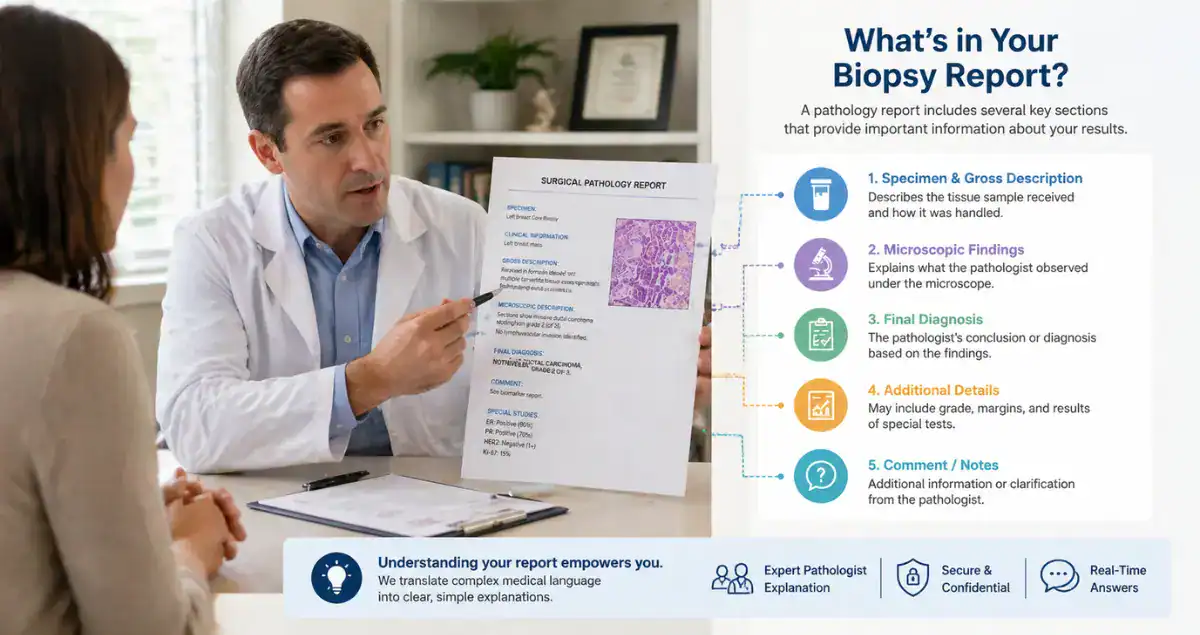
The report typically includes detailed sections such as the gross description of the tissue, microscopic findings, and a final diagnosis. It may also include additional information such as grading, margins, and special test results depending on the case.
While these details are medically precise, they are not written with patients in mind. The language is highly technical and often difficult to interpret without training in pathology.
This is where Honest Pathology provides clarity.
How Honest Pathology Reviews Your Biopsy Report
When you schedule a pathology report review consultation with Honest Pathology, the process begins with your biopsy report, and many patients choose a digital pathology consultation for a convenient and accessible way to get expert explanations. This is the only document required to begin your consultation.
You securely upload your report through a protected system, and a board-certified pathologist reviews it before your appointment. This preparation step ensures that your consultation is focused entirely on explanation rather than document review.
During your consultation, the pathologist walks you through your biopsy report step by step. Each section is explained in plain language so you can understand what was found and how it was interpreted.
The goal is to translate complex medical terminology into clear, meaningful information that you can actually use.
Focused Explanation of Microscopic Findings
One of the most important parts of a biopsy report is the microscopic description. This section explains what the pathologist saw when examining the tissue under the microscope.
At Honest Pathology, we take time to explain these findings in a way that is easy to understand. Instead of relying on technical language, we describe what the cells look like, why certain features are important, and how they contribute to the final diagnosis.
This helps patients understand not just the conclusion of the report, but how that conclusion was reached.
Understanding the Final Diagnosis in Your Biopsy Report
The final diagnosis section of a biopsy report is often the most important part for patients, but it is also the most misunderstood.
This section summarizes the pathologist’s interpretation of the tissue sample and provides the official medical conclusion. However, the wording can be brief, technical, and difficult to interpret without context.
During an Honest Pathology consultation, we explain exactly what the diagnosis means in clear language. We also help clarify how certain terms relate to the overall condition being described.
The goal is to ensure that you understand your diagnosis fully, not just recognize the medical terminology.
Clarifying Terms Like Grade, Type, and Margins
Biopsy reports often include additional details that can significantly influence how a diagnosis is understood.
These may include grading, which describes how abnormal the cells appear, or margin status, which indicates whether abnormal tissue is fully contained or extends to the edges of the sample.
There may also be specific classifications or subtypes that define the exact nature of the condition.
At Honest Pathology, we take the time to explain each of these terms in context so you understand why they matter and how they relate to your diagnosis as a whole.
Helping Patients Understand Complex or Uncertain Findings
Not all biopsy reports are straightforward. Some include language that reflects uncertainty, borderline findings, or the need for additional testing.
These situations can be especially stressful for patients who are trying to understand what their results mean.
During your consultation, we explain why certain wording is used and what level of certainty exists in the diagnosis. We also clarify whether additional testing or follow-up is typically recommended based on the findings.
This helps reduce confusion and provides a clearer sense of direction, especially when paired with additional educational resources that offer deeper biopsy insights into how findings may evolve over time.
No Need for Slides or Additional Materials
One of the most important things to understand about Honest Pathology consultations is that you do not need anything beyond your biopsy report.
We do not require original pathology slides, laboratory equipment, or additional hospital records to provide a meaningful review. Your biopsy report already contains the complete interpretation of the tissue sample.
Our focus is on helping you understand that interpretation clearly, not on re-examining the physical specimen.
This makes the process simple, accessible, and fast.
Real-Time Questions During Your Consultation
A key part of the Honest Pathology experience is the ability to ask questions directly during your consultation.
If there is something in your biopsy report that is unclear or concerning, you can pause the discussion and ask for clarification at any time. The pathologist responds in real time, ensuring that you fully understand the explanation before moving forward.
This direct interaction helps eliminate confusion and allows the consultation to adapt to your specific needs.
Connecting Your Biopsy Report to the Bigger Picture
A biopsy report is often just one part of a larger diagnostic process. It may be connected to imaging studies, surgical procedures, or follow-up testing.
During your consultation, we help place your biopsy results in context. We explain how they relate to your overall medical situation and what role they play in your diagnosis.
While we do not provide treatment recommendations, we help you understand how your biopsy report fits into the broader clinical picture.
Why Biopsy Report Understanding Matters
Biopsy results often form the foundation of major medical decisions. However, without proper explanation, patients may leave with more questions than answers.
Misunderstanding or uncertainty about a biopsy report can lead to unnecessary anxiety or confusion about next steps.
By providing a clear explanation of your report, Honest Pathology helps you feel more informed and more confident in understanding your diagnosis.
A Clear, Patient-Focused Approach to Pathology Review
At Honest Pathology, our biopsy report review consultations are designed to be straightforward and focused entirely on patient understanding.
You do not need to interpret complex medical language on your own. You do not need to gather extensive documentation. You simply provide your biopsy report, and we take care of the rest.
A board-certified pathologist reviews your report, explains it clearly, and answers your questions directly.
Final Thoughts: Turning Complexity Into Clarity
A pathology biopsy report is one of the most important documents in medicine, but it is also one of the most difficult for patients to understand without guidance.
Honest Pathology exists to bridge that gap.
By reviewing your biopsy report in a structured, one-on-one consultation, we help you move from confusion to clarity. We explain what was found, how it was interpreted, and what it means in language you can actually understand.
Because when it comes to your biopsy results, understanding should never be out of reach—it should be clear, accessible, and direct.